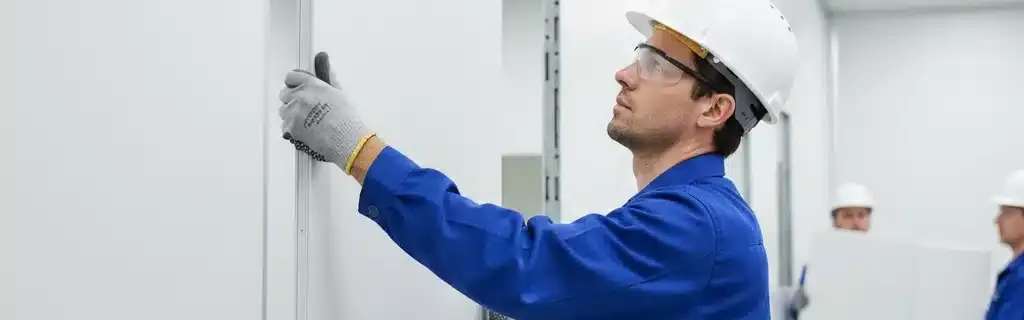

Why BPOM Audits Are the Critical Gatekeeper
Every food manufacturing facility in Indonesia that operates a cleanroom must pass BPOM (Indonesian FDA) audit. This is not a formality — it is a legal requirement. A non-compliant cleanroom can lead to distribution permit rejection, product recalls, and even operational shutdown.
BPOM data shows that 30-40% of non-conformity findings in food facility audits are related to cleanroom systems: inadequate particulate control, airflow specifications not met, or incomplete validation documentation.
Here is the key insight: BPOM auditors are not looking for perfection. They are looking for evidence that your cleanroom system is controlled, validated, and documented. These three words form the foundation of all audit preparation.
Key Standards Referenced in Food Cleanroom Audits
BPOM auditors reference several core standards (also read: ISO 14644 cleanroom certification guide) when inspecting food industry cleanrooms:
- CPPB-IRT — Good Food Production Practices for small-medium enterprises in Indonesia
- CPPOB — Good Processed Food Production Practices for medium-large facilities
- HACCP — Hazard Analysis Critical Control Point, international food safety system
- ISO 14644 series — international cleanroom air cleanliness classification standard
- GMP — Good Manufacturing Practice, WHO/PICS reference framework
In practice, the auditor will verify whether your cleanroom meets the appropriate ISO 14644 classification for your product type. For example, infant formula production requires ISO Class 7-8, while sterile product packaging may require ISO Class 5.
Mandatory Documents BPOM Auditors Will Check
Have these documents ready before the auditor arrives:
- Cleanroom Validation Report — covering particulate count, airflow, pressure differential, temperature, and humidity test results
- IQ/OQ/PQ Documentation — Installation Qualification, Operational Qualification, Performance Qualification for the entire HVAC and filtration system
- Instrument Calibration Certificates — particle counter, manometer, thermo-hygrometer with valid calibration dates
- Daily Log Book — routine recording of cleanroom parameters (pressure, temperature, RH) by operators
- Cleanroom SOPs — entry/exit procedures, gowning, cleaning, and material handling
- Operator Training Records — proof all personnel have been trained on cleanroom procedures
- HVAC & Filter Maintenance Reports — replacement schedule for pre-filters, medium filters, and HEPA filters
- Construction Material Certificates — proof walls, ceilings, and floors are food-grade and non-particle-shedding
The most common mistake: documents exist but are not up-to-date. Auditors will reject a validation report past its re-validation period (typically 6-12 months).
Critical Test Parameters in Food Cleanroom Validation
During cleanroom validation for audit preparation, six main parameters must be tested and documented:
1. Particle Count
The most fundamental test. A particle counter measures particles per cubic meter at ≥0.5µm and ≥5.0µm sizes. Results must align with your target ISO classification. For food industry, targets are typically ISO Class 7 (max 352,000 particles ≥0.5µm per m³) or ISO Class 8 (max 3,520,000 particles).
2. Pressure Differential
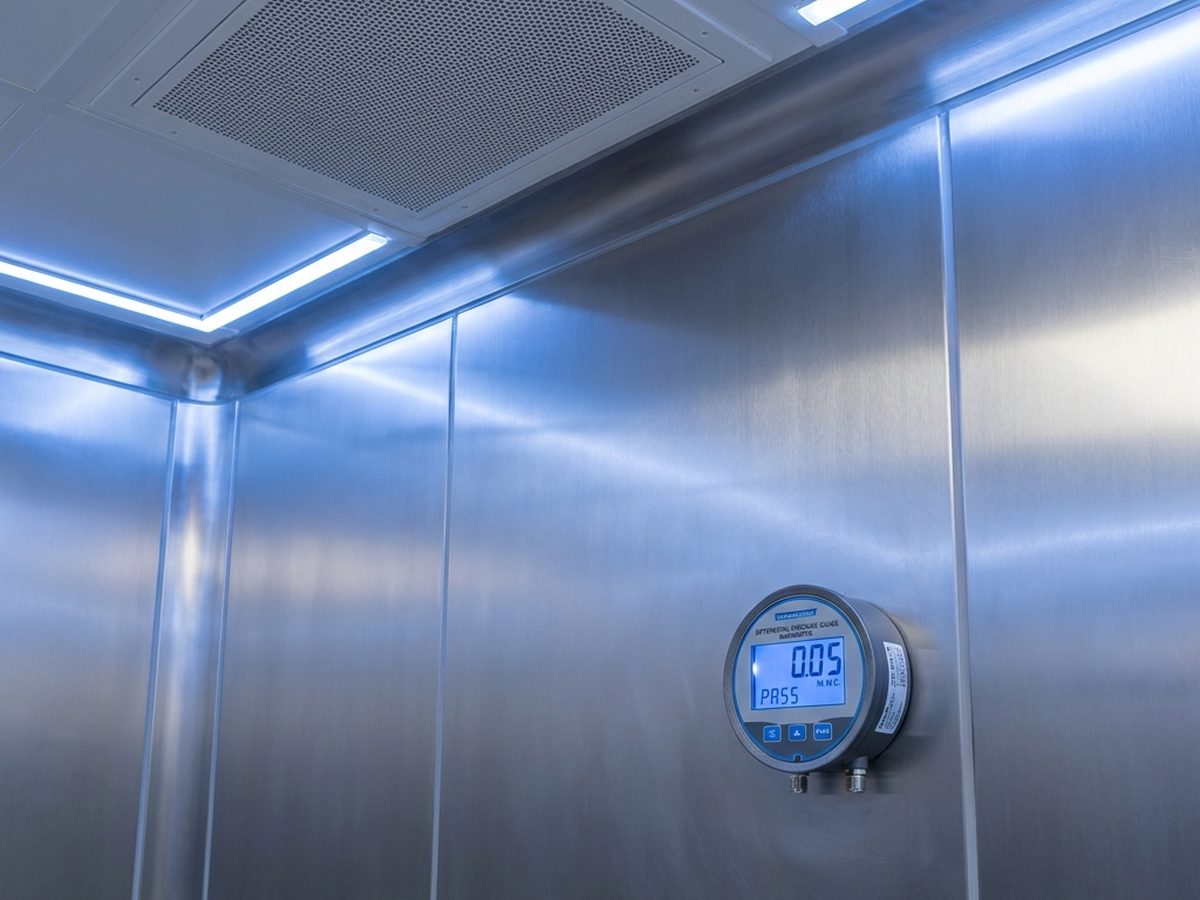
Pressure difference between rooms ensures air flows from clean to less-clean areas. A minimum of 10-15 Pa between cleanroom and non-cleanroom areas is required. Auditors will check that manometers are installed, functional, and values are logged routinely.
3. Airflow Velocity & Air Changes
Air velocity and air changes per hour (ACH) must match the design specification. For ISO 7-8 cleanrooms, 20-60 ACH is typical. Velocity is measured at HEPA filter terminals using an anemometer.
4. Temperature & Humidity
Temperature and humidity must be controlled according to product specifications. For most food production, 18-24°C with 45-60% RH is the accepted range.
5. Filter Integrity (DOP/PAO Test)
HEPA filters must pass integrity testing to ensure no leaks. DOP or PAO testing is performed by dispersing an aerosol challenge and measuring downstream penetration.
6. Recovery Test
Measures how long the cleanroom takes to return to normal conditions after deliberate contamination — essential for proving the HVAC system functions effectively.
Construction Material Selection That Passes Standards
BPOM auditors will physically inspect cleanroom walls, ceilings, and floors. Materials must be:
- Non-porous — does not absorb liquids or particles
- Non-shedding — does not release fibers or particles
- Chemical-resistant — withstands food-grade disinfectants and sanitizers
- Easy to clean — smooth surfaces with no gaps or sharp corners
- Anti-microbial (optional but recommended) — inhibits bacterial and fungal growth
Sandwich panels with stainless steel or food-grade aluminium coil facing — as discussed in our food panel vs regular sandwich panel guide are the optimal choice for food cleanrooms. These panels feature smooth, non-porous surfaces that withstand aggressive cleaning protocols. Ensure panel joints are sealed with food-grade silicone sealant to eliminate contamination gaps.
7-Day Pre-Audit Preparation Checklist
Seven days before the BPOM auditor arrives, run this checklist:
- [ ] Review all validation documents — ensure none have expired
- [ ] Re-calibrate particle counter and environmental monitoring instruments
- [ ] Check pressure differential in all rooms — log the values
- [ ] Physical cleanroom inspection: seals, coving, hermetic doors, observation windows
- [ ] Replace HVAC pre-filters if approaching replacement schedule
- [ ] Operator briefing: refresh gowning SOPs and cleanroom behavior
- [ ] Prepare inspection access routes for auditor (sampling areas, AHU room, filter plenum)
- [ ] Print and organize all documents in structured binders
Common Mistakes That Cause Audit Failure
Based on field experience, these are the most frequent causes of audit findings:
- Non-functioning differential pressure gauges — or gauges installed but broken/uncalibrated
- Personnel not following gowning procedures — exposed hair, improperly fitted masks, incorrect footwear
- Damaged or missing floor coving — creating dead corners that are difficult to clean
- Foreign materials inside the cleanroom — cardboard, wooden pallets, regular stationery releasing particles
- Inconsistent documentation — log book data does not match the validation report
- Cleanroom doors left open — pressure cascade compromised
Recommended Re-Validation Schedule
A cleanroom is not a one-time validated asset. Recommended re-validation schedule:
- Full re-validation: every 12 months (all parameters retested)
- Semi re-validation: every 6 months (particulate + pressure + airflow)
- Routine monitoring: daily/weekly (pressure diff, temperature, RH via log book)
- After major maintenance: HEPA filter replacement, cleanroom renovation, extended shutdown
BPOM Food Cleanroom Audit FAQ
How long does the BPOM audit process take?
Typically 1-3 days depending on facility complexity. Auditors review documents (usually day one), followed by physical inspection and sampling (following days).
Do all food factories need a cleanroom?
Not all. Cleanrooms are mandatory for contamination-sensitive products: infant formula, baby food, sterile/UHT products, supplements, and preservative-free claims. For general products, CPPB-IRT is sufficient.
How much does cleanroom validation cost?
Costs vary by cleanroom size and class. For an ISO Class 7 cleanroom of 100-200 m², third-party validation typically costs IDR 15-35 million. This covers all critical parameter testing and official report issuance.
Should I use a consultant or validate in-house?
In-house validation is possible if you have calibrated equipment and competent personnel. However, BPOM auditors tend to prefer reports from accredited third parties as they carry greater objectivity. Recommendation: in-house validation for routine monitoring, third-party validation for official certification.
What if there are minor findings during the audit?
Minor findings (incomplete documents, incorrect labels) typically allow 14-30 days for correction. You must submit corrective evidence (photos, revised documents) to BPOM. Major findings (negative pressure, particulate above limits) may result in temporary operational suspension until corrections are verified.
Conclusion
Passing a BPOM audit for your food cleanroom is not about luck — it is about systematic preparation. The key to success rests on three pillars: fully documented technical validation, proper food-grade construction materials, and consistent daily operational discipline.
Do not wait until 7 days before the audit to start preparing. Build your cleanroom documentation and monitoring system from day one of operations, and the BPOM audit will be a formality — not a threat.
Need help preparing your food cleanroom for BPOM audit? PT. Ruida Grup Indonesia provides consulting, food-grade cleanroom construction, and technical validation services. Contact our team for a free consultation and initial site visit.