

Cleanroom qualification is the documented process of proving that a clean space genuinely operates as designed and sustains the required cleanliness class throughout the production cycle. For pharmaceutical plants, medical device makers, and sterile food processors in Indonesia, this is far more than paperwork — a failed qualification means the facility cannot legally operate until the deviation is fixed and retested by an independent assessor.
A question project owners often ask: why do two cleanrooms with near-identical HVAC specifications end up with different qualification outcomes? The answer usually sits in details rarely covered elsewhere — wall panel joint quality, instrument calibration, or a test sequence that skips a mandatory step. This article summarizes the DQ-IQ-OQ-PQ stages, the critical test parameters, the requalification schedule under ISO 14644-1:2015 and EU GMP Annex 1, and how wall material choice ties into passing certification.
What Is Cleanroom Qualification and Why Is It Mandatory?
Cleanroom qualification (also called clean space validation) is a set of tests proving that the HVAC system, HEPA filters, and building envelope actually achieve the planned air cleanliness class — not merely a claim on a design brochure. In Indonesia, this is a mandatory part of Cara Pembuatan Obat yang Baik (CPOB) certification overseen by BPOM for pharmaceutical manufacturers, and an implicit requirement for food GMP and medical device certification.
Without documented qualification, a clean space is only an "air-conditioned room with a filter," not a certified cleanroom. BPOM auditors and international inspectors (FDA, EU GMP inspectors for export products) will ask for DQ, IQ, OQ, and PQ documentation as the primary evidence before a facility is cleared for commercial production.
The DQ, IQ, OQ, and PQ Stages of Cleanroom Qualification
Cleanroom qualification follows a fixed sequence that cannot be skipped, since each stage is a documented prerequisite for the next:
- Design Qualification (DQ) — verifies that layout drawings, wall/ceiling material choices, room adjacency, and HVAC specifications match process needs and regulatory requirements before construction even begins.
- Installation Qualification (IQ) — confirms every component (AHU unit, HEPA filters, pressure/temperature sensors, UV lamps, wall panels, interlocked doors) is installed per the design spec, backed by instrument calibration certificates.
- Operational Qualification (OQ) — tests whether the system runs within set limits under an "as built," unoccupied state: airflow velocity, air change rate (ACH), differential pressure between rooms, HEPA filter leak testing, and at-rest particle counts.
- Performance Qualification (PQ) — proves the cleanroom still meets its cleanliness class while fully operating with personnel and production equipment running (in-operation state), including viable and non-viable microbial monitoring.
Indonesian pharmaceutical facilities typically need 3 to 6 months to complete all four stages after construction finishes, depending on facility complexity and how ready the company's internal validation protocols are.
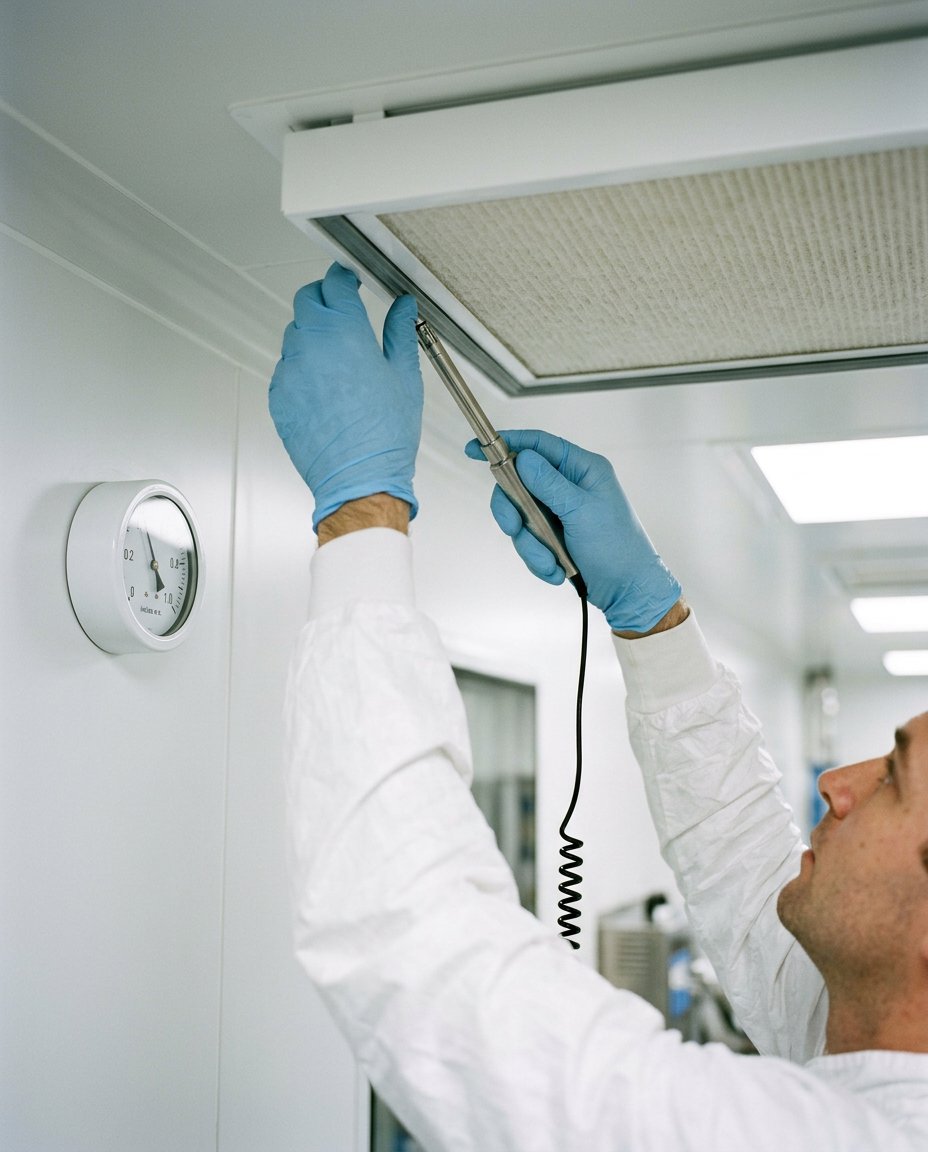
Critical Test Parameters: Particles, ACH, Pressure, and Filter Leaks
The following parameters are usually the auditor's main focus when reviewing OQ and PQ reports:
- Airborne particle counts — measured with a particle counter per ISO 14644-1 and compared against ISO class limits (ISO 5 roughly equals EU GMP Grade A/B).
- Air Change Rate (ACH) — the number of air changes per hour, ensuring particles and contaminants dilute as fast as the DQ stage planned.
- Differential pressure — maintains airflow direction from cleaner to less-clean zones so contaminants cannot migrate backward.
- HEPA filter leak testing — uses an aerosol photometer to confirm no leaks exist in the filter media or frame seals, following ISO 14644-3 methodology.
- Smoke visualization studies — specifically for unidirectional/laminar Grade A zones, proving the airflow pattern truly runs one-way without turbulence at critical points.
- Viable microbial monitoring — settle plates, contact plates, and active air sampling, with the strictest limits in Grade A (no colony growth allowed on a contact plate) and Grade B (maximum 5 CFU per plate).
Requalification Frequency Under ISO 14644-2 and EU GMP Annex 1
The ISO 14644-2:2015 revision removed the fixed schedule table from the earlier edition, requiring every facility to build its own risk-based requalification schedule. Even so, EU GMP Annex 1 (2022 revision) still offers a practical benchmark widely adopted across the industry: requalify at least every 6 months for Grade A and B, and every 12 months for Grade C and D.
Additional requalification is mandatory whenever a significant change occurs — HEPA filter replacement, HVAC ducting modification, wall or ceiling renovation, or a change in production equipment layout. Relying on an old certificate after such changes is one of the most common causes of failed BPOM audits and export inspections.
How Sandwich Panel Wall Material Affects Qualification Outcomes
Many IQ and OQ failures actually originate from the room envelope material and its installation, not the HVAC system itself. Loose panel joints, shrinking sealant, or a wall-to-floor junction without a curved coving will leak air and become a particle accumulation point — exactly what our article on cleanroom wall material mistakes that cause certification failure explains in detail.
PU/PIR-core sandwich panels with pre-painted galvanized steel facing and precision tongue-and-groove joints help preserve differential pressure integrity during OQ, since air leakage between rooms is far lower than with conventional gypsum-partitioned or plastered brick walls. Our full guide to cleanliness classes and how they relate to building specification choices is available in the ISO 14644 cleanroom classification guide.
Building Qualification Documentation From the Planning Stage
The costliest mistake QA teams often make is postponing IQ/OQ/PQ protocol planning until after construction is finished. Ideally, acceptance criteria for every parameter — particle count, ACH, differential pressure, microbial limits — should be agreed with the validation consultant during the DQ stage, so the sandwich panel contractor and HVAC installer both build toward the same target instead of guessing standards after the building is already up.
Tidy documentation also speeds up BPOM audits and export-partner inspections: instrument calibration certificates, as-built drawings, test protocols with results, and requalification history are best kept in a single master validation plan binder that is easy to trace, rather than scattered across emails and separate project folders.
FAQ
What is the main difference between IQ, OQ, and PQ in cleanroom qualification?
IQ verifies that physical components are installed per the design, OQ tests whether the system runs within set limits without personnel present, and PQ proves that performance stays consistent once the cleanroom is fully operating with personnel and production processes running.
How long does a cleanroom qualification certificate stay valid before requalification is needed?
Following EU GMP Annex 1 practice, Grade A and B areas are typically requalified at least every 6 months, while Grade C and D areas are requalified every 12 months — with additional requalification mandatory after significant changes to filters, HVAC, or the building envelope.
Does renovating cleanroom walls require a full requalification?
Not always a full restart from DQ, but OQ and PQ requalification of the affected area is mandatory, especially if the renovation changes panel joints, coving, or ducting routes that affect differential pressure and particle counts.