
Why Cleanroom Wall Material Is the #1 Cause of ISO Certification Failure
ISO 14644 certification is non-negotiable for cleanroom facilities in pharmaceutical, semiconductor, medical device, and food processing industries. Yet many cleanroom projects in Southeast Asia fail their first audit—and the primary culprit isn't the HVAC system or HEPA filters. It's using the wrong wall material.
Cleanroom walls represent the largest surface area in any controlled environment. The wrong material sheds particulates, traps moisture, or breaks down under chemical cleaning agents. The result: your target cleanliness classification—whether ISO Class 7 or ISO Class 5—isn't achieved during final particle count testing.
This article examines six common cleanroom wall material mistakes, their impact on certification, and actionable solutions to prevent them.
6 Critical Cleanroom Wall Material Mistakes
1. Using Porous or Moisture-Absorbing Materials
Standard gypsum board, exposed brick, or unsealed concrete are fundamentally incompatible with cleanroom requirements. These porous surfaces trap moisture, creating an ideal breeding ground for mold and bacteria—the primary enemies of cleanliness validation. During audit, microbiological contamination will be detected immediately, resulting in certification denial.
Impact: Microbial contamination, excess particulate shedding from degraded surfaces, failed viability testing.
Solution: Specify sandwich panels with PIR (polyisocyanurate) core and galvanized steel or food-grade stainless steel facings. These panels provide non-porous surfaces that are easy to clean and resistant to aggressive disinfectants like VHP and quaternary ammonium compounds.
2. Choosing the Wrong Panel Joint Type
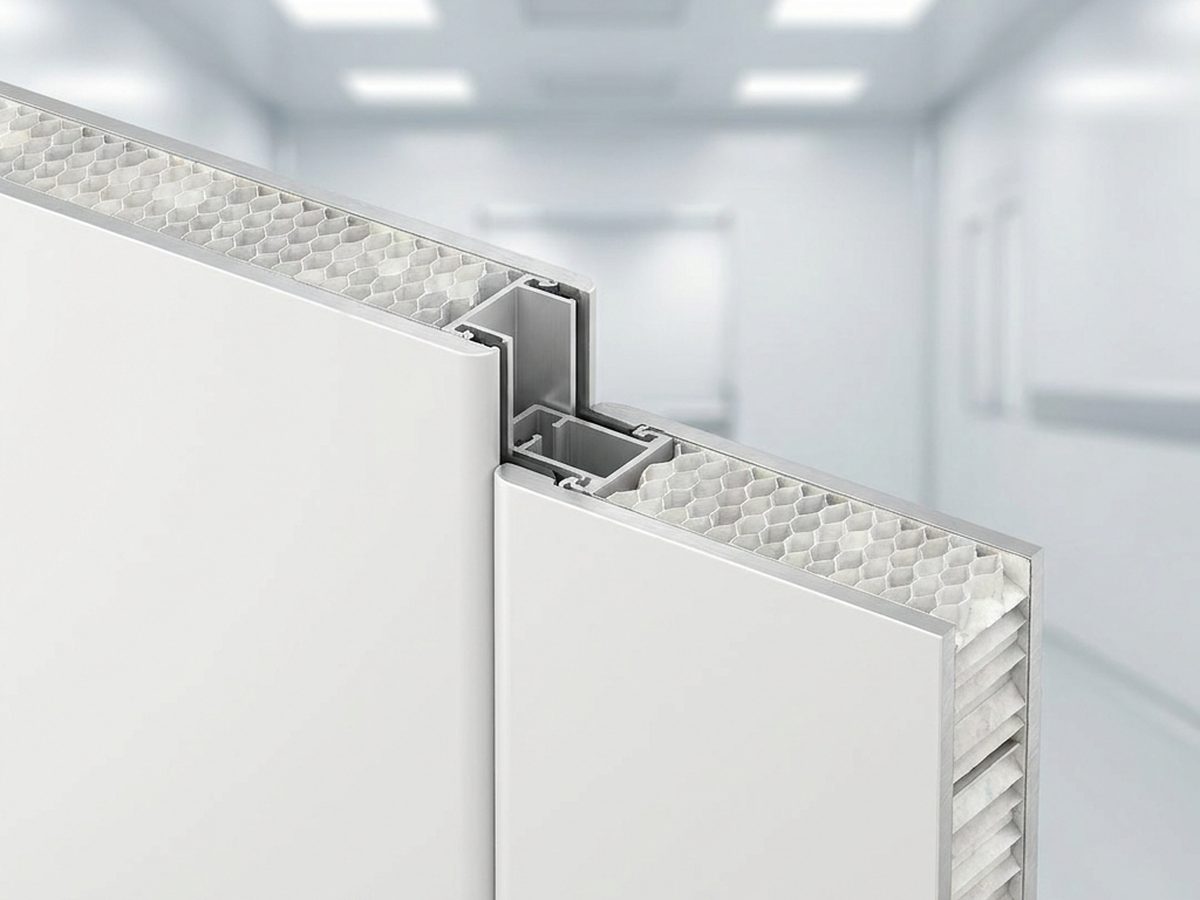
Panel joints are the weakest link in cleanroom envelope integrity. Even a 0.5 mm gap becomes a collection point for dust and microorganisms. Many contractors use standard tongue-and-groove joints that leave visible seams, while ISO 14644 requires seamless, easily cleanable wall surfaces with no crevices.
Impact: Particulate accumulation in joint gaps, cleaning difficulty, inconsistent particle count results during certification testing.
Solution: Specify invisible joint or closed-joint systems with food-grade silicone sealant. For ISO Class 5 and below, use interlocking panel systems that eliminate gaps entirely. All joints should be flush, smooth, and resistant to repeated chemical cleaning.
3. Ignoring Chemical Compatibility of Wall Materials
Pharmaceutical and biotech cleanrooms use strong disinfectants—vaporized hydrogen peroxide (VHP), sodium hypochlorite, 70% isopropyl alcohol—on a daily or weekly basis. Wall materials without verified chemical resistance suffer surface corrosion, discoloration, or coating degradation within months of operation.
Impact: Surface degradation in 6-12 months, particulate shedding from peeling coatings, premature renovation costs.
Solution: Verify chemical resistance specifications for all disinfectants used in your protocol. Panels with PVDF (polyvinylidene fluoride) coating or 304/316L stainless steel facings are proven choices for chemically aggressive environments.
4. Overlooking Electrostatic Discharge (ESD) Requirements
Semiconductor and electronics manufacturing cleanrooms are extremely sensitive to electrostatic discharge. Wall materials without conductive or dissipative properties accumulate static charges that can destroy electronic components worth millions of rupiah in a single event.
Impact: Product damage from ESD events, failure to meet ANSI/ESD S20.20 standards, fire risk from static sparks in solvent-rich environments.
Solution: Select panels with antistatic or conductive coatings. For critical applications, specify surface resistivity below 10⁹ Ω in accordance with IEC 61340-5-1. Verify ESD performance data from the manufacturer before procurement.
5. Choosing Panel Thickness Without Load Calculations
Cleanrooms often require mounting heavy fixtures on walls—pass boxes, differential pressure monitors, shelving units, or utility panels. Panels thinner than 50 mm lack adequate anchor capacity and risk deformation or detachment from the framing system under load.
Impact: Wall deformation, unstable fixtures, safety hazards, air gaps that disrupt pressure cascade and compromise room integrity.
Solution: Perform load calculations before specifying panel thickness. Standard cleanroom panels at 50-75 mm work well for light-duty applications. Walls carrying heavy fixtures require 100 mm panels or thicker, with internal reinforcement where needed.
6. Failing to Verify Material Certifications
Many suppliers offer "cleanroom-ready" panels without valid test documentation. Wall materials lacking particulate emission test reports, VOC outgassing certificates, or fire rating documentation give auditors immediate grounds to reject your facility—regardless of actual performance.
Impact: Unable to present compliance evidence during audit, forced replacement of already-installed materials, massive time and cost overruns.
Solution: Request Certificate of Compliance (CoC) and test reports from suppliers before purchase. Verify that materials meet ISO 14644-1 requirements for your target classification, carry minimum Class B fire rating per EN 13501-1, and have been tested for outgassing per ISO 14644-8 for molecular contamination-sensitive applications.
How to Select the Right Cleanroom Wall Material
Use this checklist when evaluating cleanroom wall materials to avoid all six mistakes:
- Surface: Non-porous, seamless, easy to clean, resistant to aggressive disinfectants
- Particulate emission: Low, verified for your target ISO Class with test data
- Chemical resistance: Compatible with your facility's cleaning protocols
- ESD properties: Conductive/dissipative when required (semiconductor, electronics)
- Panel thickness: Minimum 50 mm; thicker for heavy fixture mounting
- Certifications: CoC, fire rating, outgassing test reports available
- Warranty: Minimum 5 years with local technical support
PT. Ruida Grup Indonesia's cleanroom sandwich panels meet all criteria above, featuring high-density PIR cores, food-grade galvanized steel facings, and invisible joint systems compliant with ISO 14644 standards. Learn more about cleanroom panel specifications for different industries.
FAQ: Cleanroom Wall Materials
Are sandwich panels always the best choice for cleanroom walls?
For most cleanroom applications in Southeast Asia—particularly ISO Class 5 through ISO Class 8—PIR-core sandwich panels offer the best cost-performance ratio. They combine thermal insulation, non-porous surfaces, and installation efficiency in a single product. Alternatives like solid stainless steel panels are heavier and more expensive, while GRP (glass-reinforced plastic) may be needed for environments with strong acids.
What does it cost to replace cleanroom walls after certification failure?
Replacing already-installed cleanroom wall materials typically costs 2-3 times the original installation. Beyond new materials, you'll pay for demolition, production downtime, and re-testing. For a 100 m² cleanroom, total losses can reach USD 25,000-50,000—not counting revenue lost during downtime.
Do cleanroom wall materials need periodic replacement?
High-quality cleanroom wall materials with proper maintenance can last 10-15 years without replacement. However, annual inspections are essential to detect surface degradation, sealant leaks, or corrosion in areas frequently cleaned with aggressive chemicals. Schedule inspections as part of your routine ISO 14644-2 monitoring program. Also read our guide on ISO 14644 cleanroom validation and certification process.
Conclusion
ISO 14644 certification failure due to incorrect wall materials is a completely preventable problem. By avoiding the six mistakes outlined above and using the evaluation checklist, you can ensure your cleanroom passes certification on the first attempt—without costly rework.
Need cleanroom wall material consultation for your project? Our technical team is ready to recommend panel specifications tailored to your ISO classification target and budget. Contact us today for a free consultation.