
Introduction
A cleanroom is more than just a room with air conditioning and filters. For pharmaceutical and electronics manufacturers, a cleanroom is mission-critical infrastructure — directly affecting product quality, regulatory compliance, and financial risk exposure.
Yet one mistake facility managers frequently make is assuming that cleanroom specifications for pharma can be directly applied to electronics plants, or vice versa. The reality is these two industries have significantly different requirements — from ISO classification and wall/ceiling materials to HVAC design and electrostatic control.
If you're planning a new cleanroom facility or upgrading an existing one, understanding these fundamental differences can save you from costly specification errors that lead to audit failures and retrofit expenses.
ISO Classification: Different Starting Points
### Pharmaceuticals: ISO 5 – ISO 8 with Microbial Focus
Pharma cleanrooms are governed by GMP (Good Manufacturing Practice). The primary target extends beyond particulates to include viable microorganisms.
- Sterile drug production (injectables): ISO 5 (Grade A/B) — maximum 3,520 particles/m³ at ≥0.5μm
- Non-sterile production: ISO 7–8 (Grade C/D)
- Additional parameters: viable particle count (CFU/m³), temperature 18-24°C, RH 30-65%
### Electronics: ISO 3 – ISO 7 with Non-Viable Particulate Focus
Electronics and semiconductor cleanrooms are unconcerned with microbes — the critical threat is submicron dust particles that can cause short circuits on microchips.
- Semiconductor wafer fabrication: ISO 3–5 (Class 1-100 per Federal Standard 209E)
- Precision PCB assembly: ISO 6–7
- Critical additional parameter: ESD (Electrostatic Discharge) control — mandatory across all zones
- Temperature control is tighter: 21 ±1°C for lithography processes
Wall Panel Materials: More Than Just Sandwich Panels
### Panels for Pharma
| Aspect | Specification |
| -------- | --------------- |
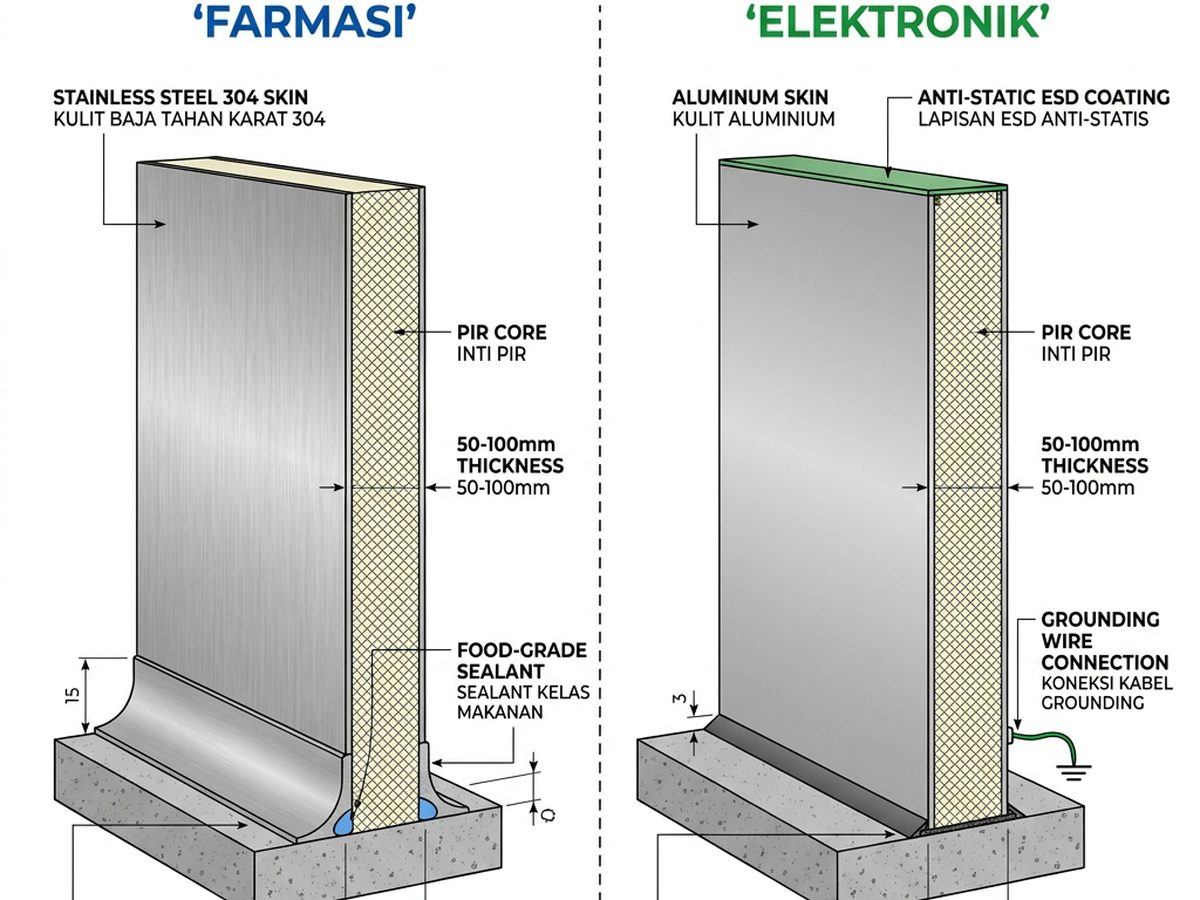
| Core material | PIR (Polyisocyanurate) or Rockwool — fire-rated and non-outgassing |
| Skin material | Stainless steel 304 (wet/production areas) or GI Sheet with anti-corrosion coating |
| Thickness | 50-100mm depending on thermal insulation requirements |
| Surface features | Food-grade finish, easy to clean, chemical-resistant (CIP agents) |
| Joints | Tongue-and-groove system with EPDM/silicone gasket |
| Radius coving | Required at all wall-floor junctions to prevent dust accumulation |
### Panels for Electronics
| Aspect | Specification |
| -------- | --------------- |
| Core material | PIR or Aluminum honeycomb — lightweight for suspended ceilings |
| Skin material | Stainless steel 304 or aluminum — non-magnetic for sensitive areas |
| Surface features | Anti-static / ESD-safe coating with surface resistivity 10⁶–10⁹ Ω |
| Thickness | 50-75mm |
| Joints | Tongue-and-groove system with conductive gasket for grounding continuity |
| Ceiling | FFU (Fan Filter Unit) grid system, needs walkable ceiling panels for maintenance |
HVAC Systems: The Most Significant Difference
### Pharma: Airflow Pattern + Pressure Cascade
- Unidirectional/laminar airflow in critical zones (ISO 5)
- Stepped pressure differential: production area > corridor > external environment (minimum 10-15 Pa per step)
- Tight temperature and RH control: 18-24°C / 30-65% RH
- HEPA H14 filters minimum in Grade A/B zones
- High air recirculation (80-90%) for energy efficiency
### Electronics: Fan Filter Unit (FFU) + Precision Temperature
- FFU ceiling system: tens to hundreds of FFUs for 100% coverage in critical zones
- Tight temperature band: often ±0.5°C for lithography processes
- Strict humidity control: 35-55% to prevent ESD buildup (RH too low increases static)
- ULPA U15-U16 filters in ISO 3-4 zones
- AMC (Airborne Molecular Contamination) control: chemical filters to remove ammonia, siloxanes, and VOCs from air
- Low make-up air: only 5-15% — the majority is recirculated
Regulations & Certifications
| Aspect | Pharma | Electronics |
| -------- | -------- | ------------- |
| Primary standards | GMP, PIC/S, EU Annex 1 | SEMI Standards, IEC 61340-5-1 (ESD) |
| Regular audits | National BPOM/FDA | Customer audits (electronics brands) |
| Cleanroom certification | ISO 14644-1 (classification), ISO 14644-2 (monitoring) | ISO 14644-1 + ISO 14644-9 (AMC) |
| Documentation | Batch records, daily logbooks, periodic HVAC validation | SPC (Statistical Process Control), real-time particle trend monitoring |
| Validation | IQ/OQ/PQ mandatory for all equipment | IQ/OQ focused on process equipment + ESD audit |
Panel Specification Selection Checklist by Industry
Use this checklist to ensure you select the correct specifications:
### For Pharmaceutical Facilities:
- Panels with stainless steel 304 skin in wet production areas
- PIR or Rockwool core (minimum fire rating B-s1,d0)
- Radius coving at all wall-floor junctions
- Food-grade/neutral-cure silicone sealant (no acetic acid outgassing)
- Easy-clean surfaces resistant to CIP agents
- Material traceability documentation for GMP audits
### For Electronics/Semiconductor Facilities:
- Panels with anti-static/ESD-safe coating
- Conductive gaskets at joints for grounding continuity
- Walkable ceiling panels capable of supporting FFU + personnel loads
- High ceiling plenum for chemical filtration systems
- Non-outgassing materials (zero VOC emission)
- ULPA filter-ready ceiling grid (not just HEPA)
Common Mistakes to Avoid
1. Using standard panels for ISO 5 cleanrooms — Open or non-seamless panel joints become particle sources.
2. Ignoring ESD control in electronics cleanrooms — A single ESD spark can destroy components worth thousands of dollars. Panels must integrate with the grounding system.
3. Wrong sealant selection — Outgassing silicone sealant can contaminate semiconductor wafers.
4. Non-walkable ceilings — In electronics cleanrooms, technicians must routinely access the plenum for filter changes. Ceilings must support human loads.
5. Overlooking HVAC pressure cascade differences — Pharma requires tiered positive pressure; electronics with chemical processes sometimes need negative pressure.
FAQ: Pharma vs Electronics Cleanroom
What is the main difference between pharma and electronics cleanrooms?
Pharma cleanrooms focus on microbial contamination control (viable particles) following GMP standards. Electronics cleanrooms focus on submicron dust particles (non-viable) and ESD (Electrostatic Discharge) control. This affects panel material selection, sealants, and HVAC design.
What type of panels are needed for electronics cleanrooms?
Electronics cleanroom panels must have anti-static/ESD-safe coating with surface resistivity of 10⁶–10⁹ Ω. Panel joints must also use conductive gaskets for grounding continuity.
Can pharma panels be used in electronics cleanrooms?
Not recommended. Pharma panels generally lack ESD protection features critical for electronics manufacturing. Using non-ESD panels in electronics cleanrooms risks component damage from electrostatic discharge.
What budget should be allocated for cleanroom construction?
Budget varies significantly based on ISO classification and material specifications. ISO 5 pharma cleanrooms typically cost more than ISO 7 electronics assembly rooms due to stricter laminar airflow HVAC requirements. Consult our team for an accurate estimate tailored to your project.
Related reading: Sandwich Panel Types for Cleanrooms and Cleanroom HVAC Systems: Complete Guide
Conclusion
Choosing the right cleanroom specifications isn't just about cost per square meter — it's about understanding your industry's specific requirements. Pharma and electronics cleanrooms have fundamentally different DNA: one focused on microbial contamination, the other on particulates and electrostatics.
If you're planning a new cleanroom facility or upgrade, the safest approach is consulting a team that understands both industry standards. PT. Ruida Grup Indonesia provides customizable sandwich panel and cleanroom component solutions tailored to your specific needs — whether for pharmaceutical, electronics, or other industries.
Contact us via WhatsApp for your cleanroom specification consultation.