

Factory Roof Too Hot? A Problem Beyond Comfort
Factory floor temperatures under non-insulated roofs in Indonesia routinely hit 45-50°C during midday — not just a comfort issue for workers, but a direct impact on productivity, product quality, and machinery lifespan. Ministry of Manpower data shows 15-20% productivity drops in workspaces above 32°C.
Galvanized zinc or metal sheet roofing — still common across Indonesian factories — absorbs and transmits solar radiation with virtually no resistance. The result: indoor spaces turn into giant ovens by noon, and electricity bills skyrocket as air conditioning systems fight the relentless heat pouring through the roof.
This goes well beyond comfort. Temperature-sensitive food and pharmaceutical products degrade. Precision manufacturing equipment demands stable temperatures to maintain accuracy. Heat-stressed workers suffer higher fatigue and accident rates.
Sandwich Panel Roofs: Thermal Protection at the Structural Level
A sandwich panel roof is a modular roofing system comprising two metal skin layers (top and bottom) with a thermal insulation core sandwiched between them. Unlike conventional roofing that serves only as weather protection, sandwich panel roofs deliver dual functionality: weather shield and thermal insulator in one product.
How it works:
- Top metal skin — reflects a portion of solar radiation and protects against rain and corrosion
- Insulation core (PIR/EPS/Rockwool) — blocks conductive heat transfer from the roof into the interior, with thermal conductivity as low as 0.022 W/mK for PIR materials
- Bottom metal skin — provides a clean, easy-to-maintain interior ceiling surface
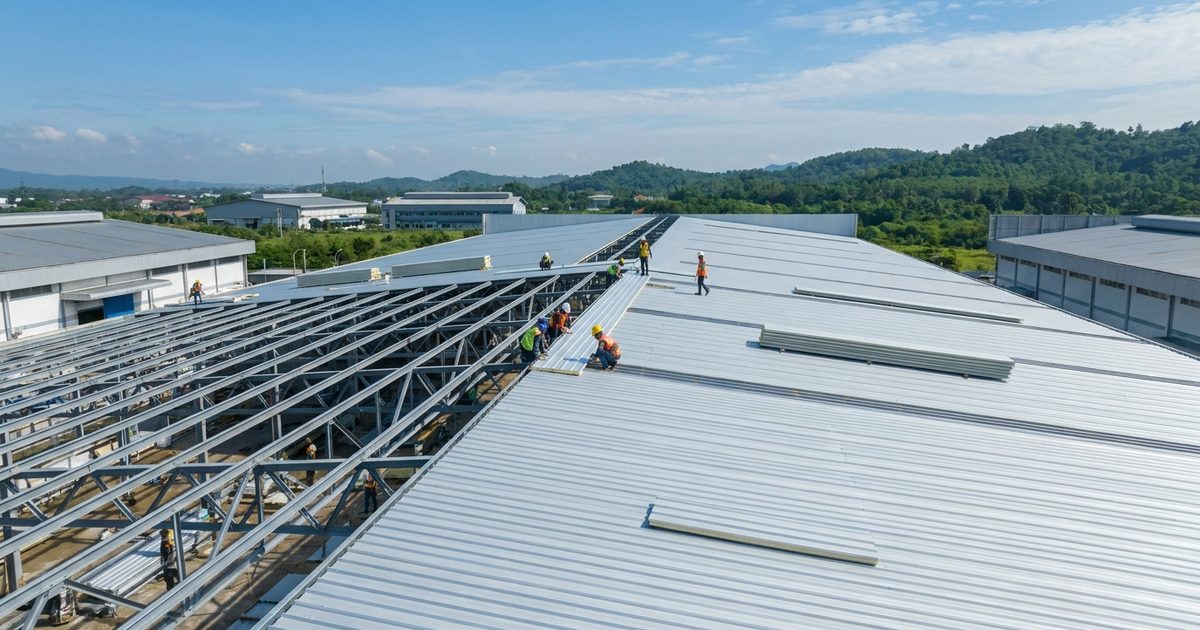
Field measurements confirm significant temperature differences: a garment factory in Bandung recorded a drop from an average of 38°C (old zinc roof) to 30°C after switching to 75 mm PIR sandwich panel roofing — an 8°C reduction without adding any AC capacity.
3 Core Materials for Sandwich Panel Roofs: Which One Fits Your Factory?
Core material selection is the most critical decision — it determines thermal performance, fire resistance, and project budget. Three core materials commonly available in the Indonesian market:
1. PIR (Polyisocyanurate) — Premium Performance
- Thermal conductivity: 0.022-0.024 W/mK (best in class)
- Fire rating: B1 (flame retardant, self-extinguishing)
- Density: 38-42 kg/m³
- Water absorption: < 1%
- Recommended for: Pharmaceutical factories, food processing, electronics, and buildings with high fire safety requirements
- Estimated cost: IDR 550,000 - 750,000/m² installed (75 mm thickness)
2. Rockwool (Mineral Wool) — Fire Safety Priority
- Thermal conductivity: 0.035-0.040 W/mK
- Fire rating: A (non-combustible, withstands up to 1000°C)
- Density: 80-140 kg/m³
- Water resistance: requires additional vapor barrier
- Recommended for: Chemical plants, high fire-risk areas, buildings requiring Class A fire rating
- Estimated cost: IDR 750,000 - 950,000/m² installed (75 mm thickness)
3. EPS (Expanded Polystyrene) — Budget-Friendly
- Thermal conductivity: 0.034-0.038 W/mK
- Fire rating: B2 (combustible, not recommended for production areas)
- Density: 12-18 kg/m³
- Water resistance: adequate for short-term applications
- Recommended for: Non-production storage warehouses, canopies, semi-open structures
- Estimated cost: IDR 350,000 - 450,000/m² installed (75 mm thickness)
Panel Thickness: It's Not Just "Thicker Is Better"
Roof sandwich panel thickness affects three things: insulation performance, structural load, and cost. Choosing the right thickness is about balancing all three.
Thickness selection guide by application:
- 40-50 mm — Canopies, covered parking, open storage buildings. Sufficient for rain protection with minimal insulation.
- 75 mm — General factories, logistics warehouses, non-temperature-sensitive production areas. The sweet spot for performance-cost balance in Indonesia's tropical climate.
- 100-120 mm — Pharmaceutical plants, cleanrooms, food production areas, small data centers. Optimal insulation for stable internal temperatures.
- 150 mm — Cold storage, freezer rooms, facilities with extreme indoor-outdoor temperature differentials.
A practical rule: every additional 25 mm of PIR panel thickness reduces heat transfer by approximately 15-20%. For factories in Indonesia's lowland regions (Jakarta, Surabaya, Semarang), 75 mm is the minimum recommended specification.
Critical Pre-Installation Factors: Slope, Drainage, and Wind Load
Sandwich panel roofing cannot be installed like standard metal sheet roofing. Three technical factors must be accounted for during the design phase:
- Minimum slope — Sandwich panel roofs require a minimum slope of 5-7% (approximately 3-4 degrees) for effective rainwater drainage. Lower slopes risk water pooling and leaks at panel joints.
- Drainage system — Install adequately sized gutters along all roof edges. For roof spans exceeding 30 meters, consider additional mid-span gutters or double-lock sealant joint systems.
- Wind uplift load — Sandwich panel roofs are lighter than concrete roofs, making them more susceptible to wind uplift forces. Use fastener spacing calculated based on local wind zone data. For coastal areas or buildings above 20 meters in height, consult a structural engineer for wind load calculations.
5 Costly Sandwich Panel Roof Installation Mistakes
- Non-perpendicular screws or over-tightening — Angled or over-tightened screws damage the EPDM washer waterproofing layer, creating hard-to-detect leak points. Use torque-controlled screwdrivers and ensure screws enter at 90 degrees to the panel surface.
- Insufficient joint overlap — Panel overlaps must be at least 100-150 mm for horizontal joints and follow the direction of prevailing winds. Insufficient overlap causes leaks during heavy rain with strong winds.
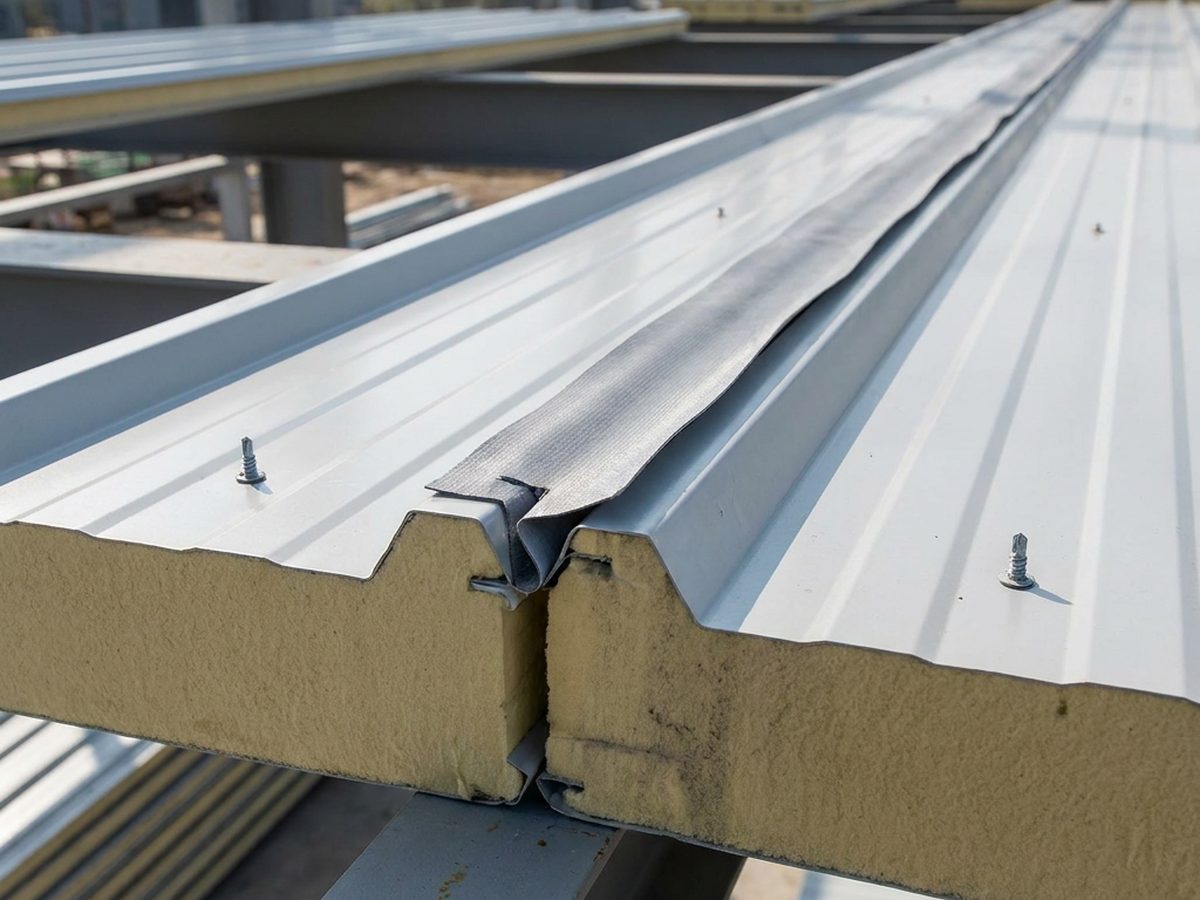
- Skipping sealant at joints — Panel joints MUST be sealed with butyl or silicone weatherproof sealant. Without sealant, rainwater seeps through microscopic gaps between panels even with correct overlap.
- Ignoring expansion gaps — Metal panels expand and contract with temperature changes. For roof spans exceeding 12 meters, provide expansion gaps every 10-12 meters to accommodate thermal movement and prevent buckling.
- No safety mesh or walking boards — The top metal skin of sandwich panels is not designed for concentrated loads (workers walking on the roof). Always use walking boards or catwalks for maintenance access, and safety mesh beneath the roof to prevent fall injuries during installation.
Cost vs. Benefit: Calculating Sandwich Panel Roof ROI
The upfront investment in sandwich panel roofing is higher than conventional metal sheet roofing, but operational savings typically recover the cost difference within 3-5 years:
- AC electricity savings — A 60-70% reduction in roof heat gain means HVAC systems work significantly less. For a 1,000 m² factory, AC electricity savings can reach IDR 3-5 million per month.
- Minimal maintenance — No repainting, waterproofing layer replacement, or leak repairs required as with conventional roofing. Near-zero annual maintenance costs for the first 10-15 years.
- Productivity gains — Cooler workspaces improve worker output. Lawrence Berkeley National Laboratory studies show 2-3% productivity increases for every 1°C temperature reduction above 25°C.
Simple ROI calculation for a 1,000 m² factory:
- PIR 75 mm sandwich panel roof cost: IDR 550,000/m² × 1,000 m² = IDR 550,000,000
- Metal sheet roof + extra insulation + ceiling cost: IDR 350,000/m² × 1,000 m² = IDR 350,000,000
- Investment difference: IDR 200,000,000
- Annual AC electricity savings: IDR 36,000,000 - 60,000,000
- ROI: 3.3 - 5.5 years (not including maintenance savings and productivity gains)
FAQ: Factory Sandwich Panel Roofs
Can sandwich panel roofs be installed on existing steel structures?
Yes. Sandwich panel roofing can be installed on existing steel frames as long as the structure can support the additional load (panel weight around 10-15 kg/m² for 75 mm PIR). A structural engineer should survey and verify load capacity before installation. If existing framing is inadequate, structural reinforcement or partial frame replacement options should be considered.
What is the lifespan of a sandwich panel roof?
With proper installation and quality materials, sandwich panel roofing has a service life of 15-25 years for galvanized steel with PVDF coating, and 20-30 years for stainless steel skins. Key factors affecting lifespan: coating quality, exposure to pollution or salt air (coastal areas), and routine maintenance (cleaning and sealant inspection).
Are sandwich panel roofs noisy when it rains?
Sandwich panel roofs are significantly quieter than single-skin metal roofs due to the double-skin construction with an insulating core that dampens sound. Rain noise on sandwich panel roofs is approximately 50-60% lower than single-skin metal roofing. However, some rain sound remains — especially on panels thinner than 50 mm. For rooms requiring absolute quiet (studios, meeting rooms), add an acoustic layer to the interior ceiling.
How do you maintain sandwich panel roofing long-term?
Minimal routine maintenance: clear leaves and debris from the roof surface every 6 months to prevent drainage blockage. Inspect joints and sealant every 12 months — replace cracked or peeling sealant. Check fastener condition every 2 years; tighten loose screws (be careful not to over-tighten). For coastal areas with salt air, increase inspection frequency to every 6 months.
Conclusion
Sandwich panel roofing is an investment that pays for itself within 3-5 years through energy savings and productivity gains. For factories in Indonesia's tropical climate, 75 mm PIR panels with a minimum 5% slope provide the optimal balance of cost, thermal performance, and long-term durability.
Don't let your factory roof continue to be a source of heat and energy waste. Consult with our technical team to get material recommendations, load calculations, and accurate cost estimates tailored to your specific project needs.
PT. Ruida Grup Indonesia provides PIR, Rockwool, and EPS sandwich panel roofs with structural survey services, engineering support, and professional installation. Our sandwich panels for factory construction have proven to reduce energy costs and improve working environments across industrial sectors. Combine sandwich panel roofing with proper factory ventilation for maximum cooling results.