

Plenty of food processing plants in Indonesia use the terms "blast freezer" and "IQF" as if they were interchangeable. They solve different problems. One freezes a load sitting on trays, the other freezes piece by piece. Getting this wrong at the design stage means the wrong machine, the wrong room size, and the wrong insulation spec.
This article compares the two on technical numbers, product fit, and what each one demands from the building itself. We write as a panel manufacturer, so the parts equipment vendors rarely cover, namely walls, floors, and airtightness, are included here.
What Actually Separates IQF From a Blast Freezer
A blast freezer, or air blast freezer (ABF), is a room or cabinet where product sits on trays and racks while high-velocity air at roughly -35°C to -40°C removes heat. The process is batch based: load, freeze, unload, repeat.
IQF, short for Individual Quick Freezing, is a continuous process. Product travels on a belt through a tunnel held below -35°C, and each piece freezes separately instead of clumping into a block. The output pours freely, so it can be reweighed and packed per portion.
Both answer to the same quality benchmark. Codex Alimentarius CXC 8-1976, adopted in 1976 and last revised in 2008, requires quick frozen foods to reach and hold -18°C or colder at the thermal centre, at every point in the cold chain. Indonesian SNI practice for frozen fish uses the same -18°C core temperature.
One distinction gets lost on site: -18°C is a storage target, not a freezing target. Blast freezers and IQF tunnels get product there; cold storage only holds it. We covered that split in more detail in our blast freezer vs cold storage comparison.
Technical Comparison: Speed, Ice Crystals, and Drip Loss
Freezing duration is the number that drives product quality, because it decides how large the ice crystals grow inside the tissue.
- Freezing time. IQF freezes each piece in minutes, typically 3 to 15 depending on size. A blast freezer works per load: thin fillets take 30 to 90 minutes, shrimp blocks around 2 hours, and thick cuts or full loads can run several hours. Reference figures for fish are published in the FAO document on freezing time in fisheries.
- Ice crystal size. Slow freezing produces crystals above 100 micrometres that rupture cell walls. IQF systems produce crystals below 25 micrometres, so cell structure stays largely intact.
- Drip loss on thawing. IQF product typically loses 3 to 8 percent of its weight, against 10 to 20 percent for block frozen equivalents. That gap works out to a 30 to 50 percent reduction in loss.
- Output format. IQF yields loose pieces ready for portion packing. A blast freezer yields blocks or trays that must be broken up before repacking.
For shrimp and cut fruit exporters, the drip loss gap shows up directly in the accounts. At 1,000 kg of throughput per day, a 7 percent difference means 70 kg of product per day leaving as water on the customer's counter.
IQF Machine Types and Their Capacities
IQF is not a single machine. Three configurations dominate food industry practice, and each one demands a different room shape.
- Fluidised bed. High-velocity air lifts small pieces so they freeze while suspended. It suits peas, sweetcorn kernels, berries, and diced vegetables. Typical capacity runs 500 to 5,000 kg per hour.
- Belt tunnel. A straight belt carries product through several separately controlled temperature zones. It suits medium to large items such as shrimp, chicken portions, and cut fruit. Typical capacity runs 1,000 to 10,000 kg per hour.
- Spiral. A helical belt climbs upward, saving floor area, and is chosen when product needs a longer residence time inside the tunnel. Available from small scale up to roughly 8,000 to 10,000 kg per hour.
Energy use is not a rounding error. For a fluidised bed running green beans, refrigeration demand sits around 80 to 140 kW per tonne of product. That figure sets compressor capacity, and compressor capacity ends up setting how much insulation thickness makes economic sense.
When to Choose a Blast Freezer, and When to Choose IQF
The question is not which technology is more advanced. It is which one matches your product and your volume.
Choose a blast freezer when product is large or cannot be separated, such as carcasses, whole fish, and fillet blocks. It also makes sense when daily volume is still uneven, when you run many product types in small batches, or when capital is tight. A single room handles a wide product mix without changing machinery.
Choose IQF when pieces are uniform, when the market demands free-flowing retail packs, when daily throughput is consistent and high, and when texture quality sets your selling price. Note that IQF requires a continuous line upstream and downstream. The tunnel cannot stand alone without sorting, blanching, and packing running at the same rhythm.
In practice many plants run both: IQF for high-margin flagship lines, and a blast freezer for the remainder of production plus raw material arriving off schedule.
Room and Panel Specifications That Get Overlooked
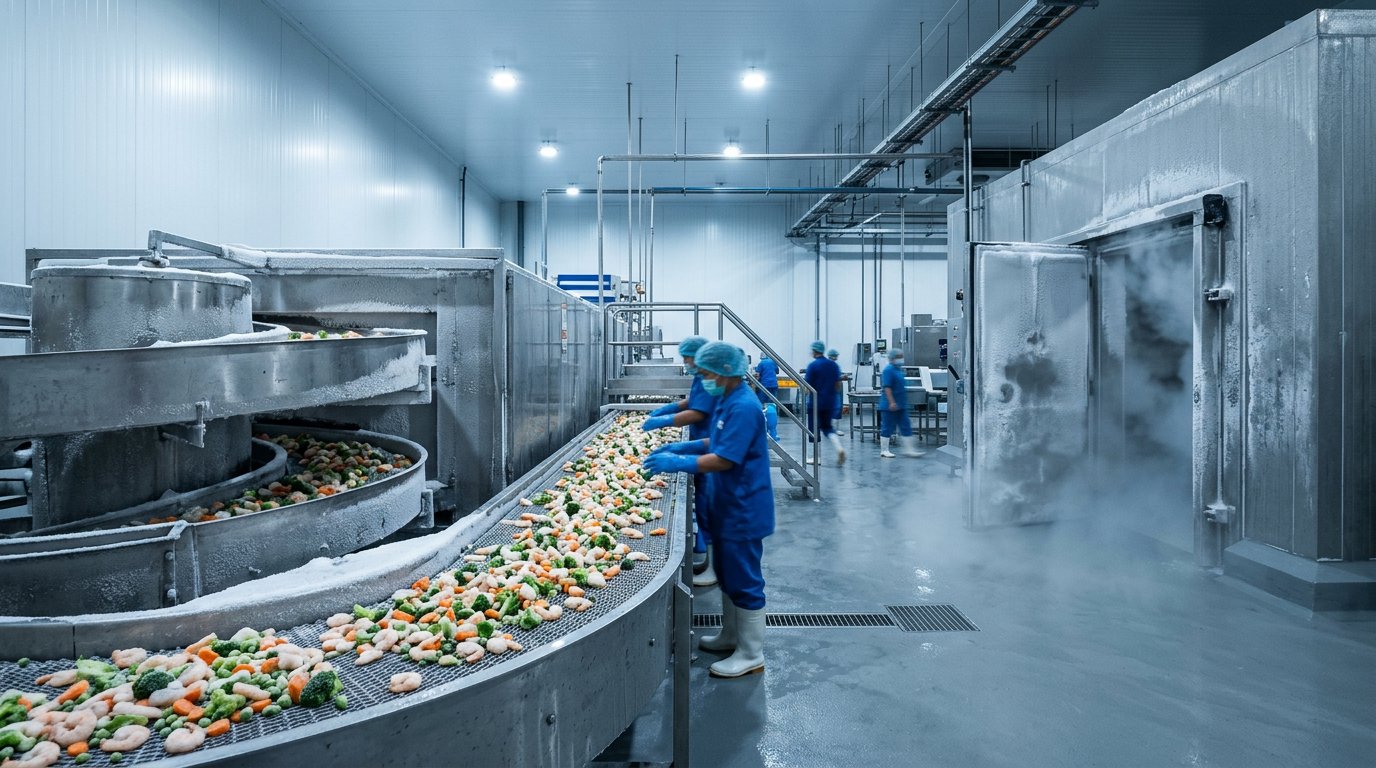
The machine usually gets specified first and the room follows afterwards. That order is why so many projects run energy-hungry from their first day of operation.
PIR panels with thermal conductivity around 0.020 W/(m·K) come in thicknesses from 50 to 200 mm and hold up across a service range of -50°C to +80°C. For rooms below -20°C, 150 to 200 mm is the practical reference. U-value maths is simple, lambda divided by thickness, and freezer envelopes are generally aimed at 0.17 to 0.24 W/m²K.
ASHRAE 90.1-2016 sets a minimum of R-32 for walk-in freezer walls and ceilings and R-28 for floors. Industrial facilities working in the -30°C to -40°C range normally exceed those minimums.
Three items get missed on site more than any others:
- Frost heave in the floor. The soil under the slab freezes, the moisture in it expands, and the slab lifts by several centimetres over a few seasons. The fix is under-slab heating: an electric grid, a glycol loop, or recovered heat from the refrigeration system.
- Joint airtightness. Properly sealed cam-lock or tongue-and-groove joints keep air leakage below 0.1 m³ per hour per m² at 50 Pa. A small leak means ice forming inside the panel, not merely a higher electricity bill.
- Vapour barrier position. Water vapour always travels from the warm side toward the cold side. Put the barrier on the wrong face and the insulation wets out, losing R-value permanently.
For small capacities or temporary needs, container-based freezer rooms can bridge the gap before a permanent facility is built. We covered the advantages and the limits in our guide to container cold storage and mobile cold rooms.
The Indonesian Market Context in 2026
Investment in freezing capacity is climbing. Indonesia's cold chain logistics market is projected to grow from USD 7.19 billion in 2025 to USD 7.51 billion in 2026 according to the Mordor Intelligence report, with fish and seafood accounting for 42.25 percent of market share in 2025.
Installed capacity still falls short. Industry data puts national cold storage at roughly 350,000 pallet positions, only about 3 percent of national requirements, with more than 200,000 additional pallet positions needed over the next three years. That shortfall explains the long queue for freezer construction in fisheries hubs.
Coastal plants carry one extra variable that is routinely underestimated: corrosion. Sea air shortens the life of a panel's protective coating, which we address separately in our guide to corrosion-resistant panels for aquaculture and coastal sites.
FAQ
Is IQF always better than a blast freezer?
No. IQF wins for uniform pieces at high volume destined for retail packs. For carcasses, whole fish, or fillet blocks, a blast freezer is the better fit and far cheaper in both capital and operating terms. Many plants run both for different lines.
What panel thickness do IQF and blast freezer rooms need?
For rooms operating below -20°C, PIR panels of 150 to 200 mm are the common reference. The exact figure depends on design temperature, product load, local climate, and the target U-value. Finish the cooling load calculation before locking thickness into the drawings.
Can IQF replace cold storage?
It cannot. IQF is a freezing process, not a storage facility. Once product leaves the tunnel it still needs to be held at -18°C or colder under Codex CXC 8-1976. The two are built with different panel specifications and different refrigeration configurations.
Why does a freezer floor need heating?
Because the ground under the slab freezes and expands. Under-slab heating keeps soil temperature above freezing so the slab does not lift, racking stays plumb, and the floor does not crack. This component costs far more to retrofit than to install from the start.
The sandwichpanels.id team handles IQF rooms, blast freezers, and cold storage from panel specification through installation. Send us your design temperature, daily capacity, and room dimensions for a thickness calculation and a panel quantity estimate.