

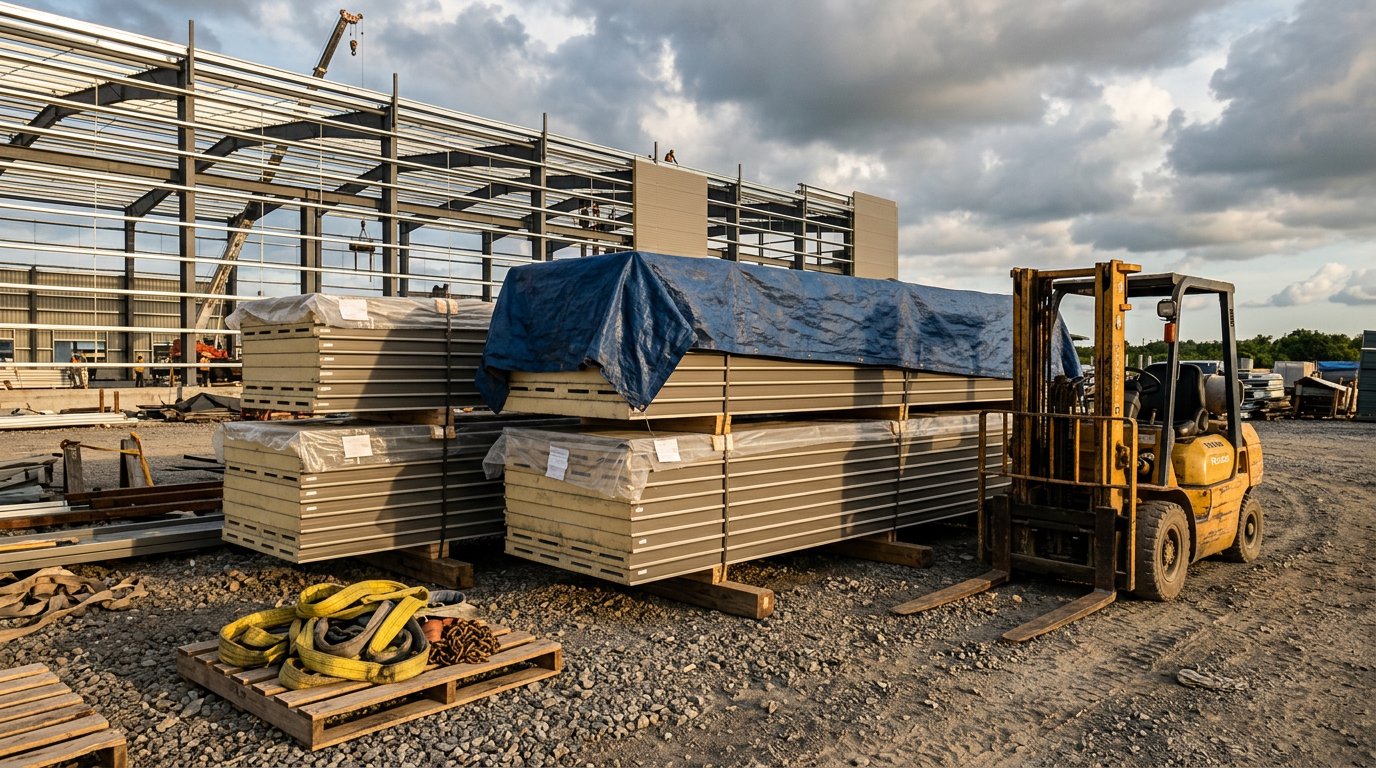
Panels arrive in perfect condition, then get damaged before a single sheet is installed. It is the most frustrating loss on a panel job: the driver has delivered, the installers have not started.
This guide collects the numbers for handling and storing sandwich panels on site, drawn from European panel manufacturers' installation guidance, product standard EN 14509, and Indonesian occupational safety rules.
The stakes are easy to quantify. A mid 2026 survey of Indonesian suppliers' public price lists puts PU panels of 50 to 75 mm at roughly IDR 350,000 to 550,000 per square metre installed, so one 6 metre sheet dented through to the core is worth millions of rupiah. Panels are also made to order, which means a replacement waits for the next production slot while the crew is already on site.
The Unloading Check Decides Whether You Can Claim
An inspection before the slings come off is worth more than a complaint a week later. Work through the following, with dated photographs:
- Match sheet count, thickness, and cut length of every bundle against the delivery note.
- Confirm the bundle label carries the order number plus production and delivery dates; supplier warranty letters require all three.
- Inspect bundle edges, corners, and joint tongues. Edge damage is the most common defect during unloading.
- Check that the outer wrapping and the surface protective film are both intact.
- Look for water marks inside the bundle, especially on the bottom sheet.
Record any finding on the delivery note before signing it; that document is what the supplier uses to process a claim. It also helps to know how to read panel certificates and datasheets.
Lifting Gear and Slings: Numbers That Are Not Negotiable
European installation manuals are fairly consistent on the limits. Bundles up to 6 metres long are normally lifted with a forklift, with the forks spread to maximum separation and the load centred.
Bundles up to 10 metres are lifted by crane using nylon straps at least 200 mm wide. Timber battens at least 200 mm wide, and 2 cm wider than the bundle, must sit between each strap and the bundle. Steel cable must never replace nylon, because it crushes the panel facing.
For bundles over 10 metres, a spreader bar keeps the straps apart, and the pick points sit at two positions separated by about three fifths of the bundle's total length.
Indonesian Ministry of Manpower Regulation 8 of 2020 on lifting and conveying equipment safety prohibits employers from using a rigger who holds no K3 licence. Ask your lifting contractor to show those licences.
How to Bed and Stack Bundles on Site
Panel bundles must never sit directly on the ground. The bottom sheet is ruined, and the bundle is hard to lift again without scoring the panel above it.
The correct bed is a rigid, flat surface with timber or polystyrene spacers no more than one metre apart. Those spacers also open an air gap under the bundle.
Bundles should be set at a slight tilt, a minimum slope of 5 percent, so rain and condensation drain out instead of being trapped inside the wrapping. A maximum of three bundles may be stacked, with timber or polyester spacers between every tier.
Stack height is still limited by the bearing capacity of the ground, not by that figure of three. Base flatness is covered in our article on panel base flatness tolerance.
Protecting the Stack Through the 2026/2027 Rainy Season
BMKG forecasts quoted by national media say the 2026/2027 rainy season starts roughly 20 to 30 days later than normal because of El Nino, with peaks spread between December 2026 and February 2027.
Factory polyethylene wrapping is not built for prolonged open air exposure. Stacks kept outdoors need an additional cover that is impermeable yet still allows air to circulate. Avoid dark or heat absorbing fabric.
- Inspect the stack daily; patch any damaged cover with compatible waterproof tape.
- Re-cover opened bundles at the end of every working day.
- Panels that got wet are taken out of the bundle and dried individually.
- Keep stacks away from salt water, corrosive chemicals, ash, and site fumes.
Protective Film: When It Has to Come Off
The protective film on the panel face is not a permanent layer. It does not resist ultraviolet light and can age to the point where it is hard to peel, leaving adhesive residue baked into the paint. Manufacturer guidance sets removal at no later than four months after delivery.
In normal practice the film comes off as each panel is installed. If bundles must stay outdoors for a long spell, strip the film from the topmost sheet exposed directly to the sun first.
Colour raises the stakes. EN 14509 uses design surface temperatures of 55 degrees Celsius for very light colours, 65 degrees for light colours, and 80 degrees for dark ones. Dark panels waiting in tropical sun sit near that upper bound. Colour choices are discussed in our piece on panel colour and coating.
Moving Single Panels Without Scratching Them
Most damage happens not while the crane works, but while workers pull single panels off the stack:
- Never drag a panel across another panel. Rotate the top sheet on its longitudinal axis first, then lift it clear.
- Lift along the longitudinal axis, at points about one metre in from each end, and carry the panel upright.
- Never hold a panel by its short side and never carry it flat; it will bow and the core will shear.
- Panels longer than 3 metres need more than two people.
- Wear soft gloves; swarf, metal dust, and rough gloves all score the paint layer.
Cutting swarf trapped between two panels is the classic cause of long scratches that only become visible once the wall is standing.
FAQ: Frequently asked questions
How long can panels safely be stored on site?
The clearest limit comes from the protective film: four months after delivery. The panels themselves last longer if they are off the ground, tilted, under a breathable cover, and inspected daily. In practice, schedule deliveries per installation zone.
Can panels that have been wetted still be used?
Panels wetted on the surface and dried individually straight away are usually still fine. The real risk is water trapped between facing and core, where vapour weakens adhesion and triggers delamination years later. Panels that were submerged or have a softened core should not be installed.
Plan Delivery and Storage at the Quotation Stage
Handling and storage are cheapest to solve while the quotation is being written, not when the truck is at the gate. Tell us the wall area, the thickness of wall, partition, or ceiling panels you need, and your site access conditions. We will set a phased delivery schedule, cut lengths, and lifting needs, then prepare the quotation. Start a consultation through the sandwichpanels.id contact page.