

Sandwich panel wall vs lightweight brick is a common comparison during design review, but the better choice rarely comes from material price alone. For modern construction that values fast installation, stable thermal performance, and a cleaner jobsite, sandwich panel walls usually lead. Lightweight brick still has a place, but it is often better suited to projects that are comfortable with conventional site work and less sensitive to time or temperature control.
If you are choosing a wall system for a warehouse, factory, workshop, cold room support area, packing room, or fast expansion building, the comparison should cover total cost, installation rhythm, structural load, and long term maintenance. Those are the factors that decide whether a project moves smoothly into operation or gets delayed in finishing and handover.
- Sandwich panels usually win on speed, insulation, and jobsite cleanliness.
- Lightweight brick can still make sense for conventional projects with very tight upfront budgets.
- The right decision depends on building function, not just price per square meter.
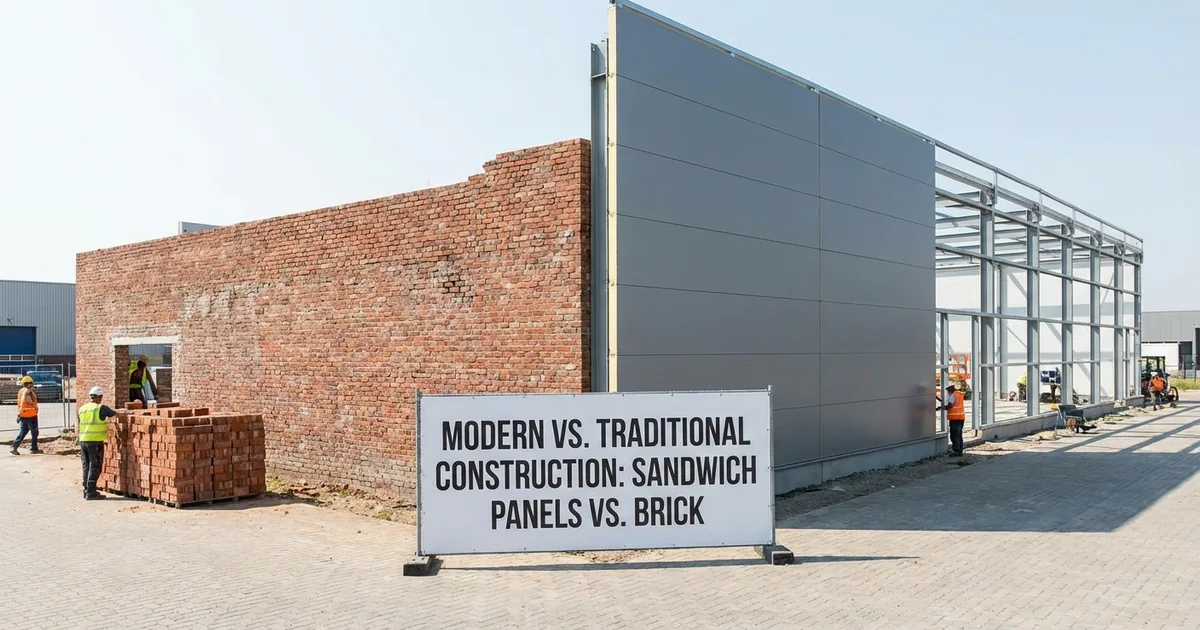
Quick Answer: When Does a Sandwich Panel Wall Perform Better?
A sandwich panel wall is usually the better answer when a project needs three things at once: short construction time, reliable insulation, and fewer finishing steps. The panel arrives as a prefabricated system with finished outer skins, so the contractor does not need plaster, skim coat, and paint just to make the wall usable.
That advantage is obvious in modern warehouses, food factories, cold storage projects, clean support areas, and modular buildings. The envelope closes faster. Mechanical and electrical work can enter sooner. The project also avoids part of the delay risk that comes with wet trades and long curing cycles.
Lightweight brick is still useful. It fits projects that prefer conventional labor, plastered wall aesthetics, and lower first purchase cost. Even so, once a project starts valuing operational efficiency from day one, sandwich panels usually deliver a more measurable result.
How the Two Wall Systems Actually Work
How a sandwich panel wall works
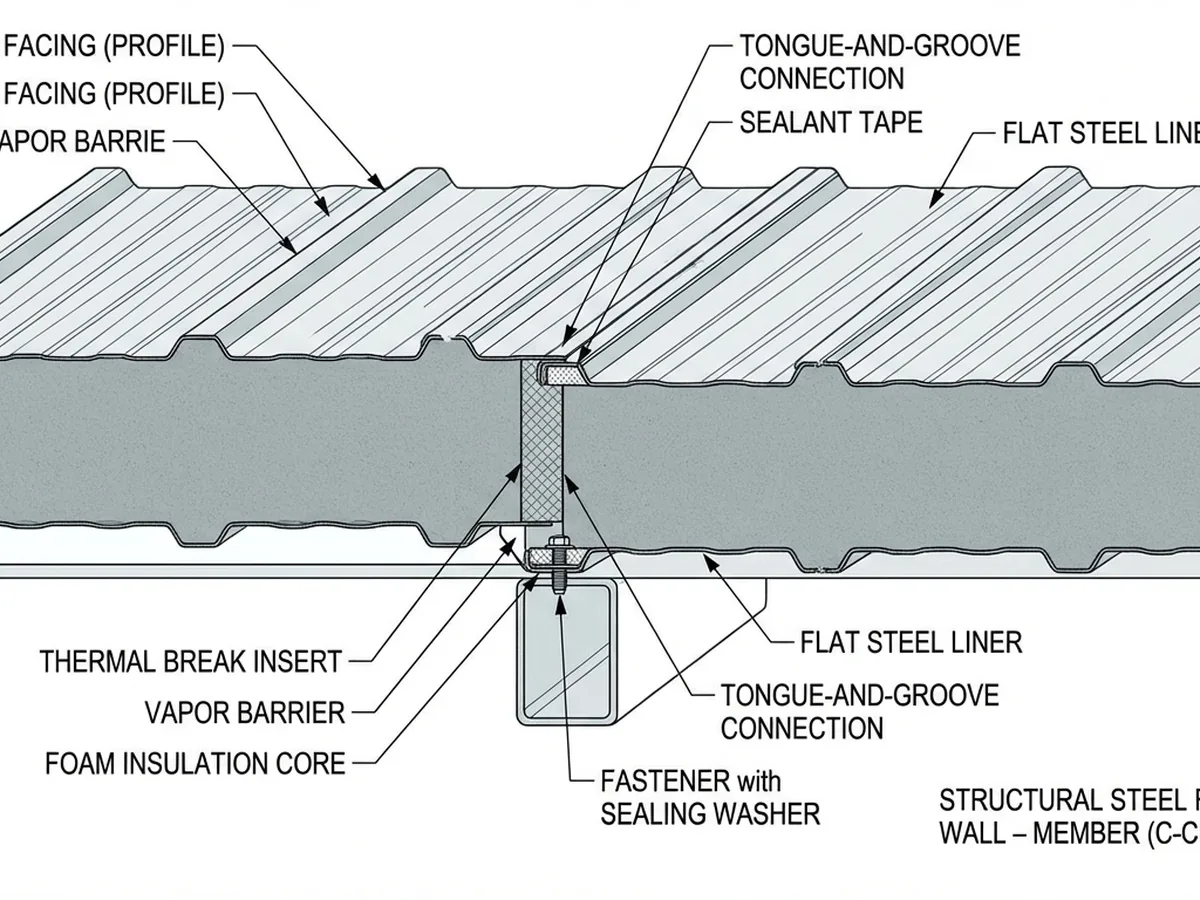
A sandwich panel wall uses two metal skins with an insulated core in the middle. Common cores include EPS, PU, PIR, and Rockwool. Because the panels are factory made with tight dimensional control, they install as a modular system with predictable joints. That gives the site a cleaner workflow and gives the owner a more consistent finished surface.
You can see standard insulated options on the EPS sandwich panel page. If the project needs cleaner and more controlled interior conditions, the cleanroom panel page shows how the same wall concept can be adapted to stricter environments. The real comparison is not wall sheet versus block. It is finished modular system versus layered site-built wall.
How lightweight brick works
Lightweight brick is a porous masonry unit installed block by block with thin bed mortar. After the wall is built, the project still needs joint correction, plaster, skim coat, and usually paint. The method is familiar to many site teams, but it moves in more stages and the final result depends heavily on workmanship discipline.
Because the method is layered, the real cost of lightweight brick often extends well beyond the block price. A project must account for labor, finishing materials, drying time, hairline crack risk, and rework if the wall face is not flat. That is why lightweight brick can look cheaper at the buying stage but lose part of that advantage by the time the building is ready.
Total Project Cost: Do Not Stop at the Material Price
One of the biggest mistakes is to compare sandwich panel walls and lightweight brick by material price alone. A better lens is total cost of construction. That means wall material, labor, support materials, finishing, duration, delay risk, and the operating effect after the building starts working.
In many industrial projects in 2026, sandwich panels still show a higher material range. The difference is that the panel already includes exterior skin, insulation, and finished surface in one package. Lightweight brick may appear cheaper as a base material, yet plaster, skim coat, paint, longer labor time, and extra structural demand narrow the gap very quickly.
| Parameter | Sandwich Panel Wall | Lightweight Brick |
|---|---|---|
| Main material | IDR 250,000 - 450,000 per m2 | IDR 120,000 - 180,000 per m2 |
| Labor and finishing | IDR 60,000 - 90,000 per m2 | IDR 180,000 - 270,000 per m2 |
| Small crew output | 50 - 80 m2 per day | 15 - 20 m2 per day |
| Wall weight | 15 - 25 kg per m2 | 80 - 120 kg per m2 after finishing |
That is why sandwich panel walls should be judged as a finished wall system, not as a single material sheet. If your project is sensitive to overhead cost, equipment rental, foundation load, or the value of opening earlier, the higher first price can be recovered by savings elsewhere. This is one reason industrial warehouses and fast expansion buildings often move toward panels.
If you still need to choose the right panel core, read our comparison at EPS vs Rockwool vs PU. That article helps separate cost driven choices from performance driven ones.
Construction Speed and the Impact on Operations
Installation speed is often the clearest divider between modern construction and conventional methods. When panels arrive in ready-to-install dimensions, the crew mounts modules, secures joints, and finishes sealant points. A large wall area can be closed in days or weeks instead of months.
With lightweight brick, progress moves through more steps. After the block wall is complete, the project still needs plaster, skim coat, drying time, and paint before the finish is truly ready. In rainy conditions or in projects with weak coordination, even a small delay in one step can push the next trade backward.
The benefit is not only visual progress. Once the building is closed earlier, racks, machinery, ducting, cable trays, and cooling systems can enter sooner. For commercial and industrial projects, a month of acceleration can mean a month of earlier operation and earlier revenue.
That is why sandwich panel walls almost always outperform lightweight brick in active renovation, logistics warehouses, food factories, and buildings that need fast commissioning. They also reduce dust, wet work, and construction waste around sensitive operating areas.
Thermal, Acoustic, and Fire Performance
Heat control
In Indonesia's climate, thermal performance matters every day. A wall that transfers heat too easily will push cooling demand higher. Sandwich panels perform better because the core already works as insulation. In the right application, the difference in indoor comfort and energy load becomes noticeable very quickly.
Lightweight brick is better than red brick in some cases, but it is still not the same as a fully insulated panel system. If your building is a warehouse, packing area, workshop, or temperature sensitive space, yearly operating cost can become a stronger business argument than the first purchase price.
Sound control
Lightweight brick benefits from mass in some sound reduction scenarios. However, for industrial needs, Rockwool core panels and acoustic panel assemblies can also perform very well. If noise is a major concern, the comparison should include core type and joint detail, not just panel versus brick.
For project references, review the acoustic sandwich panel page. Many projects fail not because they chose a panel, but because they chose the wrong panel specification for the acoustic target.
Fire performance
Fire resistance must be matched to building risk. Lightweight brick is naturally stable in fire exposure. Sandwich panel walls can still meet demanding requirements when the core is chosen correctly, especially with Rockwool or other assemblies aimed at fire performance.
This is not a brochure decision. It needs local regulations, evacuation strategy, building use, and the actual fire load in the space. The practical advantage of panels is that thermal performance, speed, and fire intent can be assembled into one modular wall system.
Structural Load, Renovation Flexibility, and Jobsite Cleanliness
Material weight directly affects structure design, especially in wide span buildings, mezzanines, and extension projects where foundation capacity is limited. Sandwich panel walls are far lighter than finished lightweight brick walls. A lighter envelope gives more design freedom and can reduce strengthening needs.
Panels also work better in staged renovation. When the owner wants to move openings, add partitions, or expand one area, a modular wall is usually easier to modify than a masonry wall that must be demolished and rebuilt. That matters in buildings that keep changing production flow or storage layout.
Jobsite cleanliness is another overlooked cost. Lightweight brick adds wet trades, cutting dust, and more leftover material. For projects that keep part of the site operational or require cleaner installation conditions, sandwich panels are usually the safer choice. That is one reason hygienic support areas and production spaces lean toward panel systems.
When Does Lightweight Brick Still Make Sense?
Lightweight brick still makes sense for houses, standard partitions, and buildings that do not need high insulation. If the schedule is flexible, the finish is expected to be plaster and paint, and the budget is heavily focused on lowering first purchase cost, lightweight brick remains a reasonable option.
It also fits projects where available labor is deeply familiar with conventional masonry and sandwich panels were never part of the early planning. Even then, the decision should still include realistic estimates for time, rework, hairline cracks, and maintenance over several years.
So the issue is not that lightweight brick is bad. The issue is that modern construction often values speed, cleaner execution, better thermal control, and easier future changes, and those are the areas where sandwich panels usually deliver more value.
Checklist Before You Decide
Use this simple checklist before choosing a wall system:
- Define the building function: warehouse, factory, office, cold storage, or hygienic area.
- Calculate the handover target and the cost of one month of delay.
- Compare total cost, including finishing, rework, and structural load.
- Check the required level of heat control, sound control, and fire resistance.
- Ask how easy the wall will be to modify after the building is in use.
If most of your answers point toward time efficiency, thermal stability, and renovation flexibility, sandwich panel walls should usually be the priority. If your answers lean toward conventional labor methods and simpler building needs, lightweight brick can still work well.
If you want to compare a real project instead of a generic example, send the brief through our contact page. A more accurate recommendation needs building function, area, and performance target.
FAQ: Common Questions Before Choosing
Is a sandwich panel wall always more expensive than lightweight brick?
Not when you calculate the full project cost. The first material price is often higher, but finishing, labor time, earlier operation, and reduced structural demand can make the total investment very competitive.
Is lightweight brick better for residential buildings?
In many cases, yes. Conventional houses that do not need strong insulation often work well with lightweight brick. But for modular houses, quick build projects, and spaces that need better temperature control, sandwich panels can be a more efficient alternative.
Which panel core is suitable for modern construction?
EPS works for cost balanced projects. PU and PIR are stronger for thermal efficiency. Rockwool is worth considering when fire and acoustic performance matter more. The correct choice depends on building function, not the lowest headline price.
Can an existing wall be renovated with sandwich panels?
Yes, and that is one of the most practical reasons to use them. Many projects use panels as cladding or as a replacement for old partitions so the renovation moves faster and causes less disruption.
Conclusion
If the question is which material is better for modern construction, the answer is often the sandwich panel wall. The reason is not that panels are always the cheapest option. The reason is that they perform better in the areas modern projects value most: speed, insulation, cleaner execution, layout flexibility, and long term operating efficiency.
Lightweight brick still fits certain projects. But when the building is tied to warehouses, factories, production areas, hygienic rooms, or fast expansion, sandwich panels usually offer the safer decision from both schedule and performance standpoints. If you want a project specific comparison, contact our technical team on WhatsApp and we will review the options against your actual building needs.