

A car wash is one of the harshest commercial buildings a wall can face. Pressurised water, detergent foam and constant humidity leave rendered brick damp and bare steel rusting within a season. Insulated panels are chosen because the surface is sealed, absorbs no water and can be hosed down. This guide covers specification, the details that decide wall life, 2026 costs and the permits to prepare first.
For an early budget fence: a survey of Indonesian supplier price lists and contractors between June and August 2026 put installed polyurethane panels of 50-75 mm at roughly Rp350,000-550,000 per square metre, and installation labour without material at Rp150,000-230,000 per square metre. They move with thickness, core type and delivery distance, so they are a fence, not a quotation.
Why car wash bay walls fail early
ISO 12944-2 sorts environments into corrosivity categories from C1 to CX. Production rooms with high humidity sit in C3, indoor swimming pools and chemical plants in C4, and buildings with near-constant condensation in C5. A wash bay lands between C3 and C5 depending on ventilation and how long surfaces stay wet. The 2018 revision replaced the old C5-I and C5-M categories with C5 and CX.
The second problem is the soap, not the water. Coil coating suppliers state that organic coatings resist weak alkalis reasonably well but are weak against strong acids and alkalis, and that prolonged contact can cause blistering and peeling. They also warn that alkalis attack the aluminium-zinc layer on a Galvalume substrate. High-pH snow foam left to dry usually damages the coating before plain water does.
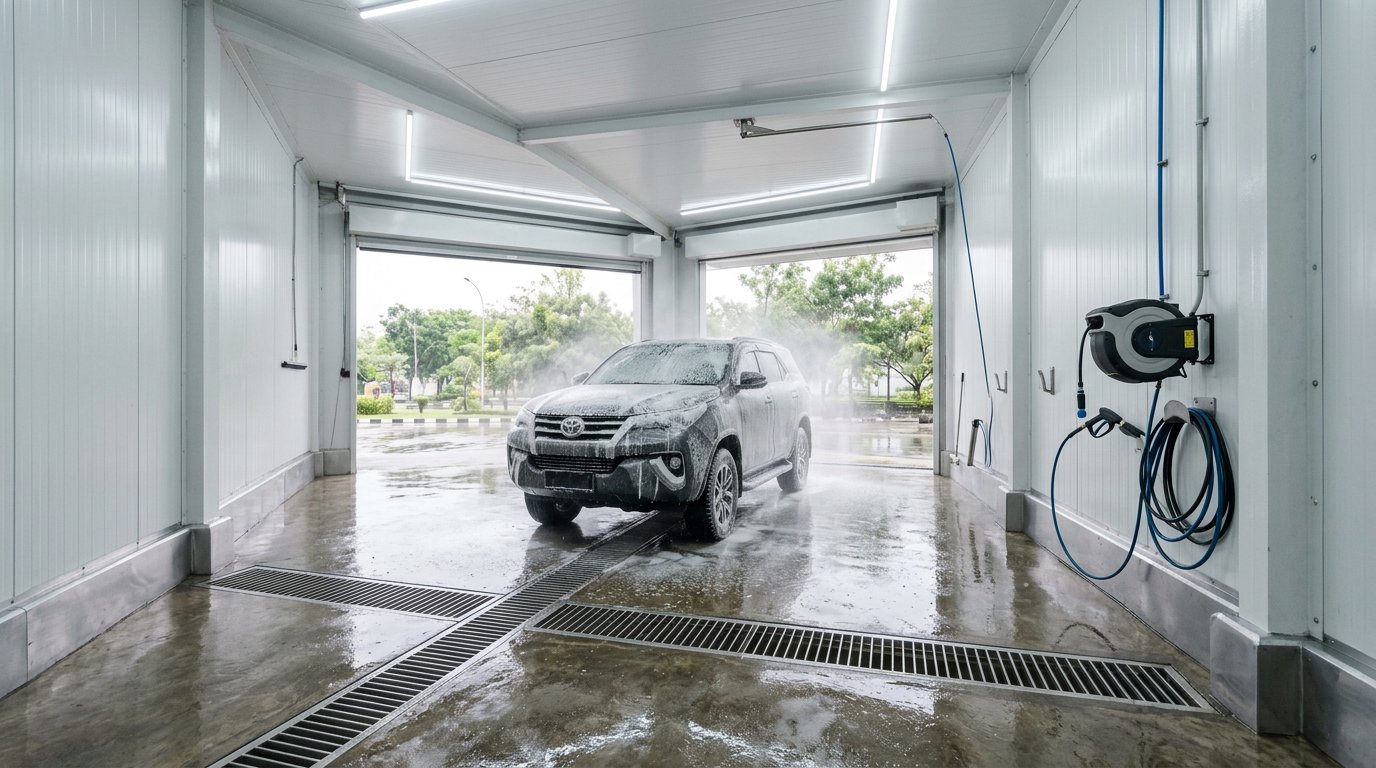
The right panel specification for a wet area
The panel lines used in a car wash building are external walls, bay partitions and room ceilings; roof and canopy structures are handled by separate roofing materials outside these lines. For a wet area the critical decision is not thickness but coating quality and joint tightness.
- Thickness 50-100 mm. A wash bay is unconditioned, so 50 mm suits walls and partitions. Move to 75-100 mm where the wall adjoins an air-conditioned waiting room or a detailing bay needing sound damping.
- U-values as design estimates. By ISO 6946 arithmetic, a 50 mm EPS core gives about 0.63 W/m2K, 75 mm about 0.43, and 50 mm rockwool about 0.70. Declared manufacturer values use the EN 14509 reference method.
- Steel facings 0.3-0.5 mm. That is the range circulating in the Indonesian market, with cover widths of 1000 or 1050 mm. For bays taking regular hose and bucket knocks, specify the upper end.
- Paint system. Standard polyester is cheapest, but PVDF is far more stable against cleaning chemicals and sunlight on exposed elevations. Ask for the coating data sheet, not just a colour name.
- Joints. Choose a joint profile that accepts neutral-cure sealant, then insist on a level base before the first panel is stood up.
Installation details that decide wall life
Panels in wet areas almost always fail at the edges, not mid-span. Water entering through a cut face or screw hole is trapped inside the core, and the damage only shows months later. The sequence below closes those entry paths.
- Lift panels clear of the slab on a base channel with a 100-150 mm concrete upstand so the bottom edge is never standing in water.
- Seal every cut face and pipe penetration with neutral-cure sealant, not acid-cure silicone, which can attack the facing coating.
- Fit screws with bonded washers at the correct torque; over-tightened screws dish the facing and create a water pocket.
- Fall the floor 1-2 per cent towards a trench drain. Drainage vendors describe that range as common practice rather than a mandatory building-code figure.
- Add cove trim where wall meets floor so water does not stand in the corner.
One number helps size the drainage. A functional servicing report for the Town of Caledon, Canada, cites the International Car Wash Association for average water use: about 15 gallons per car self-serve, 50-60 gallons for in-bay automatics and 66-85 gallons for conveyors. That report itself calculated on 65 gallons, roughly 246 litres, per car.
Permits, effluent, and rules that changed
Two administrative items are regularly missed once the budget is approved. First, the business code: car washing and detailing now sits under KBLI 2025 code 95312, moved from 45202 in KBLI 2020. OSS and AHU are reported to have fully migrated to KBLI 2025 since 15 June 2026, so old codes are refused. Licensing follows the risk-based regime under Government Regulation 28/2025.
Second, wastewater. Environment Ministry Regulation 11 of 2025 took effect on 9 September 2025, replacing Permen LHK P.68/2016 and part of Permen LH 19/2010. The new regime governs not only effluent quality but also the treatment technology required by flow, with classes below 3 cubic metres per day and 3-50 cubic metres per day. Do not cite the P.68/2016 tables as current.
For vehicle-wash effluent parameters themselves, figures circulating in Indonesian literature still mix the workshop annex of Permen LH 5/2014 with provincial governor regulations. Verify them against the official text and annexes at the Environment Ministry legal documentation portal and with your local environmental agency before locking the treatment design.
Panel walls against brick and bare steel
Rendered brick is cheaper on day one, but render and paint in a wash area peel repeatedly, and that cost returns every one to two years. Bare steel without an organic coating is consumed fastest of all in a C4 environment. Panels win because the surface never needs repainting, can be scrubbed daily, and closes a building in within days once the frame is ready. Corrosion mechanics are covered in our article on panel rust causes and prevention.
Cheap maintenance that actually works
The rule is simple: dilute cleaners as instructed, keep them neutral to mildly alkaline, and never let foam dry on the wall. Rinse each shift, inspect sealant every six months, and repair scratches that reach bare steel. The same discipline applies to other wet rooms, as in our piece on panel walls for laundry rooms.
Frequently asked questions
Is it safe to pressure wash a sandwich panel wall?
It is safe across the panel face, with two conditions. Keep the nozzle far enough back that water is not forced into joints, and never aim at cut edges or screw heads. High pressure aimed at a joint drives water into the core, where failures begin.
What panel thickness does a car wash building need?
For wash bay walls and partitions, 50 mm is usually enough because the space is unconditioned. Choose 75-100 mm where the wall adjoins an air-conditioned waiting area, compressor room, or detailing bay needing sound damping. Our supplied range is 50-150 mm across all core types.
Next step for your project
If you are planning a new wash bay, adding one at a site already trading, or replacing walls that have started to rust, our team can work out the wall, partition and ceiling panel quantities from your bay dimensions and service mix. Send a layout or rough dimensions, then request a quotation and a requirements consultation through the sandwichpanels.id contact page.