

An ice plant is usually pictured as one large cold room. In fact it holds three zones with different temperatures, humidity levels and corrosion risks. Applying one panel specification to all three overspends in one area while storing up maintenance problems in another.
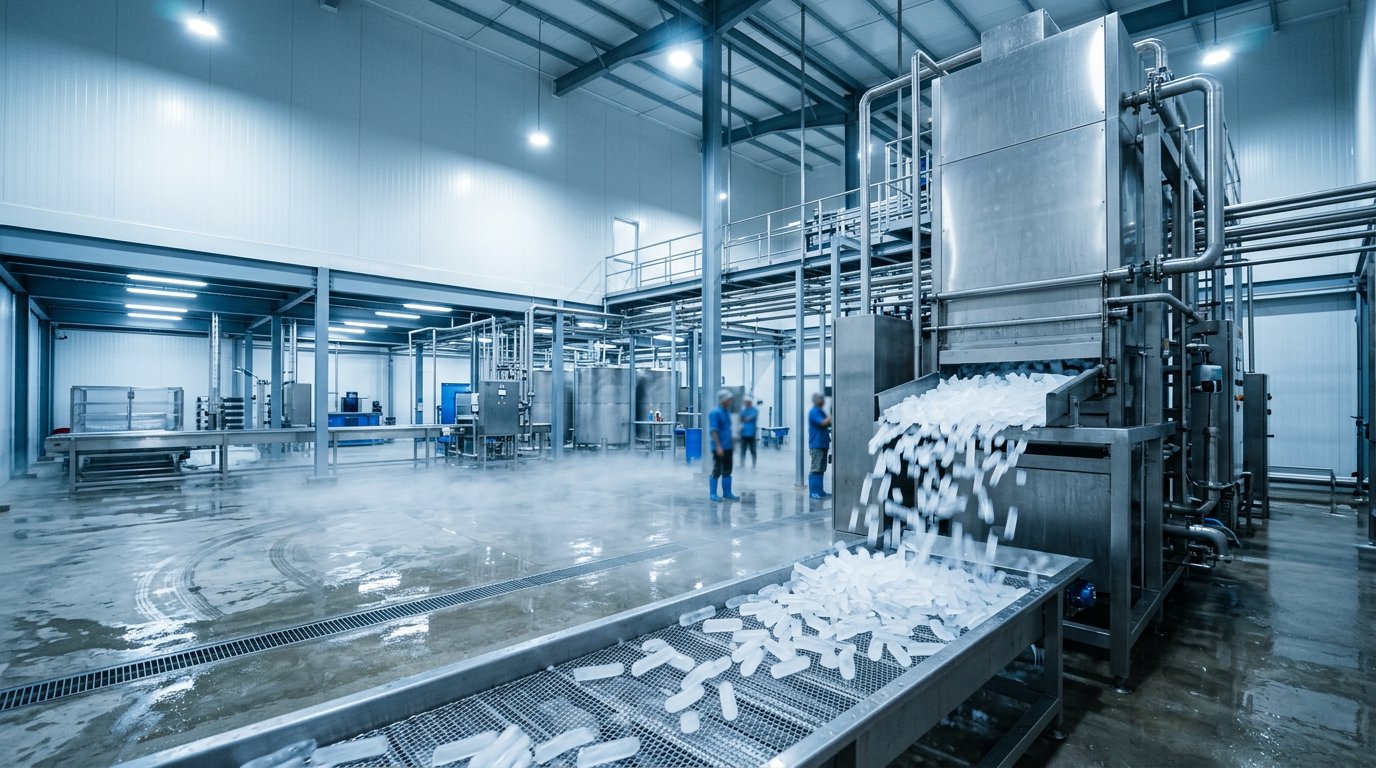
Three Temperature Zones Under One Roof
The first zone is the machine and production hall. It sits close to ambient temperature, but the air stays saturated because ice makers spray and drain water continuously. It needs washable, water-tolerant surfaces rather than thick insulation.
The second zone is the ice store. FAO planning data puts ice storage temperature at about minus 5 degrees Celsius, far warmer than a frozen food freezer. This is where specifications go wrong most often.
The third zone is packing and dispatch, a cool room around 10 to 15 degrees with doors opening constantly. Condensation shows up here first.
Sizing the Ice Store
Store size is not set by machine capacity alone. FAO planning data notes that ice stores are commonly built at two to four times daily production capacity, because production and demand are rarely in phase.
For volume, FAO uses roughly 1.4 to 1.5 cubic metres per tonne of crushed block ice. Those two figures are enough to size a room during feasibility study:
- Production of 10 tonnes per day with three days of buffer means 30 tonnes in store.
- Thirty tonnes multiplied by 1.45 cubic metres gives about 43.5 cubic metres.
- At an effective stack height of 2.5 metres, the floor area needed is roughly 18 square metres, plus circulation and loading access.
Panel Thickness and Core for a Minus 5 Room
Our panel line covers walls, partitions and room ceilings, in thicknesses from 50 to 150 millimetres across every core type. For an ice store, the sensible range is 75 to 100 millimetres.
Supplier practice places chiller rooms near 0 degrees at 80 millimetres, and freezers at minus 18 to minus 20 degrees at 100 to 140 millimetres. An ice store at minus 5 degrees sits between them, closer to the chiller end of the scale.
As a design estimate using the ISO 6946 method, a 100 millimetre panel gives roughly 0.23 W/m2K with a PIR core, 0.33 with EPS and 0.37 with rockwool; at 75 millimetres, 0.30, 0.43 and 0.49. Tender documents should carry the manufacturer declared values obtained by the EN 14509 reference method, not these estimates.
Supplier practice adds 20 to 50 percent thickness in hot climates, which makes 100 millimetres the safe default for a lowland ice store. Panel selection is covered in our cold storage wall panel guide.
Brine Vapour: The Quiet Enemy of Steel Facings
Block ice plants use a brine tank, a calcium or sodium chloride solution chilled to about minus 5 degrees, into which water-filled cans are lowered for 16 to 24 hours.
FAO gives a warning that panel vendors rarely quote: block plants require more attention to the building structure because of brine evaporation and its effect on the steelwork, although inhibitors can reduce the damage.
In practice the steel facings of any panel near a brine tank work in chloride-laden air. There, coating specification and joint detailing matter far more to service life than core thickness.
Humidity, Condensation and Floors
An ice plant is a wet building: moulds drip, floors are washed down, cold room doors open many times an hour. Three details decide how long the structure lasts:
- An unbroken vapour barrier on the warm side, because vapour always moves toward the cold side and condenses inside joints wherever a gap exists.
- Panel joints sealed with food grade sealant, then re-inspected after a few months of operation.
- A seamless floor with no cracks or joints, which is exactly what FAO recommends for ice storage rooms.
Stated plainly: sandwich panel is a wall, partition and ceiling material, not a flooring material. Cold room floors still use floor insulation beneath a concrete topping, as discussed in our cold storage condensation article.
Costs: Electricity Dominates, Panels Are Paid Once
FAO planning data for tropical zones lists tube ice at 60 to 75 kWh per tonne, block ice at 55 to 70, and flake ice at 70 to 85. Those figures cover the ice maker and refrigeration plant only, excluding handling and storage.
A study of 20 Thai ice factories between 2015 and 2018 recorded whole-plant consumption of 59 to 133 kWh per tonne, averaging 98. The gap against the FAO figures is storage, handling and waste, which a properly specified envelope reduces.
At the 2026 Indonesian non-subsidised I-3 industrial tariff of Rp1,122 per kWh, a 10 tonne per day plant running at 90 kWh per tonne pays roughly one million rupiah a day for production and cooling alone. Under-specified panels add to that figure daily.
A 2026 market survey places installed PU panels of 50 to 75 millimetres between Rp350,000 and Rp550,000 per square metre, with installation labour alone at Rp150,000 to Rp230,000.
Water Quality and the Permit Trail
Ice sold for consumption is a food product. Its feed water must meet drinking water standards, regulated in Indonesia through Minister of Health Regulation 2 of 2023, the implementing rule for Government Regulation 66/2014 on Environmental Health. FAO likewise requires potable-standard water for ice making.
The product standard still widely cited is SNI 01-3839-1995 on ice. That edition is very old and our search found no replacement, so its status should be confirmed with BSN before the number appears on a tender document or a label.
Demand keeps growing. Indonesia's Ministry of Marine Affairs and Fisheries targets 25.84 million tonnes of fisheries production in 2026, up from 24.58 million in 2025, with 566,250 tonnes exported in the first half. The cold chain behind those numbers begins with ice, as covered in our fisheries cold storage article.
Frequently asked questions
What panel thickness suits an ice storage room?
For a store at around minus 5 degrees, 75 to 100 millimetres is sufficient, and 100 millimetres is the safe choice in Indonesia's hot climate. Freezer-grade thickness adds cost without a matching benefit.
Is a PIR core mandatory, or will EPS do?
EPS is adequate for many ice stores because the working temperature is not extreme. PIR delivers a better U-value at the same thickness, which helps when space is tight or energy targets are strict. Rockwool is chosen when fire performance outranks insulation value.
Can panels be installed around a brine tank?
Yes, but the facing and sealant specification must be adjusted, because the air around a brine tank carries chlorides. Mark this zone at the drawing stage so each area gets the right panel.
Plan Your Ice Plant Rooms
Every ice plant combines capacity, ice type and site conditions differently, so a panel specification should be built from the layout and production target rather than from a price list. Share your planned capacity, ice type and project location through our consultation and quotation page, and we will help you assemble the specification and a cost estimate.