

Sports hall (GOR) construction is picking up pace across Indonesia through 2026, driven by regional and national budget allocations for public sports facilities. Projects such as Bangli Sport Center in Bali, with Rp30 billion budgeted for 2026, GOR Berau at around Rp9.3 billion, and GOR Banjarmasin at around Rp7 billion show district and city governments keep pushing to accelerate public sports infrastructure. The overall budget for a large-scale facility like Bangli Sport Center is estimated at up to Rp600 billion, so the build is phased across fiscal years.
Government-to-business (B2G) projects like these carry distinct pressures: tight deadlines tied to the fiscal year, capped budgets, and quality requirements that still must satisfy national technical standards. Construction delays can mean contract termination risk or unabsorbed budget realization. This is where sandwich panel becomes a material worth serious consideration for contractors and planning consultants aiming to shorten the construction period without compromising structural quality.
Why Sandwich Panels Fit Government GOR Projects
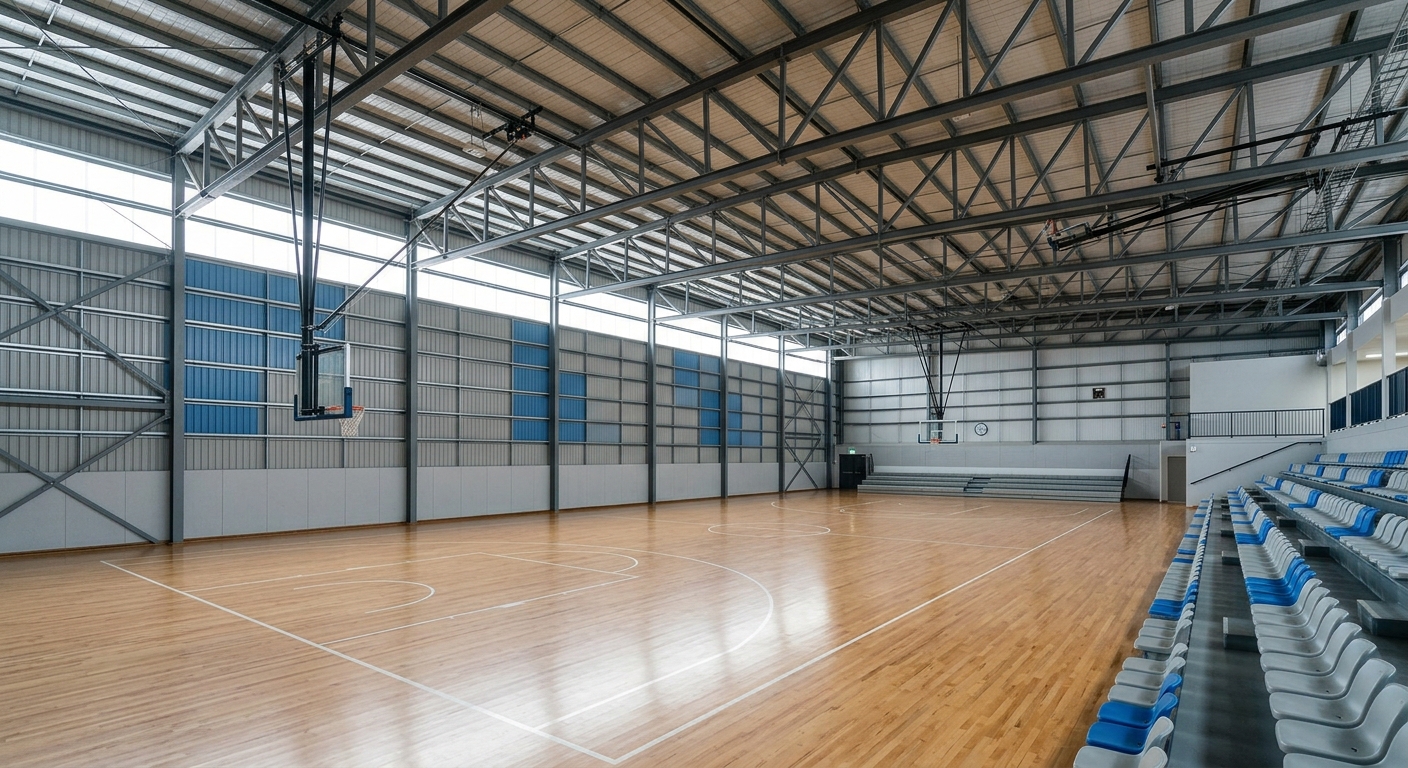
Sports halls need wide roof and wall spans free of columns interrupting the court. Combining a light steel frame with sandwich panel walls and roofing allows this wide span to be built far faster than conventional brick-and-plaster methods, which require curing time and layered finishing. Panels arrive factory-finished, so fieldwork becomes erection work rather than wet trades dependent on weather.
For contractors holding a government tender, this matters because APBD/APBN project schedules are usually locked to the running fiscal year and funds often only disburse mid-year. See our complete guide to sandwich panel types to understand which core (PU, PIR, EPS, or rockwool) best fits a sports hall application.
Technical Standards and Regulations That Must Be Met
Technical planning for sports halls in Indonesia refers to SNI 03-3647, the code covering general provisions, building components, materials, and structure for sports facility design. The standard also requires interior lighting between 200 and 1000 lux depending on the hall's class and function, whether training, regional competition, or national-standard events.
Beyond SNI 03-3647, a GOR structure must also comply with the seismic design standard SNI 1726:2019, the minimum load standard SNI 1727:2020, and, where concrete elements are used, SNI 2847:2019 for concrete structural requirements. Sandwich panels with galvalume steel skins mounted on light or conventional steel frames are typically lighter than brick walls, which reduces the structure's dead load and makes seismic design more cost-efficient.
- SNI 03-3647 — technical planning code for sports facility buildings
- SNI 1726:2019 — seismic design requirements for building structures
- SNI 1727:2020 — minimum design loads for buildings
- SNI 2847:2019 — structural concrete requirements for buildings
Construction Speed: Lessons from 2026 GOR Tenders
The Bangli GOR phase I tender was valued at around Rp29 billion before an additional Rp30 billion was allocated for 2026, targeting completion of the west grandstand and a standard-grade athletics track by year-end. A similar pattern shows up at GOR Berau (Rp9.3 billion) and GOR Banjarmasin (Rp7 billion) — mid-scale projects that need to close out within a single fiscal year to avoid unabsorbed budget carryover.
Under a conventional scheme, wide-span wall and roof work alone can take months just for the upper structure stage. Sandwich panels cut this down because panels are factory-precision made and only need erecting to the steel frame module, letting contractors run MEP and sports-flooring work in parallel once the envelope is closed. This is also why sandwich panels are increasingly chosen for portable cabins and fast-build structures — read more in our article on portable cabins and container conversion with sandwich panels.
Panel Specifications: Acoustics, Thickness, and Cost Estimates
Beyond installation speed, acoustics matter a great deal for a GOR because whistle blasts, crowd noise, and bouncing balls in an enclosed space create echo easily. Acoustic sandwich panels with a perforated facing and rockwool core can reach an NRC (Noise Reduction Coefficient) of 0.8 to 1.0 and noise reduction of 30-40 dB, far better than a bare brick wall that tends to reflect sound back into the room.
On cost, market prices for sandwich panels as of July 2026 range from roughly Rp250,000 to Rp700,000 per square meter for standard rockwool and PU cores, while specially certified PIR can reach Rp800,000 to Rp1,200,000 per square meter. A thickness of 50-75 mm is generally adequate for a non-cold-storage GOR wall, while thicker combinations are worth considering when acoustic and thermal insulation needs are higher, for instance a GOR that also doubles as an air-conditioned multipurpose hall.
B2G project planners should spell out core type, thickness, and acoustic performance explicitly in the bill of quantities and technical specification so there is no room for differing interpretation during tender evaluation or handover. Check the latest sandwich panel price-per-meter guide to keep budget estimates accurate and close to real market prices in the field.
One item that often gets missed in an early budget is panel-to-panel jointing work — sealant, flashing at the roof-wall junction — and accessories like gutters and ridge ventilation. Experienced contractors typically set aside a 5-10 percent contingency on top of the panel material value for these accessories, so installation progress does not stall over small-value but critical components that keep the building watertight and weather-tight.
FAQ
Do sandwich panels meet SNI standards for government sports halls?
Yes, as long as the supporting frame structure (light or conventional steel) is designed to SNI 1726:2019 for seismic resistance and SNI 1727:2020 for loading, using sandwich panels as a non-structural wall and roof element does not conflict with SNI 03-3647 for sports facility technical planning. A structural consultant still needs to calculate wind and seismic loads specific to the project location.
How much faster is GOR construction with sandwich panels compared to conventional methods?
There is no fixed figure since it depends on building scale, but the envelope stage (walls and roof) can generally be sped up significantly because panels are factory-precision made and only need erecting to the frame module, compared to brick-and-plaster work that needs days of curing per layer. This speed gain matters for projects with a fiscal-year deadline, such as GOR Bangli, Berau, and Banjarmasin.
What is the typical material budget range for a mid-scale GOR project?
As of July 2026, market prices range from roughly Rp250,000 to Rp700,000 per square meter for standard rockwool and PU cores, and higher for specially certified PIR. A total estimate still needs to be calculated based on building envelope area, chosen thickness, and the project's specific acoustic and thermal performance needs.