

The Real Problem: Fire Risk in Industrial Buildings Without Fire-Rated Panels
Industrial buildings — manufacturing plants, logistics warehouses, and production facilities — store large quantities of combustible materials. Chemicals, paper, plastics, and wood all increase fire load substantially. Without wall and roof systems with adequate fire resistance, a single ignition point can spread rapidly and destroy your entire asset base within minutes.
Insurance industry data shows that fire is consistently among the top three causes of industrial property loss globally. A factory fire isn't just about physical damage — it cascades into operational shutdowns, lost contracts, supply chain disruptions, and complex insurance claims that can take years to settle.
This is where PIR (Polyisocyanurate) panels enter the picture. The core material is engineered with a chemical formulation that produces a protective char layer when exposed to fire — a carbon barrier that slows heat penetration and maintains structural integrity far longer than conventional insulation materials.
Why Many Industrial Buildings Are Still Vulnerable to Fire
Three key factors contribute to weak fire protection in industrial buildings across Southeast Asia:
1. Wall Material Selection That Ignores Fire Rating
Many contractors and factory owners choose wall panels based on the lowest price, ignoring fire resistance classification. EPS (expanded polystyrene) panels may be cheap, but they melt and drip when burning, creating new ignition points below. EPS also fails to form any protective char — once ignited, fire penetrates the panel quickly and the dripping plastic spreads the fire further.
2. Lack of Fire Compartmentation
International standards such as NFPA 221 and BS 476 emphasize fire compartmentation: dividing a building into zones bounded by fire-resistant walls. Without it, fire spreads freely through roof voids and inter-room gaps. PIR panels with a minimum 60-minute fire rating enable effective compartmentation that contains fire at its origin.
3. Misunderstanding Fire Testing Standards
Decision-makers across industry often don't understand the critical differences between flame spread, smoke development, and fire resistance ratings. A panel labeled "fire-resistant" doesn't necessarily pass full-standard testing. PIR panels are tested to BS 476 Parts 6/7, ASTM E84, or EN 13501-1 — standards that measure far more than just surface flame behavior.
The Solution: PIR Panels with Measurable Fire Performance
PIR panels deliver three critical properties that make them the go-to choice for industrial fire safety:
- Char Formation: The polyisocyanurate formulation creates a carbon char layer when exposed to high-temperature fire. This char acts as a thermal insulator, dramatically slowing heat transfer to the unburned side of the panel.
- Low Smoke Emission: Unlike PUR and EPS, PIR produces significantly less smoke when burning — and statistics confirm smoke is the number one killer in fire incidents, not direct flame exposure.
- Self-Extinguishing Behavior: PIR panels do not drip and do not propagate fire. Once the external flame source is removed, the panel stops burning on its own.
PIR Panel Fire Rating Classifications
Here are the common fire rating classifications for PIR panels in industrial applications:
- Class 0 / Class 1 (BS 476 Parts 6 & 7): Minimum standard for industrial buildings in the UK and many Commonwealth countries. Evaluates surface spread of flame and fire performance index.
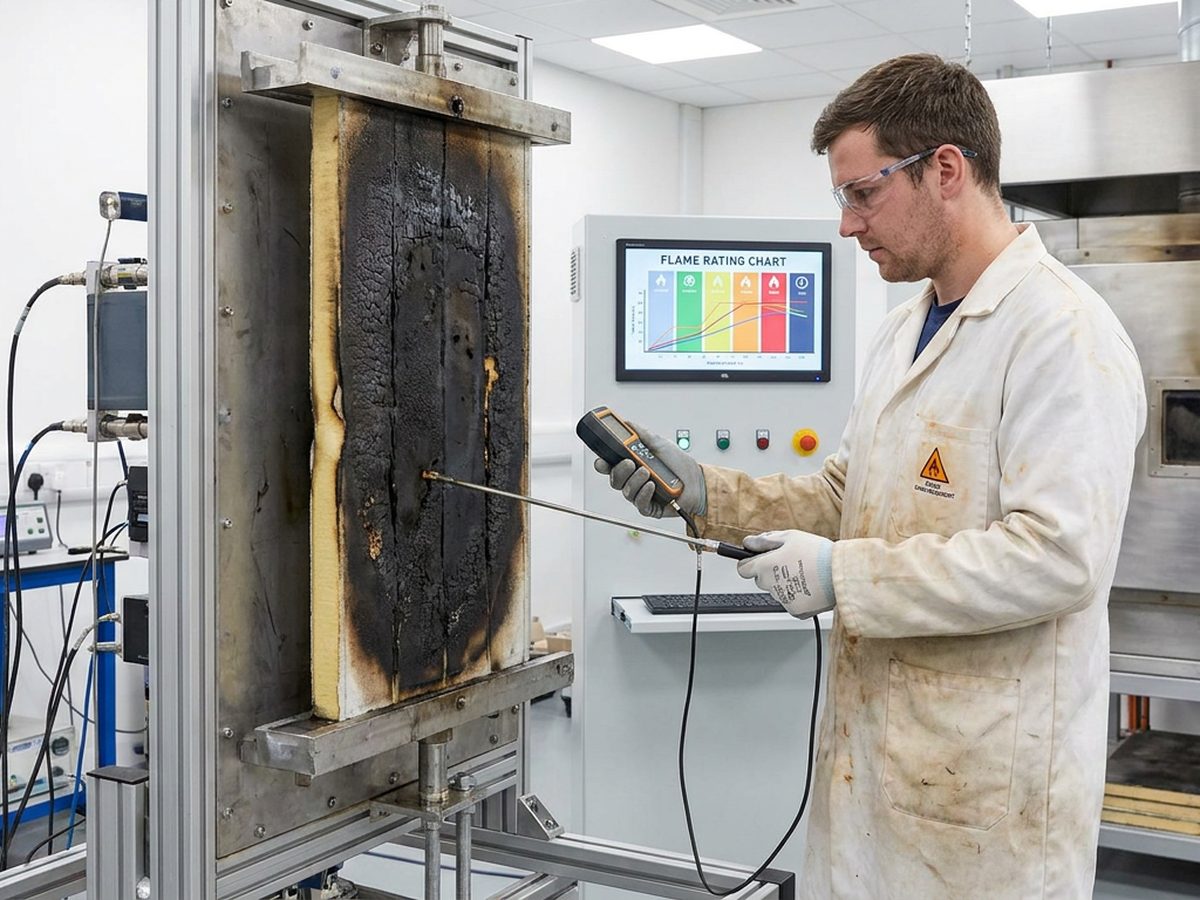
PIR panel fire rating testing in an accredited laboratory — evaluating flame spread, smoke development, and structural integrity
- Class A (ASTM E84): Flame Spread Index ≤ 25, Smoke Developed Index ≤ 450. Widely adopted in projects with international consultants operating in Indonesia.
- B-s1,d0 (EN 13501-1): European classification — B indicates very limited contribution to fire, s1 means very low smoke emission, and d0 means zero flaming droplets.
- FM 4880 / FM 4881: Factory Mutual standards for unlimited-height wall panels — critical for high-rack warehouses and multi-story industrial facilities. Read more in our FM Approved sandwich panel certification guide.
Suitable Products: PIR Panel Applications Across Industries
Not all PIR panels are created equal. Specification choices depend on the industry type and fire risk level:
- Logistics Warehouses & Distribution Centers: High racking, cardboard/packaging materials — requires FM 4880 Class 1, 75-100mm thickness, ≥ 60-minute fire rating.
- Chemical & Petrochemical Plants: ATEX zones — requires PIR panels with additional anti-static certification and ≥ 120-minute fire rating.
- Food & Beverage Facilities: Minimum 30-minute fire rating + food-grade finish (GMP compliance), PIR panels with stainless steel facing or food-grade coating.
- Data Centers: High heat load, short-circuit risk — 100-150mm PIR panels with ≥ 60-minute fire rating, FM Approved preferred.
- Electronics & Semiconductor Plants: ISO Class 7-8 cleanrooms, sensitive materials — PIR panels with anti-static surface, minimum Class 0 fire rating.
Common Mistakes When Choosing Fire-Resistant Panels
Field experience reveals several recurring mistakes made by contractors and project owners:
- Trusting "fire-resistant" claims without test certificates: Always request test reports from accredited laboratories (TÜV, BRE, Warringtonfire, Exova). Don't rely on brochures alone.
- Mixing PIR with EPS in the same building: Fire compartmentation fails when there's a weak link in the barrier. One EPS panel in the middle of a PIR wall = the entire compartment loses its function.
- Joint details and penetrations not sealed with firestop: Fire seeks gaps. Panel-to-panel joints and pipe/cable penetrations must be sealed with fire-rated sealant and collars.
- Ignoring smoke toxicity: Some insulation materials release toxic gases (HCN, CO) when burning. High-quality PIR panels are formulated to minimize hazardous gas emissions.
- Skipping inspection and maintenance: Fire ratings can degrade through physical damage, moisture ingress, or building modifications. Schedule annual inspections by qualified professionals.
FAQ — PIR Panel Fire Safety Common Questions
Is PIR panel completely fireproof?
No building material is 100% fireproof. PIR panels are fire-resistant, not non-combustible. They form a char layer that slows fire penetration, providing valuable evacuation and firefighting response time. For applications requiring non-combustible materials (A1/A2), use rockwool panels or mineral wool panels instead.
How long can PIR panels resist fire?
Resistance duration depends on panel thickness, PIR core density, and joint configuration. Standard 50mm PIR panels generally provide 30 minutes of fire resistance, 75mm achieves 60 minutes, and 100mm+ can reach 90-120 minutes. Multi-layer configurations with additional gypsum board can extend ratings further.
What's the difference between PIR and Rockwool fire ratings?
Rockwool is non-combustible (A1) — it doesn't burn at all up to 1000°C+. PIR is fire-resistant (B-s1,d0) — burns slowly with char formation. Rockwool is heavier and more expensive; PIR offers a balance of thermal insulation + fire safety + practical costs for most industrial projects. Choose rockwool for high-risk zones (boiler rooms, flammable storage); PIR for general areas.
Are FM Approved PIR panels available in Indonesia?
Yes. PT. Ruida Grup Indonesia supplies PIR panels with FM 4880/4881 certification for industrial projects across Indonesia. Our products are installed in logistics facilities, food processing plants, and data centers in Greater Jakarta, Surabaya, and Medan.
How do I verify fire ratings before purchasing?
Request the following documents from your supplier: (1) Test reports from accredited laboratories (BRE, Warringtonfire, TÜV), (2) FM 4880/4881 certificate of compliance if claiming FM Approved status, (3) Technical datasheet listing BS 476 / ASTM E84 / EN 13501-1 classifications. Cross-reference report numbers with the relevant laboratory's online database when possible.
Conclusion
Investing in PIR panels with the right fire rating isn't just regulatory compliance — it's protection for your assets, your people, and your business continuity. A factory fire can destroy a building and halt operations within hours, but recovery can take years. PIR panels offer a combination of thermal insulation, fire resistance, and cost efficiency that's difficult to match with any other single material. For material comparisons, see our PIR vs PUR vs EPS comparison.
If you're planning construction or renovation of industrial facilities, consult our team about your project's fire safety requirements. Contact us via WhatsApp or our contact form to get PIR panel specifications tailored to your facility's risk level and operational needs.