

The Problem: Choosing the Right Wall Material for Industrial Buildings
When planning a factory, warehouse, or cold storage facility, the first question is often the most basic: what wall material is best? Red brick is too slow and heavy. Lightweight bricks need additional finishing. Precast concrete is expensive and inflexible for modifications. That's where sandwich panels come in as a modern solution — fast installation, lightweight, high insulation, and cost-effective in the long run.
This article covers everything you need to know: what sandwich panels are, the different types available, their advantages over conventional materials, and how to choose the right panel for your project.
What Is a Sandwich Panel? Structure & Core Components
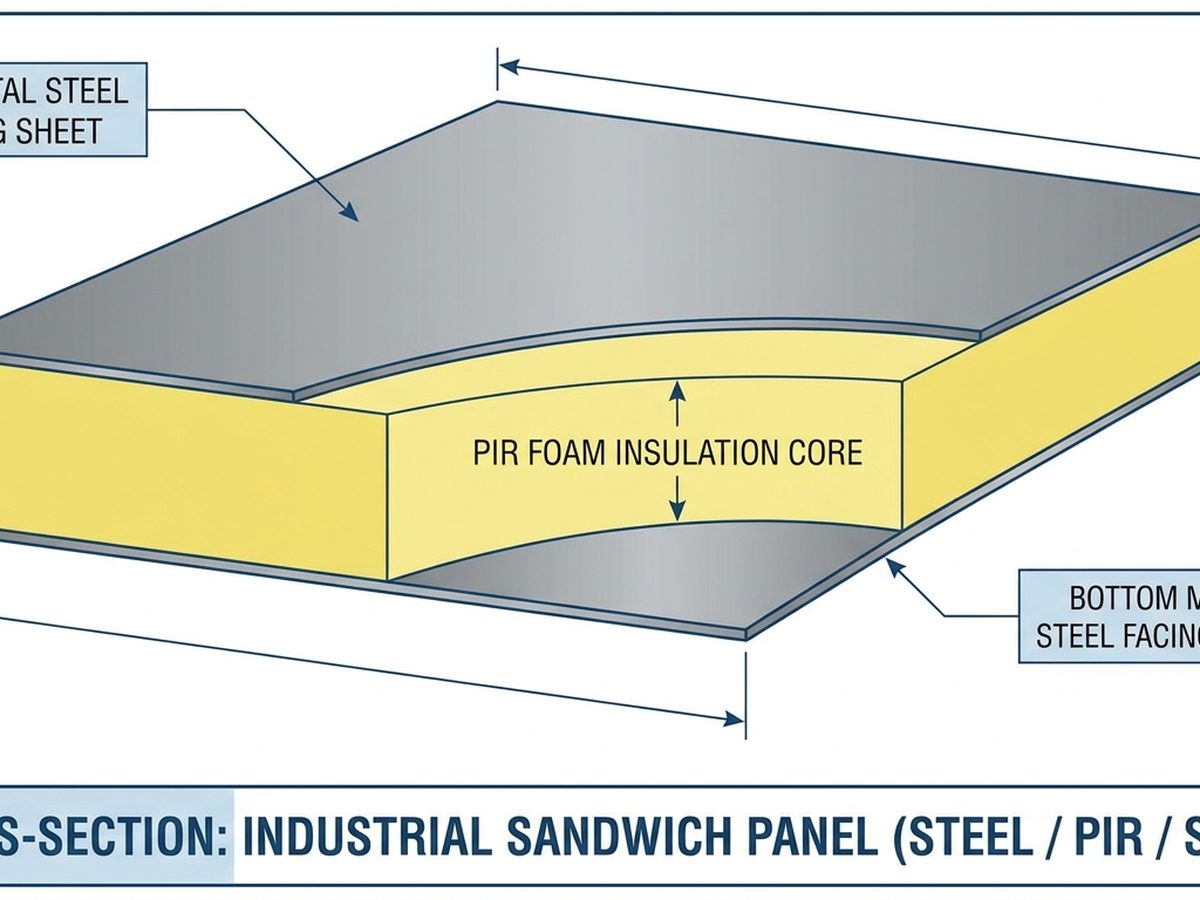
A sandwich panel is a composite construction material consisting of three main layers: two sheets of metal facing (typically galvanized steel or pre-painted steel) on the outside, and one insulation core in the middle. The configuration resembles a sandwich — two strong outer layers with a filling that provides thermal and acoustic insulation.
The basic structure of a sandwich panel consists of:
- Outer facing: Steel sheet with a thickness of 0.4–0.7 mm, coated with anti-corrosion treatment (galvanized/Galvalume) and paint coating (PVDF or PE) for weather resistance.
- Core material: Insulation material bonded using high-pressure injection or continuous lamination technology. Core options: PIR (Polyisocyanurate), PUR (Polyurethane), EPS (Expanded Polystyrene), or mineral wool (rockwool).
- Inner facing: Steel sheet similar to the outer facing, which can use the same material or food-grade stainless steel for specialized applications such as food processing plants.
Total sandwich panel thickness ranges from 50 mm to 200 mm, depending on thermal insulation requirements. The thicker the core, the higher the insulation value (lower U-value).
Types of Sandwich Panels: PIR, PUR, and EPS Explained
Not all sandwich panels are created equal. The main difference lies in the core material, which determines insulation performance, fire resistance, and suitable applications.
1. PIR (Polyisocyanurate) Sandwich Panels
PIR panels are the premium choice for applications requiring high fire ratings. With a thermally more stable cell structure, PIR offers superior fire resistance (up to B1/FM Class 1) compared to PUR. PIR panels are ideal for cold storage, cleanrooms, data centers, and buildings with strict fire safety standards. Read more: PIR Panels: Best Insulation Material for Modern Cold Storage.
2. PUR (Polyurethane) Sandwich Panels
PUR panels provide the best thermal insulation among the three — the lowest U-value per mm of thickness. They are suitable for low-temperature cold storage (chiller/freezer), fish and meat cold rooms, and facilities where energy efficiency is the top priority. PUR panels are available with B2 and B1 fire ratings (with flame retardant additives). See installation guide: Cold Storage Wall Panels: Specs & Installation Guide.
3. EPS (Expanded Polystyrene) Sandwich Panels
EPS panels are the most economical option — ideal for factory partitions, warehouses, commercial buildings, and non-critical applications that don't require high fire ratings. Insulation is adequate but below PIR/PUR levels. The key advantage: 30-50% lower cost and the lightest weight. Available with standard B2 fire rating.
Key Advantages of Sandwich Panels for Industrial Use
Why are sandwich panels increasingly chosen over conventional brick or concrete construction? Here are the main advantages:
1. Installation Speed — 5-10x Faster
A 4-person crew can install 100-200 m² of sandwich panels per day, compared to bricklaying at just 10-20 m² per day. A 1,000 m² factory project can be completed in 1-2 weeks instead of 2-3 months.
2. Superior Thermal Insulation
A 100 mm PIR sandwich panel has a U-value of approximately 0.22 W/m²K, while an equivalent 150 mm brick + plaster wall has a U-value of around 2.1 W/m²K — nearly 10x worse. For cold storage and air-conditioned spaces, electricity savings can reach 30-40% annually.
3. Lightweight — Savings on Foundation Structure
Sandwich panels weigh 10-15 kg/m² (depending on thickness), compared to brick walls at 200-250 kg/m². Lighter steel structures and foundations can save 10-20% of total construction costs.
4. Anti-Corrosion & Weather Resistant
Steel facing with PVDF/Galvalume coating resists rust, mold, and UV rays. Sandwich panels can last 20-30 years with minimal maintenance, even in Indonesia's tropical and coastal environments.
5. Hygienic & Easy to Clean
The smooth, non-porous steel surface does not accumulate dust or bacteria. This makes panels ideal for food factories, pharmaceutical plants, hospitals, and cleanrooms that require high hygiene standards (HACCP, GMP, ISO 14644).
6. Modular & Flexible
Sandwich panels can be disassembled and relocated if a factory needs to move or expand. Unlike brick walls that must be demolished, up to 80% of sandwich panels are reusable.
Applications Across Different Sectors
- Factories & Warehouses: Exterior walls and internal partitions, replacing brick/concrete.
- Cold Storage & Cold Rooms: Chiller and freezer rooms for fish, meat, vegetables, ice cream, pharmaceuticals — temperatures from -25°C to +15°C.
- Cleanrooms: Controlled environments for electronics, pharmaceutical, medical device, and laboratory industries.
- Data Centers: High fire-rated panels to protect servers and digital infrastructure.
- Modular Offices & Site Offices: Temporary buildings (project offices, worker quarters) that can be relocated.
- Food & Beverage Plants: Food-grade panels with SS304 inner facing for HACCP and regulatory compliance.
- Hospitals & Laboratories: Modular operating theatre partitions, isolation rooms, and sterile laboratories.
Common Mistakes When Choosing Sandwich Panels
Mistake #1: Choosing EPS for Cold Storage
EPS panels are not designed for extreme temperatures. Below 0°C, EPS can experience internal condensation that damages the panel structure. Use at minimum PUR, ideally PIR, for cold storage applications.
Mistake #2: Ignoring Fire Rating
For buildings housing many people or expensive equipment (factories, data centers, hospitals), B1 fire rating is mandatory. Don't be tempted by the low price of B2/B3 panels without considering fire risks.
Mistake #3: Not Accounting for Wind Load
Exterior sandwich panels must be calculated for wind loads according to the project location. Facing thickness and span specifications must be adjusted to local wind conditions.
Mistake #4: Improper Joint Sealing
Joint quality between panels determines insulation performance and leakage protection. Ensure tongue-and-groove systems with appropriate sealant, especially for cold storage and cleanrooms requiring airtight seals.
How to Select the Right Sandwich Panel for Your Project
Use this checklist when choosing sandwich panels:
- Determine core type: PIR (high fire rating), PUR (maximum insulation), or EPS (economical).
- Determine panel thickness: 50 mm for non-AC partitions, 75-100 mm for chiller cold storage, 150-200 mm for freezers.
- Choose facing material: Standard galvanized steel, or stainless steel for food-grade/pharma use.
- Select color & coating: PE coating for interior, PVDF for exterior (UV resistant).
- Match fire rating: B1 for public/industrial buildings, B2 for standard warehouses.
- Verify technical specifications: Request technical data sheets from the supplier, including U-value, fire rating, and span tables.
- Consult experts: Every project has unique requirements — don't hesitate to consult before purchasing.
FAQ: Common Questions About Sandwich Panels
1. How much do sandwich panels cost per m²?
Sandwich panel prices vary by core type, thickness, and facing specifications. EPS panels start from approximately IDR 250,000/m², PUR from IDR 350,000/m², and PIR from IDR 450,000/m². Prices may differ for large-volume projects or custom specifications.
2. Are sandwich panels earthquake-resistant?
Yes. Due to their light weight (only 5-8% of a brick wall), sandwich panels generate significantly lower seismic loads on building structures. The tongue-and-groove joint system also provides good flexibility during seismic vibrations.
3. How long do sandwich panels last?
With proper installation and minimal maintenance, sandwich panels can last 20-30 years. Key factors affecting lifespan: coating quality (PVDF > PE), environmental exposure (coastal vs inland), and sealant quality at joints.
4. Can sandwich panels be installed DIY?
Sandwich panel installation requires a professional team with specialized tools (crane, lifting clamps, sealant guns). Installation errors such as loose joints or incorrect anchoring can reduce insulation performance and structural safety. Always use experienced contractors.
5. What's the difference between sandwich panels and regular wall panels?
Sandwich panels have an integrated insulation core, while regular wall panels (metal sheet/cladding) are a single layer of steel without insulation. Sandwich panels provide thermal + acoustic insulation in one product, without needing separate insulation layers.
Conclusion & Next Steps
Sandwich panels are the modern wall material solution meeting industrial construction needs: fast installation, high insulation, lightweight, hygienic, and cost-effective long-term. With three main core options — PIR (fire rating), PUR (maximum insulation), and EPS (economical) — there is always a suitable option for every project, from simple warehouses to -25°C cold storage and ISO Class 5 cleanrooms.
The key to your project's success lies in choosing the right specifications. Use the checklist above, verify technical data sheets from suppliers, and ensure an experienced installation team.
Need consultation for your project? Our team at PT. Ruida Grup Indonesia is ready to help — from sandwich panel specification selection and material calculation to professional installation. Contact us now for a free consultation and best-price quotation.