

The Cold Storage Problem: When Temperature Targets Are Never Met
Business owners across Indonesia share a common frustration: their cold storage runs 24/7, electricity bills skyrocket, yet temperatures remain unstable. Frozen meat thaws, vegetables wilt, and pharmaceuticals risk spoilage because the room cannot maintain consistent temperatures below -18C. Financial losses from product spoilage and inefficient energy consumption can reach tens of millions of rupiah monthly.
Often, the problem is not the refrigeration unit itself, but rather inadequate wall and roof insulation materials. Conventional panels like EPS or standard PU may seem sufficient initially, but their performance degrades dramatically over time. This is why PIR panels have become the top choice for modern cold storage requiring maximum energy efficiency and temperature stability.
Root Causes of Cold Storage Insulation Failure
Before discussing solutions, it is essential to understand why cold storage fails to maintain optimal temperatures. Here are the primary factors:
1. Unaddressed Thermal Bridging
Insulation panels with poor joint connections create thermal bridges—paths where heat sneaks into the refrigerated space. Low-density EPS is particularly vulnerable to this issue due to thermal drift.
2. Insulation Material Degradation
Conventional PU begins losing insulation performance after 5-7 years of use. The blowing agent gas seeps out, leaving air gaps that reduce the panel's R-value from 0.022 to 0.035 W/mK or worse.
3. Fire Vulnerability
Cold storage facilities house high-value inventory. A fire in a refrigerated space can destroy entire stock within minutes. EPS burns easily and melts, while standard PU, though better than EPS, remains flammable.
4. Condensation and Corrosion
Extreme temperature differences between inside and outside the cold storage create dew points. If insulation is not perfectly vapor-tight, moisture seeps into the panel structure, causing metal layer corrosion and mold growth.
Why PIR Panels Make the Most Sense
PIR (Polyisocyanurate) represents an evolution from conventional PU technology. With a more complex molecular structure and stable cyclic chains, PIR offers significant advantages for cold storage applications:
Superior R-value Performance
PIR panels have thermal conductivity around 0.019-0.022 W/mK, outperforming PU (0.022-0.024) and significantly exceeding EPS (0.035-0.040). This means PIR provides 30-40% more effective insulation at the same thickness. Cold storage with PIR panels can reach temperatures of -25C to -40C without overloading the refrigeration system.
Class A Fire Rating
This is PIR's greatest advantage. The material meets Class A fire rating standards (BS 476 Part 7) and ASTM E84 Class A. When exposed to fire, PIR does not melt or drip like EPS/PU. Instead, it forms a protective char layer that shields the core and slows fire spread. For pharmaceutical and food processing cold storage, this is a non-negotiable safety requirement.
Long-term Dimensional Stability
PIR has a service temperature range of -196C to +120C. Unlike PU, which undergoes thermal degradation, PIR maintains its cellular structure and insulation performance for 20-25 years. The higher initial investment pays off through extended service life and lower operational costs.
Vapor-tight and Anti-condensation
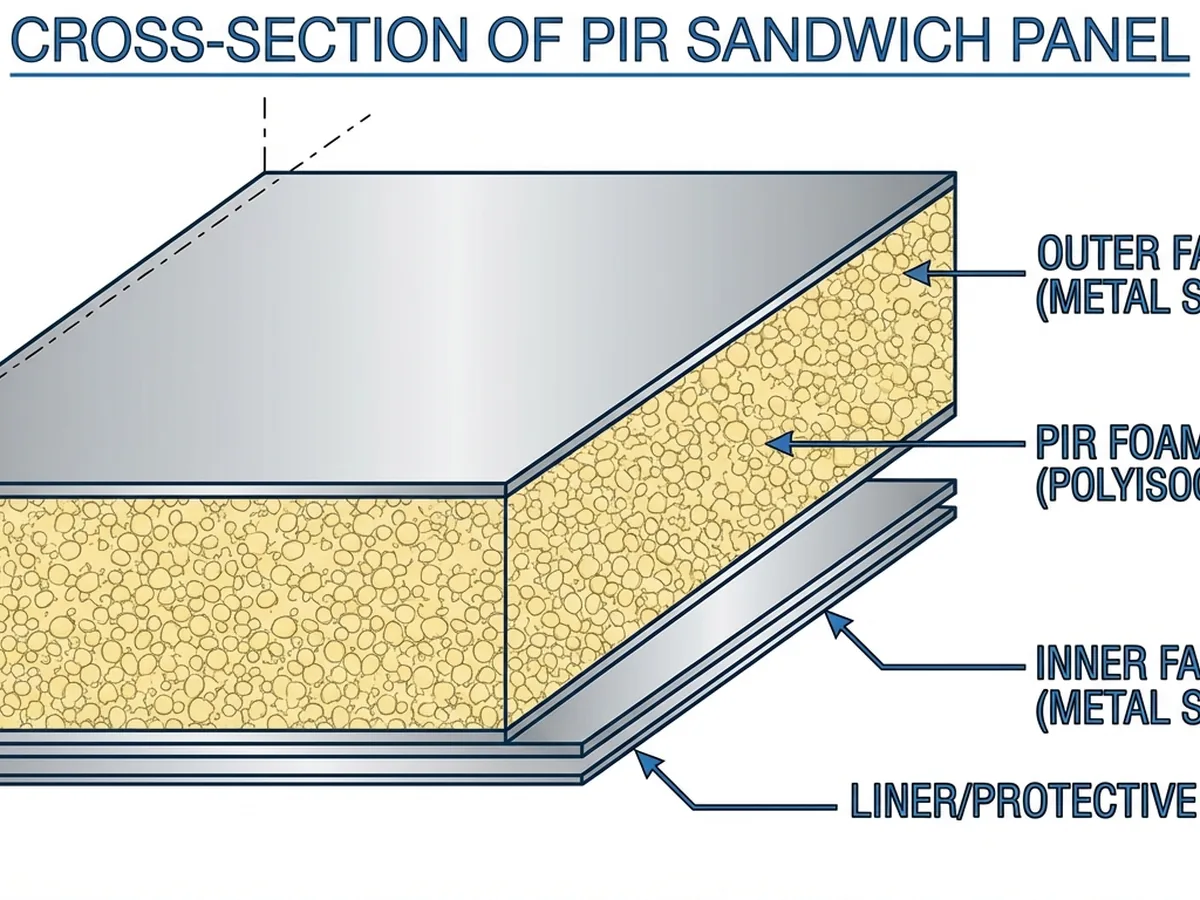
PIR panels with aluminum foil or galvanized steel facing create a perfect vapor barrier. The water vapor resistance factor (μ) reaches 30,000-50,000, preventing moisture migration into the insulation core. This eliminates the risk of internal condensation that causes corrosion and performance decline.

Choosing the Right PIR Panel for Different Applications
Not all PIR panels are the same. Specifications must match application requirements:
Pharmaceutical and Vaccine Storage (-40C to -80C)
For ultra-low temperature storage, use PIR panels with 150-200mm thickness, 40-45 kg/m3 density, and 304 stainless steel facing for maximum hygiene. Camlock systems with EPDM gaskets ensure leak-proof joints.
Food and Beverage Cold Storage (-18C to -25C)
Standard frozen food cold storage requires 100-150mm PIR panels with pre-painted galvanized steel (PPGI) facing. Class A fire-rated PIR is mandatory for food processing areas per BPOM regulations.
Chiller Rooms for Fruits and Vegetables (0C to +10C)
For chiller applications, 80-100mm PIR panels are sufficient. Facing can use coated steel with white color for good light reflectivity inside the room.
Cleanrooms with Temperature Control
PIR panels are also ideal for pharmaceutical and electronics cleanrooms requiring strict temperature control. The smooth, non-porous surface facilitates sanitation according to GMP standards.
Mistakes to Avoid When Selecting PIR Panels
Despite PIR's superiority, incorrect selection and installation can reduce its benefits:
- Ignoring fire rating certification: Ensure PIR panels have fire test certificates from accredited bodies like SGS, TUV, or equivalent.
- Insufficient thickness for thermal load: Saving costs by choosing panels that are too thin is an expensive mistake. Calculate thermal load based on delta T, humidity, and door opening frequency.
- Installation without vapor barrier: Panel joints must be properly sealed using vapor-proof tape and sealant. Thermal bridging at joints can reduce overall efficiency by up to 15%.
- Ignoring structural compatibility: Ensure existing walls can support the weight of panels and cold storage equipment. 150mm PIR panels with steel facing can reach 15-20 kg/m2.
- Not considering lifecycle cost: PIR panels cost 20-30% more than standard PU, but 30-40% annual energy savings achieve ROI within 3-4 years.
FAQ About PIR Panels for Cold Storage
What is the difference between PIR and standard PU?
PIR (Polyisocyanurate) has a molecular structure with more stable cyclic bonds compared to linear PU (Polyurethane). This gives PIR advantages: Class A fire rating vs Class B for PU, lower thermal conductivity (0.019 vs 0.022 W/mK), and wider operating temperature stability (-196C to +120C).
How much do PIR panels cost per m2?
PIR panel prices in Indonesia range from Rp 450,000 - 750,000 per m2 depending on thickness (50-200mm), facing type (galvanized vs stainless steel), and order volume. Though 20-30% more expensive than PU, 30-40% annual energy savings result in lower total cost of ownership in the medium term.
Can PIR panels be used for retrofitting existing cold storage?
Yes, modular PIR panels with camlock systems allow installation in existing cold storage. However, structural evaluation is needed to ensure walls and floors can support additional load. Modular systems also facilitate future expansion or relocation.
What is the service life of PIR panels?
With proper installation and maintenance, PIR panels can last 20-25 years without significant insulation performance degradation. Standard manufacturer warranties are typically 10 years for thermal performance and 15-20 years for structural integrity.
Are PIR panels environmentally friendly?
Modern PIR uses blowing agents with low Global Warming Potential (GWP) such as cyclopentane or HFO (Hydrofluoroolefin), not ozone-depleting CFC/HCFC. PIR can also be recycled at end-of-life through shredding and reprocessing.
Conclusion and Next Steps
Unstable temperatures in cold storage are often caused by inadequate insulation materials. PIR panels offer a comprehensive solution with superior insulation performance, Class A fire rating, long-term stability, and protection against condensation.
Investing in PIR panels may require a higher initial budget, but 30-40% annual energy savings and asset protection from fire risk make it a smart choice for your business cold storage.
Ready to upgrade your cold storage with PIR panels? Our technical team is ready to help evaluate your needs, calculate thermal load, and estimate costs. Free consultation and site surveys are available for projects in Jabodetabek, Bandung, Surabaya, and other major cities.
Contact us via WhatsApp or online form for the best PIR panel quotation tailored to your cold storage needs. Also read our complete cold storage construction guide for more information.