

Choosing wall materials for pharmaceutical sterile rooms or laboratory facilities goes beyond aesthetics. A single specification error can lead to product contamination, GMP audit failure, and financial losses in the billions of rupiah. Modular wall panels offer a proven solution — but not all panels are created equal. This guide covers how to select the right modular wall panels for your sterile environment.
Why Conventional Walls Fail in Sterile Environments
Epoxy-painted brick or concrete walls look solid, but they have fundamental weaknesses in controlled environments. Their surfaces are porous, difficult to clean thoroughly, and prone to cracking over time. Micro-cracks become breeding grounds for bacteria and mold — a serious threat for pharmaceutical production that must comply with GMP (Good Manufacturing Practice) standards.
Standard drywall is even worse. Gypsum materials shed fine particles (particulate shedding) that contaminate ISO Class 5-8 environments. Joints between sheets create gaps that are nearly impossible to seal permanently, making positive/negative room pressure control unstable.
Advantages of Modular Wall Panels for Pharma & Labs
Modular wall panels — particularly sandwich panels with PIR or rockwool cores — are purpose-built specifically for controlled environments in pharmaceutical manufacturing, biotechnology facilities, and analytical testing laboratory sectors:
- Non-porous, seamless surfaces: 0.5-0.6 mm steel sheet skins with anti-bacterial coating withstand aggressive disinfectants without material degradation.
- Zero particulate shedding: Unlike drywall, modular panels release no airborne particles — critical for maintaining ISO classifications.
- Fast installation without construction contamination: Interlocking systems install in days, not weeks. No cement dust, paint curing, or construction debris contaminating adjacent areas.
- Reconfiguration flexibility: Pharma facilities and labs frequently change layouts. Modular panels can be disassembled and reinstalled without structural damage.
- Thermal and acoustic insulation: PIR cores from 50-100 mm provide R-values of 2.5-5.0 m²K/W, maintaining room temperature stability and reducing HVAC load.
GMP and ISO Standards You Must Meet
Sterile room wall panels must comply with several key regulations:
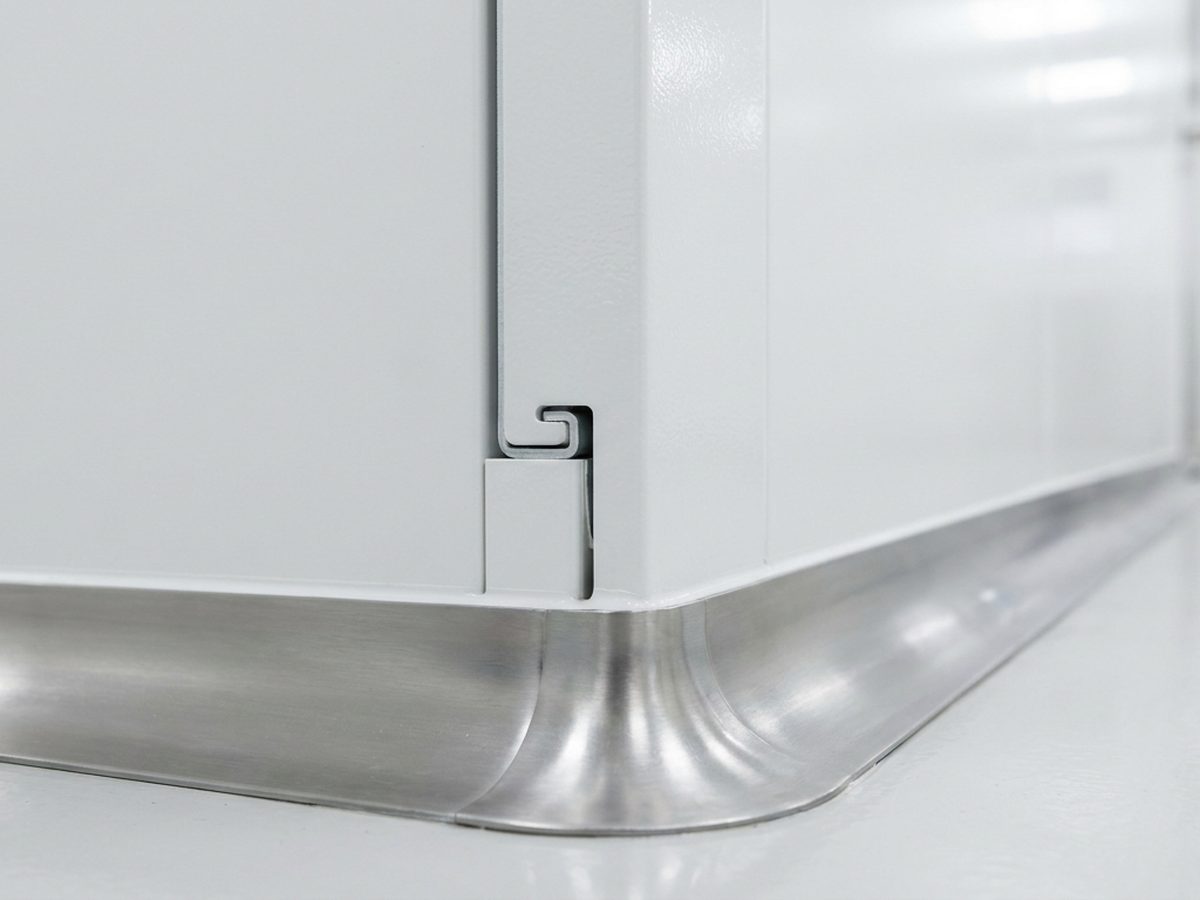
- GMP Annex 1 / EU GMP: Surfaces must be smooth, impermeable, easy to clean, and non-reactive with cleaning chemicals. No 90° corners — use coving at all wall-floor and wall-wall junctions.
- ISO 14644: Depending on room classification (ISO 5-8), panels must support airborne particulate control. Surfaces should be tested for particle retention and chemical resistance.
- FDA 21 CFR Part 211: Construction materials must not be reactive, additive, or absorptive toward drug products — applicable to both production and storage areas.
Material Types for Sterile Room Modular Panels
Three common core materials:
| Core Material | Advantages | Best For |
|---|---|---|
| PIR (Polyisocyanurate) | B1 fire rating, high R-value, moisture resistant | Sterile rooms with fire risk, HVAC areas |
| Rockwool | A1 fire rating (non-combustible), superior acoustics | High-heat sterile rooms, API production areas |
| Honeycomb Aluminum | Lightweight, zero particulate, perfect flatness | ISO 5-7 cleanrooms, sterilization suites, electronics labs |
For general pharmaceutical applications, PIR panels with stainless steel 304 (SS304) or zincalume skins hit the sweet spot between performance and cost. For high-temperature sterilization areas, rockwool is safer due to its non-combustible nature and superior fire resistance.
Choosing the Right Panel Thickness
Modular wall panel thickness significantly affects insulation and structural strength:
- 50 mm: Sufficient for internal partitions with low thermal loads. Most affordable, but limited acoustic insulation.
- 75 mm: The most common choice for perimeter walls of sterile rooms. Balances insulation, strength, and cost.
- 100 mm: For external walls or areas with high temperature differentials (cold room vs ambient). Required for high fire rating applications.
Consult with a cleanroom contractor for a thermal analysis specific to your facility's HVAC load and location.
Modular wall panels work best when integrated with a proper cleanroom HVAC system. Appropriate HVAC ducting ensures laminar airflow is not disrupted by wall contours while maintaining pressure cascades per GMP specifications. For facilities requiring high particulate control, integrate with FFUs (Fan Filter Units) mounted directly into the modular panel ceiling grid.
5 Common Mistakes When Selecting Modular Wall Panels
- Ignoring seamless requirements: Choosing panels with exposed fastener systems creates contamination gaps. Always use hidden screw or flush joint systems.
- Skipping coving: 90° corners between walls and floors cannot be cleaned thoroughly. Always install 50 mm radius coving with food-grade sealant.
- Wrong coating selection: PE (polyester) coating cannot withstand aggressive disinfectants like hydrogen peroxide vapor (HPV) or chlorine dioxide. Use PVDF coating as a minimum, ideally SS304.
- Forgetting service integration: Modular panels must accommodate penetrations for HVAC diffusers, lighting, pressure sensors, and utility pass-throughs without compromising sterile seals.
- Installation without validation: After installation, smoke tests, particle counts, and pressure decay tests are mandatory to validate room integrity. Without these, a GMP audit will almost certainly fail.
FAQ: Modular Wall Panels for Sterile Rooms
Can modular wall panels be used for ISO 5 (Class 100) cleanrooms?
Yes, provided you use honeycomb aluminum panels or PIR panels with stainless steel 304/316L finishing. Ensure the joint system is fully flush and sealed with food-grade silicone. Particle count validation is mandatory post-installation.
What is the lifespan of modular wall panels in sterile environments?
With routine maintenance and protocol-compliant cleaning, modular wall panels last 15-25 years. PVDF or SS304 coatings significantly extend lifespan compared to standard PE coatings, which can degrade within 5-7 years due to aggressive disinfectant exposure.
How much do modular wall panels cost per m2 for sterile rooms?
PIR panels with zincalume coating range from IDR 450,000-650,000/m². Panels with SS304 skins can reach IDR 1,200,000-1,800,000/m². Honeycomb aluminum for high-end cleanrooms ranges from IDR 2,000,000-3,500,000/m². Prices include joint systems and basic accessories, excluding installation and coving.
Choosing the right modular wall panels for pharmaceutical and laboratory sterile rooms is a long-term investment that directly impacts your facility's operational success. The wrong material can result in GMP audit failures, production batch contamination, and remediation costs that multiply far beyond the panel price difference itself.
Focus on three key criteria: seamless surfaces, chemical-resistant coatings, and GMP Annex 1 compliance. For new projects or existing facility renovations, ensure you work with contractors who have proven pharmaceutical cleanroom installation track records — not general building contractors. Contact our technical team for a panel specification consultation, including a free site survey and budget estimate.