

# Choosing HVAC Ducting for Cleanrooms: Material Types & Selection Guide
Why HVAC Ducting Determines Your Cleanroom Quality
The HVAC (Heating, Ventilation, and Air Conditioning) system is the heart of any cleanroom. Without the right ducting, air pressure, temperature, humidity, and contamination levels inside a cleanroom cannot be controlled to ISO 14644 standards. Yet many facility managers overlook ducting material selection when building or renovating cleanrooms.
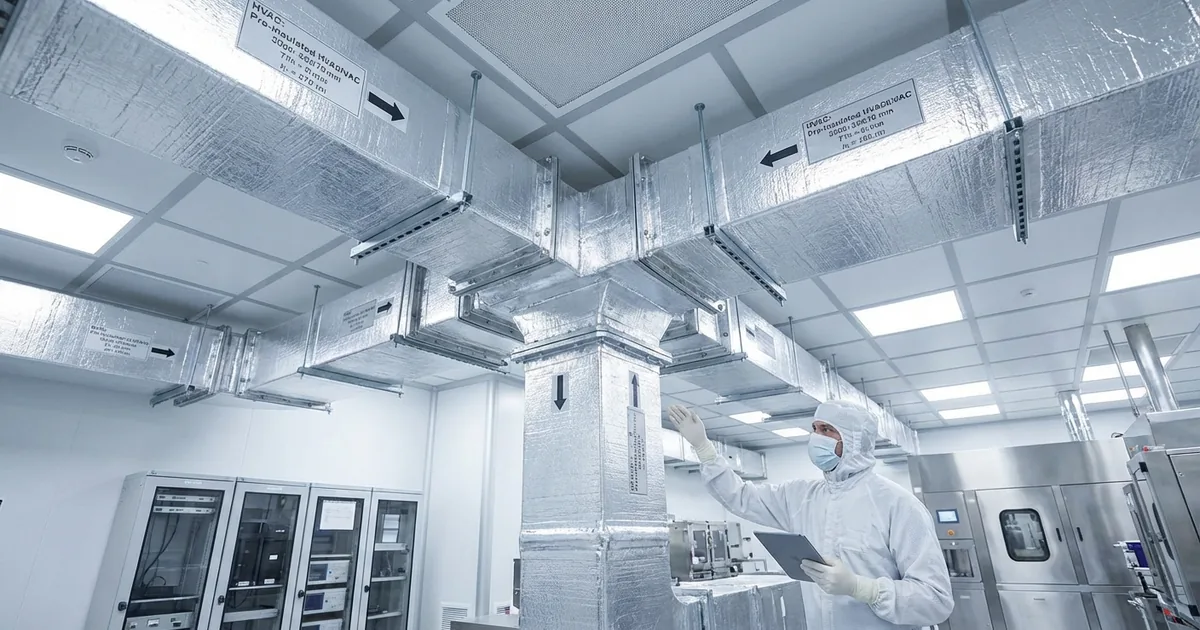
Choosing the wrong HVAC ducting can have serious consequences: particles shedding from corroded ducting materials, air leaks that reduce positive pressure, and microbial growth on moist duct surfaces. These issues lead to failed cleanroom audits, contaminated production batches, and significant financial losses.
Types of HVAC Ducting for Cleanrooms You Need to Know
1. Pre-Insulated PIR (Polyisocyanurate) Ducting
PIR ducting is the most popular choice for modern cleanrooms. PIR panels have a polyisocyanurate insulation core with aluminium foil facing on both sides. Key advantages include:
- Very low thermal conductivity (0.018-0.022 W/mK), reducing cooling load
- Fire rating up to B1 (flame-retardant) per DIN 4102 standard
- Lightweight (approximately 1.5-2.5 kg/m2 for 20mm thickness), simplifying installation
- Smooth, fibre-free surface that does not shed contaminant particles
- Moisture-resistant and non-absorbent, preventing mould growth
2. Pre-Insulated PU (Polyurethane) Ducting
PU ducting uses a polyurethane foam core. Structurally similar to PIR but with slightly different performance:
- Thermal conductivity around 0.020-0.025 W/mK
- More economical than PIR, suitable for cleanrooms with limited budgets
- Fire rating B2 (normal flammability) — needs consideration for areas with strict fire regulations
- Service life of 10-15 years under normal conditions
3. Galvanized Steel Ducting
Galvanized steel ducting is a traditional option still widely used:
- High mechanical strength, impact-resistant
- High temperature resistance, suitable for heavy industrial applications
- Long service life (20+ years) in non-corrosive environments
- Main drawbacks: heavy, requires separate external insulation, prone to corrosion in humid environments, and surface can shed particles if corrosion occurs
4. Phenolic Panel Ducting
Phenolic panels are a premium option for cleanrooms with the strictest cleanliness requirements:
- Highest fire rating (Class 0/A1) — virtually non-combustible
- Does not produce toxic smoke when exposed to fire
- Very smooth, anti-bacterial surface
- Very low thermal conductivity (0.018-0.020 W/mK)
- Higher price, used primarily in pharmaceutical, hospital, and ISO Class 5 and above cleanrooms
HVAC Ducting Material Comparison for Cleanrooms
| Material | Thermal Conductivity | Fire Rating | Contamination Resistance | Price per m2 | Service Life |
|---|---|---|---|---|---|
| PIR Ducting | 0.018-0.022 W/mK | B1 (Flame-Retardant) | Excellent | IDR 350K - 550K | 15-20 years |
| PU Ducting | 0.020-0.025 W/mK | B2 (Normal) | Good | IDR 280K - 450K | 10-15 years |
| Galvanized Steel | High (needs insulation) | A (Non-combustible) | Moderate (corrosion risk) | IDR 200K - 400K | 20+ years |
| Phenolic Panel | 0.018-0.020 W/mK | A1 (Class 0) | Excellent | IDR 500K - 800K | 20+ years |
How to Choose the Right HVAC Ducting for Your Cleanroom
1. Determine Your Cleanroom Classification
The ISO class of your cleanroom determines how strict contamination requirements are. For ISO 7-8 (Class 10,000-100,000), PIR ducting is generally sufficient. For ISO 5 (Class 100) and above, consider phenolic panels to minimize particulate risk.
2. Evaluate Building Fire Regulations
Check the fire rating requirements from local building regulations. If your facility is in an area with strict regulations (e.g., hospitals, high-rise buildings), choose PIR (B1) or Phenolic (A1) over PU (B2).
3. Calculate Thermal Load and Energy Efficiency
The lower the thermal conductivity, the less energy needed to maintain cleanroom temperature. Over the long term, the price difference between PIR/Phenolic vs Galvanized pays for itself through electricity savings. Use a 5-10 year Total Cost of Ownership (TCO) calculation, not just the upfront price.
4. Consider Installation Ease and Future Modifications
Pre-insulated ducting (PIR, PU, Phenolic) is much lighter and faster to install than galvanized steel, which requires separate insulation. If your cleanroom may be modified or expanded in the future, panel ducting offers more flexibility.
5. Prioritize Cleanliness and Maintenance
Cleanrooms require ducting with a smooth, easy-to-clean surface that does not shed particles. Pre-insulated ducting with aluminium facing provides an ideal surface. Avoid materials with exposed fiberglass insulation that can release fibres into the airstream.
Signs Your Cleanroom HVAC Ducting Needs Replacement
- Abnormal temperature or humidity fluctuations in the cleanroom
- Unpleasant odours coming from the HVAC system
- Visible corrosion or mould growth on duct surfaces
- Rising electricity bills with no change in production load
- Failed particulate or microbiological tests during cleanroom audits
- Ducting older than 15 years (depending on material)
FAQ
Is galvanized ducting still viable for modern cleanrooms?
Galvanized ducting can still be used for ISO Class 8 cleanrooms with relaxed contamination requirements. However, for modern cleanrooms requiring strict particulate control and energy efficiency, pre-insulated PIR ducting is a better choice due to its smooth surface, integrated insulation, and lighter weight. The long-term total cost of ownership is also lower due to energy savings.
How long does PIR ducting last compared to galvanized ducting?
PIR ducting has a service life of 15-20 years under normal conditions, while galvanized steel can last 20+ years. However, the key difference is not lifespan but performance: galvanized ducting can experience insulation performance degradation over time due to external insulation material breakdown, while PIR ducting with integrated insulation maintains more consistent performance.
Is PIR ducting safe from a fire safety standpoint for cleanrooms?
Yes. PIR ducting has a B1 (flame-retardant) fire rating per DIN 4102. The material does not propagate flames and does not produce burning droplets. For applications requiring higher fire ratings such as hospitals, phenolic panel options are available with Class 0/A1 ratings. Always request fire rating certificates from your supplier before purchasing.
How do I calculate the correct ducting size for my cleanroom?
Ducting size calculation involves several variables: room volume, required air changes per hour (ACH) based on ISO class, desired airflow velocity, and system static pressure. For ISO 7 cleanrooms, 30-60 ACH is typically required, while ISO 5 can require 300-600 ACH. We recommend consulting with an HVAC engineer experienced in cleanroom design for accurate calculations.
Can cleanroom ducting be installed without a specialized contractor?
Not recommended. Cleanroom ducting installation requires high precision because every joint must be completely sealed to prevent air leaks that could disrupt cleanroom positive pressure. Improper installation can also create gaps for contamination. Use an HVAC contractor with cleanroom project experience and verifiable portfolio references.
Why Choose HVAC Ducting from SandwichPanels.id
PT Ruida Grup Indonesia, through SandwichPanels.id, provides high-quality PIR and Phenolic pre-insulated HVAC ducting for various cleanroom needs — from pharmaceuticals, hospitals, electronics, to food processing. Our products offer:
- Manufactured to ISO 9001 standards with rigorous quality control
- Available in various thicknesses (20mm, 25mm, 30mm) and custom sizes
- Complete with fire rating certificates and full technical datasheets
- Supported by an experienced engineering team for design consultation and technical calculations
Learn more about our panel specifications on our sandwich panel technical guide, or contact our team now for a free consultation and site survey. We will help you calculate your ducting requirements, provide cost estimates, and develop an installation plan that fits your budget and project timeline.