

Main HVAC Ducting Problems in Industrial Settings
HVAC ducting is a critical component of ventilation systems in industrial buildings. Its role is to distribute clean air, control temperature, and maintain room pressure. However, many manufacturing facilities in Southeast Asia face serious ducting problems that compromise system performance.
Three of the most common issues with industrial HVAC ducting are air leakage, condensation on duct surfaces, and internal contamination. Each problem can reduce energy efficiency, damage products, and even violate regulatory standards such as ISO 14644 for cleanrooms or HACCP for food manufacturing.
ASHRAE data indicates that duct leakage averages 10-25% in poorly maintained commercial HVAC systems. In humid tropical climates, this problem is exacerbated by high moisture levels that accelerate corrosion and mold growth inside ductwork.
Causes of Air Leakage and Condensation in Ducting
Air leakage in HVAC ducting has several root causes. Joints between duct segments that are not properly sealed rank first. Second, duct material that has experienced corrosion or physical damage. Third, vibration from nearby machinery and equipment that gradually loosens connections over time.
Condensation occurs when humid air meets cold duct surfaces. This is common in cold air supply ducts that lack adequate insulation. When the duct surface temperature drops below the dew point, water vapor condenses and drips. In food processing plants, these condensate droplets can become serious contamination sources that violate food safety standards.
Galvanic corrosion is another common trigger, especially in areas exposed to chemicals or high humidity. Standard galvanized ducting can show corrosion signs within 3-5 years in aggressive environments such as chemical plants or food processing facilities with regular washdown procedures.
Design errors also play a major role. Undersized ducting creates excessive air velocity leading to noise and high pressure drops. Conversely, oversized ducting wastes energy and space without proportional benefits.
Operational Impact of Faulty Ducting on Factory Operations
Duct leakage means conditioned air escapes before reaching its destination. This forces the HVAC system to work harder to achieve the desired temperature setpoint, driving up electricity consumption significantly.
In pharmaceutical and electronics manufacturing, particle contamination from leaking or rusted ducting can cause product rejection. Rust particles carried by airflow enter production areas and contaminate products. A single contaminated batch of pharmaceuticals can mean billions in losses. Cleanliness standards like those covered in our cleanroom wall materials guide also require contamination-free ducting.
Condensation dripping into food production areas is a critical finding in HACCP audits and can lead to temporary facility closure until the issue is resolved. Production downtime costs often far exceed the cost of ducting repairs themselves.
Beyond that, poorly maintained ducting becomes a breeding ground for mold and bacteria. This produces unpleasant odors that spread throughout the facility and potentially cause health problems for workers.
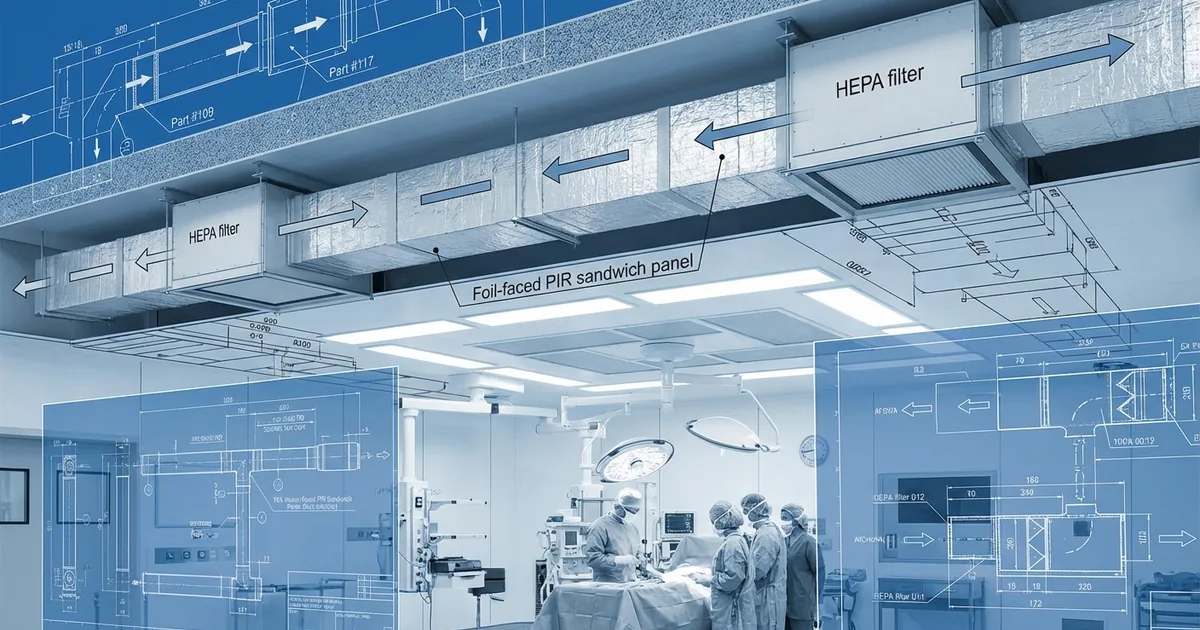
Solution: Pre-Insulated Ducting Panels for Industry
Pre-insulated ducting panels offer a modern solution that addresses all three major problems simultaneously. These panels are made from sandwich panels with a PIR (Polyisocyanurate) insulation core sandwiched between aluminum foil or galvanized steel facing on both sides.
The first advantage is integrated insulation. Unlike conventional ducting that requires separate insulation wrapping, pre-insulated ducting features built-in insulation with low thermal conductivity (0.020-0.024 W/mK for PIR). This eliminates condensation risk because the duct's outer surface stays above the dew point.
The second advantage is superior airtightness. Sandwich panel ducting is fabricated with tight, sealed joint systems that reduce air leakage to below 2%, meeting SMACNA Leakage Class 3 standards. Compared to conventional ducting at 10-25% leakage, this represents significant energy savings.
The third advantage is a smooth, easy-to-clean internal surface. Aluminum foil or stainless steel lining creates a non-porous surface that doesn't support microbial growth. This makes pre-insulated ducting ideal for ISO Class 5-8 cleanroom applications and food processing facilities.
PIR material also has good fire ratings — typically achieving Class 0 or Class 1 per BS 476, with fire resistance up to 2 hours for certain thicker panels. This is important for industrial building safety compliance.
Comparison: Conventional Ducting vs Pre-Insulated Ducting Panel
- Insulation: Conventional needs separate glasswool wrapping (prone to detachment and damage) vs Pre-insulated is factory-integrated
- Air leakage: Conventional 10-25% vs Pre-insulated under 2%
- Installation speed: Conventional requires on-site fabrication plus insulation vs Pre-insulated is assembly-only, 3x faster
- Service life: Conventional 5-10 years with maintenance vs Pre-insulated 15-20 years
- Lifecycle cost: Conventional cheaper upfront but expensive in energy and maintenance vs Pre-insulated better ROI within 3-5 years
- Cleanliness: Conventional difficult to clean internally vs Pre-insulated smooth surface, CIP-friendly
Pre-Insulated Ducting Applications Across Industries
In pharmaceutical cleanrooms, PIR pre-insulated ducting with aluminum foil lining helps maintain ISO 7 or ISO 8 cleanliness classification without risk of particulates from duct material degradation. The smooth internal surface prevents particle accumulation and is easy to clean during validation processes.
In food processing plants, moisture resistance and easy sanitation make pre-insulated ducting superior. There are no glasswool fibers that can escape into production areas — a common problem with conventionally insulated ducting.
For cold storage and cold rooms, pre-insulated ducting maintains cooling efficiency by eliminating thermal bridging. Cold air from evaporators is distributed without significant thermal losses.
In hospitals, particularly operating theaters and isolation rooms, pre-insulated ducting meets strict air pressure and filtration requirements. Superior airtightness prevents cross-contamination between rooms, which is critical for patient safety.
Mistakes to Avoid in HVAC Ducting Installation
First, specifying ducting that doesn't match actual thermal loads. Many projects choose ducting based on lowest price without accounting for pressure drop, optimal air velocity, and insulation requirements. The result is an inefficient system from day one.
Second, neglecting sealing at joints and access panels. Low-quality sealant or uneven application is a primary cause of leakage. Use silicone or polyurethane-based sealant that is compatible with the duct material and resistant to temperature fluctuations.
Third, installing without pressure testing. SMACNA recommends leakage testing to verify the ducting meets the specified leakage class. Many contractors skip this test to save time, but fixing leaks after the system is operational costs far more.
Fourth, failing to provide access panels for routine cleaning and inspection. Ducting should have access doors at strategic points so personnel can perform visual inspections, cleaning, and air parameter measurements periodically.
FAQ
What causes HVAC ducting to leak?
Duct leakage is typically caused by improperly sealed joints, corrosion of galvanized material due to high humidity, mechanical vibration loosening connections, and physical damage. In tropical climates like Indonesia, high humidity accelerates degradation of conventional ducting.
Is pre-insulated ducting more expensive than regular ducting?
The upfront cost of pre-insulated ducting is higher, but total cost of ownership is lower within 3-5 years. This is due to energy savings from integrated insulation, elimination of insulation wrapping costs, faster installation, and longer service life. Typical figures show 20-30% energy savings compared to conventional ducting.
How do you prevent condensation on AC ducting?
Ensure duct insulation has adequate thickness based on internal air temperature and ambient humidity. In Southeast Asia with 70-85% RH, cold air ducts (4-12°C) require insulation of at least 25-50mm glasswool or 20mm PIR panel. Make sure the vapor barrier is installed perfectly without gaps.
What is the service life of pre-insulated ducting?
PIR pre-insulated ducting panels have a service life of 15-20 years under normal conditions, longer than conventional galvanized ducting at 5-10 years. Factors affecting lifespan include chemical exposure, extreme temperature fluctuations, and initial installation quality.
Are sandwich panel ducts suitable for cleanrooms?
Absolutely. Pre-insulated ducting with aluminum foil or stainless steel lining meets ISO 14644 cleanroom cleanliness requirements. The smooth, non-porous internal surface prevents particle accumulation and is easy to clean. These systems are widely used in pharmaceutical, semiconductor, and hospital cleanrooms.
Conclusion
HVAC ducting problems in industrial settings — leakage, condensation, and contamination — are more than technical nuisances. Their impact can be extremely costly: energy waste, product rejection, audit shutdowns, and worker health risks.
Pre-insulated ducting panels based on PIR sandwich panel technology offer a comprehensive solution. With integrated insulation, superior airtightness, and hygienic surfaces, investing in modern ducting delivers long-term operational savings and regulatory peace of mind.
PT. Ruida Grup Indonesia provides pre-insulated ducting panels with customizable specifications for factory, cleanroom, cold storage, and hospital applications. See also our pre-insulated ducting price guide per m2 for cost estimates. Consult our engineering team about your HVAC ducting needs via WhatsApp or the contact form on this page.