

Common Problems with Conventional Factory Walls
Many factories in Indonesia still use concrete, lightweight brick, or corrugated metal walls. These materials are cheap upfront, but serious problems usually surface within the first 3-5 years. Here are the most common issues we encounter during field surveys:
- Cracking and water seepage — Concrete and brick walls are prone to cracking from soil settlement, machine vibration, or extreme temperature changes. Rainwater enters through cracks and damages production equipment.
- Rust and corrosion — Untreated zinc or light steel walls rust within 2-3 years, especially in coastal areas or high-humidity factories.
- Mold and mildew — Moisture trapped in porous walls creates an ideal environment for mold growth — a serious problem for food, pharmaceutical, and electronics factories.
- Poor thermal insulation — Conventional walls lack insulation layers, making production room temperatures difficult to control. AC and electricity costs skyrocket.
- Long construction time — Laying bricks, plastering, smoothing, painting — takes weeks. Production must stop during renovation.
Why Sandwich Panels Are the Best Solution
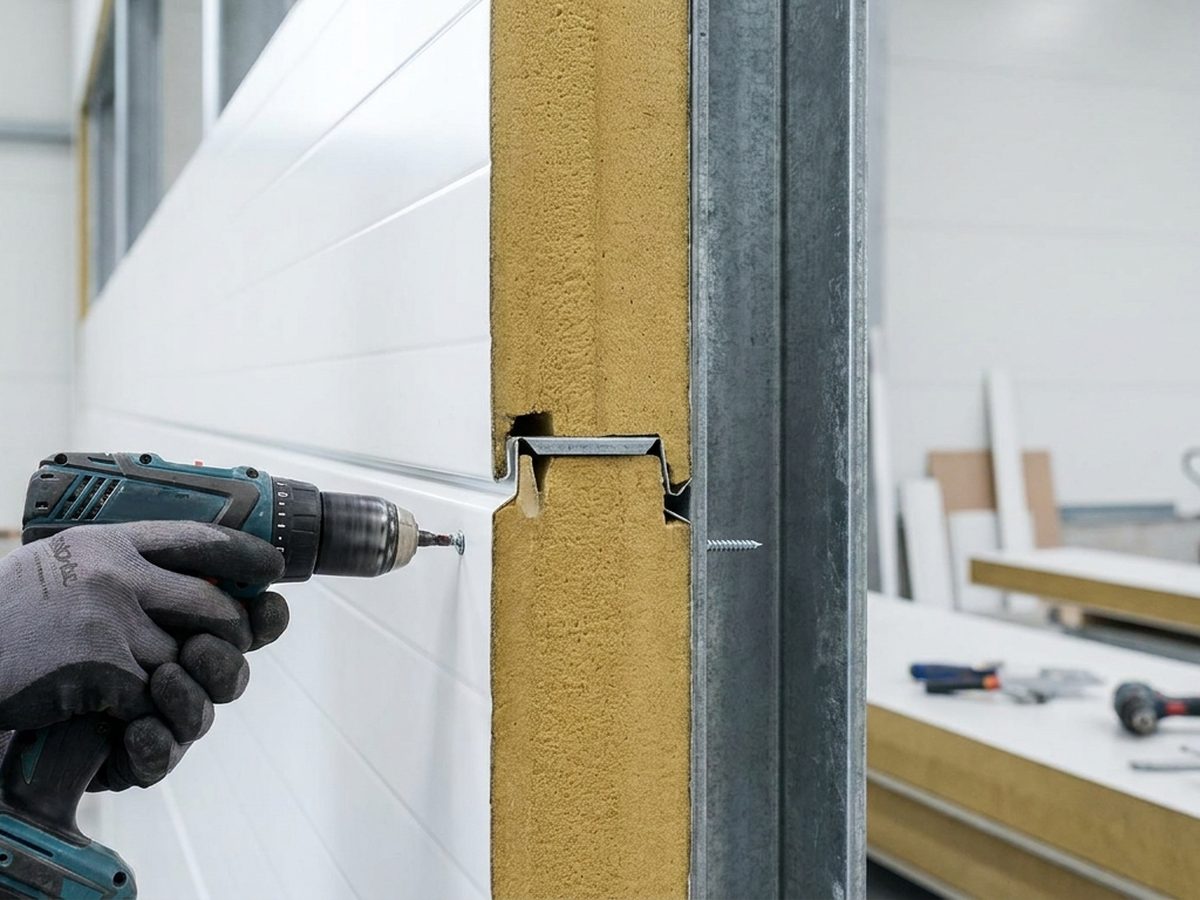
Sandwich panels combine two metal skin layers with an insulation core (EPS, PU, PIR, or rockwool). This structure solves all conventional factory wall problems simultaneously. Here are the key advantages:
- 100% waterproof — No pores, no gaps for water entry. Panel joints use a tongue-and-groove system with tight seals.
- Rust-resistant — Metal skins are coated with galvanized finish and 25-35 micron polyester coating. Suitable for coastal areas and humid environments.
- Anti-mold — Non-porous surfaces cannot support mold growth. Food-grade versions with anti-bacterial coating are available for food and pharma factories.
- Superior thermal insulation — A 50mm PU/PIR core provides insulation equivalent to a 1.5-meter-thick brick wall. Save up to 40% on cooling costs.
- Fast installation — 100m² of wall can be installed in 1 day by 3-4 workers. No plastering, no painting, no curing.
Conventional Walls vs Sandwich Panels: Comparison
The table below shows the critical differences between conventional walls and sandwich panels for factory construction:
| Aspect | Conventional Walls (Brick/Concrete) | Sandwich Panels |
|---|---|---|
| Installation time per 100m² | 7-14 days | 1-2 days |
| Water resistance | Prone to seepage | 100% waterproof |
| Insulation value (R-value, 50mm) | ~0.5 m²K/W | ~1.8 m²K/W (PU) |
| Rust resistance | Depends on waterproofing | Galvanized + polyester coating |
| Weight per m² | 150-250 kg | 10-15 kg |
| 5-year maintenance | Repaint, patch cracks | Surface wash only |
| Earthquake resistance | Prone to structural cracks | Flexible, earthquake-resistant |
From a long-term investment perspective, sandwich panels are far more economical due to near-zero maintenance costs and significant energy savings.
Types of Sandwich Panels for Factory Walls
Not all sandwich panels are the same. Choose based on your factory's specific needs:
- EPS Panels — Economical, suitable for general factories, warehouses, and office partitions. Withstands temperatures up to 80°C. The most affordable option.
- PU/PIR Panels — Best insulation, fire-resistant (PIR), for cold storage, cleanrooms, and pharmaceutical factories. Highest R-value.
- Rockwool Panels — Fire rating up to 2 hours. Mandatory for chemical plants, oil & gas, and high fire-risk areas.
- Food Grade Panels — Anti-bacterial coating, GMP and HACCP compliant. For food, beverage, and pharmaceutical factories.
For general factory walls, our recommendation is 50-75mm EPS Panels or PU Panels if higher insulation is needed. Thickness is adjusted based on wind load and building height.
Signs Your Factory Needs a Wall Upgrade to Sandwich Panels
When is the right time to upgrade? Check for these signs:
- Multiple cracks appearing — Patching one by one is only a temporary fix. Cracks will keep appearing elsewhere.
- AC electricity bills keep rising — Uninsulated walls force AC units to work harder. 50mm PU sandwich panels can cut cooling load by 30-40%.
- Products contaminated by dust or mold — Porous walls release particles. For food/pharma factories, this is an audit failure risk.
- Expansion or relayout plans — Sandwich panels can be dismantled and reassembled. Ideal for factories that frequently change production layouts.
- Existing walls are severely rusted — Rust cannot be reversed. The longer you delay, the larger the area that needs replacement.
Long-Term Cost Comparison
When calculated over a 10-year period, the cost difference between conventional walls and sandwich panels becomes dramatic. Lightweight brick walls require re-waterproofing every 3-5 years, repainting every 2-3 years, and periodic crack repairs. These costs are invisible upfront but accumulate significantly.
Sandwich panels with polyester or PVDF coating require no meaningful maintenance for the first 15-25 years. The AC electricity savings from 50mm PU insulation alone can reach tens of millions of rupiah per year for a mid-sized factory. If you calculate the total cost of ownership (TCO), sandwich panels consistently come out lower — even for small factories.
Additionally, sandwich panels can be dismantled and reinstalled if your factory relocates or needs expansion. This is impossible with conventional walls that must be completely demolished. This flexibility adds long-term investment value that traditional materials simply cannot match.
FAQ
Are sandwich panels more expensive than lightweight bricks?
Sandwich panel material costs are higher upfront. But the 5-year total cost of ownership (TCO) is actually lower due to no plastering, painting, or maintenance costs, plus AC electricity savings. Installation is also much faster.
What is the lifespan of sandwich panels for factory walls?
With standard coating (PVDF or 25-micron polyester), sandwich panels can last 15-25 years. The determining factor is environmental conditions — coastal areas may experience faster wear if coating is inadequate.
Can sandwich panels be installed without a specialist contractor?
The installation system is modular and relatively simple. However, for optimal results and warranty coverage, we recommend experienced installation teams. Imprecise joints can cause leaks.
Can sandwich panels be installed on existing structures without full demolition?
Yes. Sandwich panels can be installed as inner lining in front of existing walls. This is an ideal solution for renovation without stopping production.
What is the long-term maintenance like?
Practically zero maintenance. Simply wash the surface with low-pressure water every 6-12 months to remove dust. No repainting needed. The anti-rust coating protects the metal skin throughout its service life.
Conclusion
Conventional factory walls have too many weak points: cracks, leaks, rust, and energy waste. Sandwich panels solve all these problems in one solution — waterproof, rust-resistant, highly insulated, and installable in days, not weeks.
For factories that want to focus on production without periodic wall repair disruptions, upgrading to sandwich panels is an investment that pays for itself through energy savings and zero maintenance costs. Also read our complete guide to choosing cold room panels to understand panel specifications suited for your industrial building insulation needs. Contact our team for a free consultation and site survey — we'll help calculate your panel requirements and cost estimates based on your factory conditions.