

What Is a ULPA Filter and How Does It Work
ULPA (Ultra-Low Penetration Air) filter is the highest-efficiency air filtration technology commercially available. The EN 1822 standard classifies ULPA as filter classes U15 through U17, with a minimum efficiency of 99.9995% at MPPS (Most Penetrating Particle Size) of 0.12 microns.
ULPA works through the same three mechanisms as HEPA filters: inertial impaction for large particles, direct interception for medium-sized particles, and Brownian diffusion for nano-scale particles. However, ULPA media uses denser and finer fiberglass fibers than HEPA to achieve ultra-class efficiency ratings.
The key difference between ULPA and HEPA lies not just in efficiency numbers but in the particle size range captured. HEPA H14 filters at 0.3 microns with 99.995% efficiency. ULPA goes deeper to 0.12 microns—covering nano-particles, single virus particles, and sub-micron particles from semiconductor etching processes that conventional filters cannot capture.
Because of this extreme filtration capability, ULPA cannot be installed arbitrarily. Its pressure drop is higher than HEPA, requiring HVAC and blower systems specifically designed to handle the greater airflow resistance. Using ULPA without proper system calculations can actually reduce overall cleanroom performance.
Technical Specifications of ULPA Filters
Understanding the following technical parameters is essential before selecting a ULPA filter to avoid specification errors:
- Filtration efficiency: Minimum 99.9995% (U15), 99.99995% (U16), or 99.999995% (U17) at MPPS of 0.12 microns
- Classification standards: EN 1822-1 (Europe), ISO 29463 (international), IEST-RP-CC001 (United States)
- Filter media: Sub-micron fiberglass with high surface area and tight fiber packing
- Nominal pressure drop: 250–500 Pa depending on class; significantly higher than HEPA's 150–200 Pa
- Scan test requirement: Mandatory post-installation per EN 1822 or ISO 29463 to verify integrity of each panel
- Frame material: Aluminum, galvanized steel, or 304/316 stainless steel for corrosive environments
- Seal system: Gel-sealed or gasket-sealed—gel-sealed provides better zero-leakage assurance
Class U15 is sufficient for most sterile pharmaceutical and semiconductor applications. U16 and U17 are used in nanotechnology research facilities and microelectronics manufacturing where sensitivity to sub-0.1 micron particles is critical.
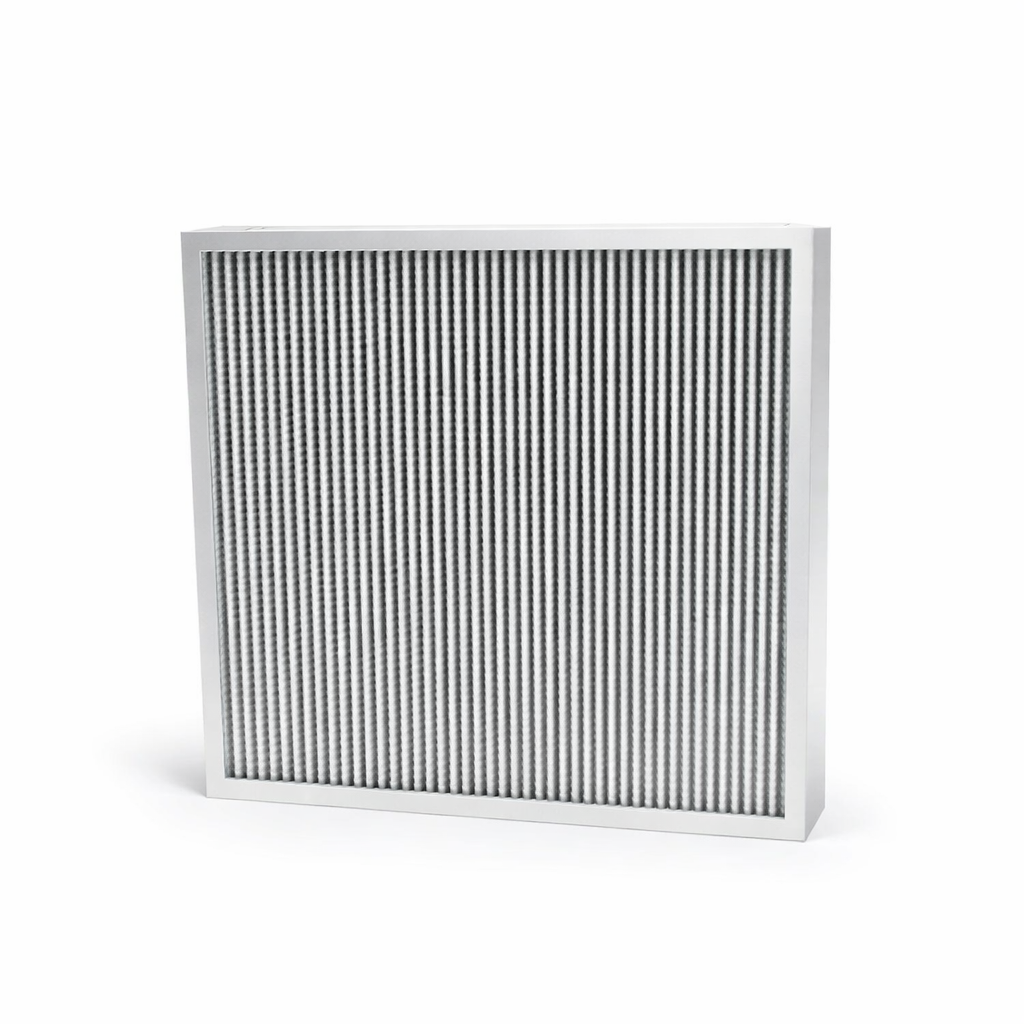
The most commonly available standard dimensions are 610×610mm, 610×1220mm, and 305×610mm. Custom sizes can be ordered with minimum order quantities based on plenum or housing design specifications.
ULPA vs HEPA: Key Differences and When to Choose Each
The most frequent question from cleanroom engineers is: when should ULPA be used, and when is HEPA sufficient? The answer depends on the required ISO cleanroom class and the type of contaminants being targeted for elimination.
Generally, HEPA H13–H14 is adequate for ISO 5 through ISO 8—covering most non-sterile pharmaceutical facilities, GMP food processing, and hospital operating rooms. ULPA becomes mandatory when requirements escalate to ISO 3–4, which applies to active semiconductor fabs, Class A sterile injectable pharmaceutical manufacturing, or BSL-3 laboratories.
| Parameter | HEPA H14 | ULPA U15 | ULPA U17 |
|---|---|---|---|
| Efficiency at MPPS | 99.995% | 99.9995% | 99.999995% |
| MPPS particle size | 0.3 microns | 0.12 microns | 0.12 microns |
| Nominal pressure drop | 150–200 Pa | 250–350 Pa | 400–500 Pa |
| Relative cost per panel | Standard | 2–3× higher | 5–8× higher |
| Target ISO class | ISO 5–8 | ISO 3–5 | ISO 1–3 |
| Primary applications | Pharma, Hospital, Food GMP | Semiconductor, Biotech, Sterile Pharma | Nanotech, MEMS, Advanced Research |
One factor often overlooked: ULPA's higher pressure drop means increased fan workload, higher electricity consumption, and shorter mechanical component lifespan. The principle here is to select based on actual regulatory requirements, not on the assumption that higher is always safer.
Applications of ULPA Filters Across Industries
Several industrial sectors consistently require ULPA filters as part of their air filtration system design:
- Semiconductor manufacturing: Fab areas and IC bonding zones require ISO 3–4 cleanrooms with ULPA as terminal filters. Nano-scale particles below 0.1 microns can damage silicon wafers worth millions of rupiah.
- Class A/B sterile pharmaceuticals: Filling lines, vial packaging, and aseptic areas for injectable drugs and eye drops must comply with EU GMP Annex 1, requiring ISO 5 with strict sub-micron particle control.
- BSL-3 laboratories: Research facilities handling dangerous pathogens such as coronaviruses, tuberculosis, or anthrax require ULPA exhaust filters to ensure outgoing air carries no active biological agents.
- Medical device manufacturing: Production of implants, sterile catheters, and invasive surgical devices requires strict particle control to meet ISO 13485 and FDA 21 CFR requirements.
- Optical and laser industries: Precision lens components and laser assemblies are sensitive to sub-micron particles that can cause microscopic scratches on optical surfaces.
For Pass Box applications requiring ULPA-grade filtration between cleanroom transfer zones, Interlocking Steel Pass Box with ULPA/HEPA filters supports electromagnetic interlock and meets GMP standards.
For facilities needing terminal filter panels in standard aluminum configurations for cleanroom ceiling plenums, HEPA Air Filter Panel 610×610mm is available in H13–H14 classes and can be upgraded to U-class for specific project requirements.
Guide to Selecting the Right ULPA Filter
Proper ULPA filter selection involves several technical evaluation steps that cannot be skipped:
- Establish the ISO cleanroom class: ISO 3–4 requires ULPA; ISO 5–8 is typically adequate with HEPA. Confirm requirements from applicable regulatory standards (EU GMP, USP 797, or local BPOM standards).
- Calculate air change rate (ACPH): Determine room volume and required Air Changes Per Hour to define the number of filter units and flow capacity per panel.
- Identify contaminant type: Biological particles (viruses, bacterial spores) have different specification requirements than inorganic chemical particles or metallic nano-dust.
- Calculate total system pressure drop: Combined pressure drop from pre-filter, medium filter, and ULPA terminal filter must match the fan and blower performance curve.
- Select seal system: For critical cleanrooms (ISO 3–4), gel-sealed ULPA provides more consistent zero-leakage assurance than standard gaskets.
- Verify dimensional compatibility: Frame size must fit precisely with existing housing or plenum boxes to prevent bypass leakage at the edges.
- Plan the scan test: Include PAO/DOP scan test costs and schedule in the project plan as a commissioning requirement.
The most common mistake is selecting ULPA purely based on efficiency numbers without considering HVAC system capacity. If the fan cannot push air through ULPA's pressure drop, the cleanroom will not achieve the required air change rate despite having a superior filter.
Installation and Maintenance of ULPA Filters
ULPA filter installation requires stricter procedures than standard filters. Small mistakes during installation—such as imperfect seals or uneven frame seating—can render a high-cost filter ineffective.
Proper installation steps: clean the housing and plenum of dust before installing a new filter, visually inspect the gel or gasket on the frame, mount the filter with the correct orientation (airflow direction must match the arrow marking on the frame), and apply even tightening at all mounting points.
Post-installation PAO or DOP scan testing is mandatory before the cleanroom is declared operational. The scanner is swept across the downstream face of each filter panel to detect leakage points. Any leak exceeding the standard threshold must be repaired with compatible sealant or the filter unit replaced.
ULPA filter replacement is typically scheduled every 3–5 years, but may be required sooner in environments with high particle loads. Early replacement indicators include: pressure drop increasing more than 20% above design value, or scan results showing leakage in the filter media that cannot be repaired.
FAQ: Frequently Asked Questions About ULPA Filters
Can ULPA filters replace existing HEPA filters in an operating facility?
Physically possible if dimensions are compatible, but a thorough technical review is required first. ULPA has a higher pressure drop than HEPA, so the existing blower may not maintain the required airflow rate. Fan performance re-validation and HVAC system rebalancing are mandatory. Without this review, switching to ULPA can actually reduce actual ACH inside the room.
What is the approximate cost of a ULPA filter per panel (610x610mm) in Indonesia?
Prices vary by class, brand, and purchase volume. For a 610×610mm U15 class panel with aluminum frame, the price range starts from IDR 1,500,000 to IDR 4,000,000 per panel. U17 class can be 4–6 times more expensive due to far stricter manufacturing and quality control requirements. These prices exclude installation and scan test costs.
Are ULPA filters effective against airborne viruses such as COVID-19?
Yes. The SARS-CoV-2 virus measures approximately 0.1 microns—right within the MPPS range handled by ULPA (0.12 microns at 99.9995% efficiency). Even HEPA H14 can capture this virus through Brownian diffusion mechanisms. However, for negative-pressure medical facilities handling infectious patients, ULPA provides a greater safety margin than HEPA alone.
For technical consultation on ULPA filter selection and procurement for your facility, contact our technical team via WhatsApp. We are ready to assist from technical specifications through delivery to your project site.