
The Problem: Can Sandwich Panels Be Curved?
Many contractors assume sandwich panels can only be installed in straight lines. But modern architecture — curved roofs, wavy facades, and radius walls in cold storage — frequently requires bending panels. When panels are forced into curves without proper technique, the results are costly: cracked insulation cores, buckled metal facings, and compromised joint seals. Thermal performance drops sharply, and the panel's service life is cut short.
Baca juga: modular wall panels | sandwich panel types
The reality is: sandwich panels CAN be curved, provided you respect minimum radius rules and apply techniques suited to the core material type. This article walks through the technical steps of sandwich panel curving — from planning to field execution.
Why Curve Sandwich Panels?
Curving serves functional and aesthetic needs across multiple project types:
Artikel terkait: sandwich panel accessories | fire resistant sandwich panels
- Curved roofing: Large warehouses and aircraft hangars use arched roofs for rainwater drainage and reduced wind loads
- Cylindrical cold storage: Silo-style cold rooms need curved panels to maximize internal storage volume
- Architectural facades: Commercial buildings and showrooms seek dynamic wave-like exteriors
- Smooth corner transitions: Cleanroom wall-to-ceiling joints require radius edges to prevent dust accumulation
- Tunnels and canopies: Curved structures for loading bays and material handling zones
Without curving capability, these projects must use more expensive alternative materials or thermally less efficient segmented joint systems.
Key Factors Determining Curving Success
Before bending begins, understand the four critical factors:
1. Core Material Type
Not all cores offer the same flexibility:
- EPS (Expanded Polystyrene): Most rigid, with a large minimum radius (≥20× panel thickness). Prone to snapping if forced. Not recommended for tight curves
- PU / PUR (Polyurethane): Moderately flexible, minimum radius ~15× thickness. Strong adhesion to metal facings helps prevent delamination during bending
- PIR (Polyisocyanurate): Similar to PU but slightly more brittle. Minimum radius 18× thickness. Trade-off: higher fire rating
- Rockwool / Mineral Wool: Cannot be curved — mineral fibers will fracture and lose structural integrity. Use straight panels with segmented joint systems instead
2. Panel Thickness
Thinner panels (50-75 mm) bend more easily than thick ones (100-150 mm). Rule of thumb: minimum radius = panel thickness × material factor. Example: a 50 mm PU panel needs a minimum radius of 750 mm (50 × 15).
3. Metal Facing Profile
Micro-rib or flat profiles curve more easily than deep trapezoidal profiles. Trapezoidal profiles tend to buckle on the compression side during bending. Choose 0.4-0.5 mm steel facings for optimal flexibility; avoid facings thicker than 0.6 mm for tight radii.
4. Panel Length
Panels longer than 6 meters require special handling during curving due to weight and bending moments. Use a rigid radius template and a minimum of 3 workers for panels exceeding 8 meters.
Step-by-Step Curving Technique
Step 1: Prepare the Radius Template
Build a template from plywood or steel hollow sections matching the desired radius. This serves as both a formwork guide and a verification tool throughout the bending process. Ensure the template is rigid and won't deform when the panel is pressed against it.
Step 2: Position the Panel on the Roller Curving Machine
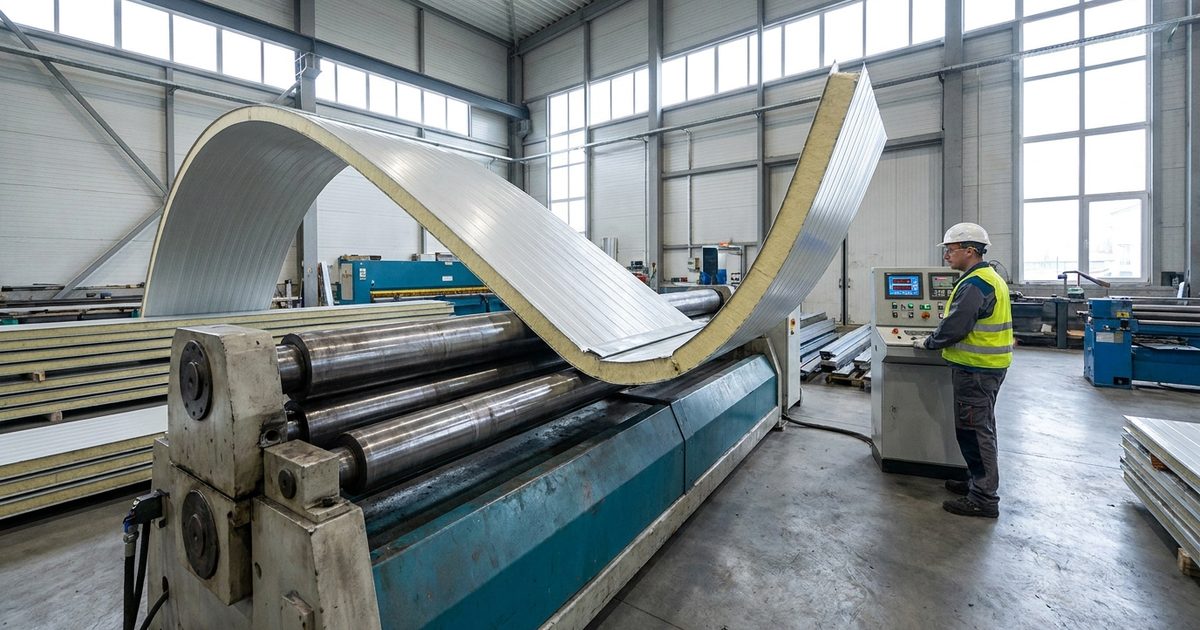
Use a dedicated 3-roll or 4-roll panel bending machine. Set roller spacing according to panel thickness. Feed the panel with the male joint facing the inside of the curve (compression side). This prevents joint gaps after installation.
Step 3: Bend in Gradual Passes
Never bend directly to the final radius in one pass. Use 3-4 passes with incremental curvature increases (~25% per pass). This allows the core material to adapt without cracking. Listen for cracking sounds — if you hear a crack, stop immediately and inspect.
Step 4: Verify Against the Template
After each pass, compare the panel curve with the template. Acceptable tolerance: ±3 mm from target radius. Over-bending cannot be reversed — curving is a one-way plastic deformation process.
Step 5: Cut and Seal Edges
Once the target radius is achieved, trim excess length with a carbide-tipped circular saw. Immediately apply PU sealant to cut edges to prevent moisture ingress into the core. Curved cut panels are more vulnerable to moisture than straight panels.
Step 6: Install with Specialized Fasteners
Curved panels require fasteners with wider EPDM washers and closer spacing (recommended: every 300-400 mm, not the standard 500 mm). At the apex of the curve, add stitching screws to prevent wind uplift lifting.
Common Mistakes to Avoid
Avoid these frequent field errors:
- Forcing radii below the material minimum: Results in core cracking or delamination. Always calculate minimum radius based on material and thickness BEFORE ordering panels
- Using a standard plate bending machine: Plate benders are not designed for composite materials. Rollers must be freely driven to avoid abrading the metal facing
- Ignoring curving direction: Panels must be curved perpendicular to rib direction. Bending parallel to ribs causes immediate buckling
- Skipping pre-heating of PU/PIR panels in cold weather: Below 10°C, PU/PIR becomes more brittle. Store panels at >20°C for at least 24 hours before curving
- Forgetting expansion gaps: Curved panels experience greater thermal expansion. Leave 2-3 mm gaps between panels for accommodation
When Curving Is Not the Right Solution
There are scenarios where curving sandwich panels is not advisable:
- Required radius < 10× panel thickness — use segmented panel arrangement (small straight pieces forming a polygonal curve)
- Rockwool or mineral wool core — use corner joint systems with aluminium flashing
- Panels thicker than 150 mm — consider factory pre-bent panels
- Applications with high structural loads at the curve — add secondary steel support framing
- Environments with extreme freeze-thaw cycles — consult an engineer for fatigue analysis
FAQ
Can all sandwich panel types be curved?
No. EPS, PU, and PIR core panels can be curved within specified radius limits. Rockwool and mineral wool panels cannot be curved because the fiber structure fractures. Always consult your supplier before attempting curving.
What is the minimum radius for a 75 mm PU sandwich panel?
The minimum radius for PU panels is 15× thickness, so for 75 mm = 1,125 mm (about 1.1 meters). For optimal results with a safety margin, use a 1.3-1.5 meter radius.
Does curving affect the panel warranty?
It depends on the manufacturer. Most manufacturers provide official curving guidelines — as long as you follow the recommended minimum radius and method, the warranty remains valid. Keep documentation of the curving process as evidence.
How much extra does curving sandwich panels cost?
Costs vary. On-site curving with a rented roller machine: approximately USD 1.50-3.00 per linear meter, depending on radius and thickness. Factory pre-bent panels: 15-30% premium over standard panel pricing with a 2-4 week lead time.
Can curved panels be installed vertically?
Yes. Vertical curved panels are often used for silo walls or storage tank cladding. Ensure the fastener system and support structure are designed to handle lateral loads per local building codes.
Conclusion
Sandwich panel curving unlocks broader design possibilities for industrial and commercial projects. Success hinges on proper material selection, accurate minimum radius calculations, gradual staged bending, and installation with specialized fasteners. Never force a panel beyond its material limits — the cost of repairing cracked or delaminated panels far exceeds the cost of proper curving.
Need technical consultation for your curved sandwich panel project? The engineering team at sandwichpanels.id is ready to assist — from material planning to installation supervision. Contact us via WhatsApp or the contact form for a free discussion.
Need Technical Help with Sandwich Panel Curving?
Consult our engineering team for free — get material recommendations, optimal radius, and cost estimates.
💬 Free Consultation via WhatsApp📞 +62 811-9898-835 | ✉️ sales@sandwichpanels.id