

Factory Ventilation Problems — Why It Matters
Factories without adequate ventilation face three serious challenges: uncontrolled indoor temperatures, accumulation of airborne pollutants, and excessive humidity. All three directly impact worker productivity, product quality, and equipment lifespan. In tropical climates like Indonesia where year-round heat is the norm, this problem is especially acute in factories with metal roofing that directly absorbs solar radiation.
Research shows that workplace temperatures above 32°C (90°F) can reduce productivity by up to 30%. Worse still, the buildup of dust, smoke, and chemical fumes in production areas can trigger serious occupational health issues including respiratory diseases.
A properly designed factory ventilation system — using a combination of sandwich panels for thermal insulation and HVAC ducting for air distribution — is the primary solution every manufacturing facility needs.
Components of an Effective Factory Ventilation System
Industrial ventilation is more than just mounting exhaust fans on walls. The key components that must work together include:
- Industrial exhaust fans — removing hot air and pollutants from indoor spaces
- Supply fans / blowers — introducing fresh outdoor air
- HVAC ducting — distributing air evenly across all production areas
- Wall & roof insulation (sandwich panels) — reducing external heat load
- Air filters (pre-filter & medium filter) — capturing particulates from incoming air
- Dampers & louvers — controlling airflow direction and volume
Without proper wall insulation, exhaust fans must work harder against solar heat radiation penetrating through walls and roofs. That's why sandwich panels are a critical component of factory ventilation strategy.
The Role of Sandwich Panels in Factory Ventilation
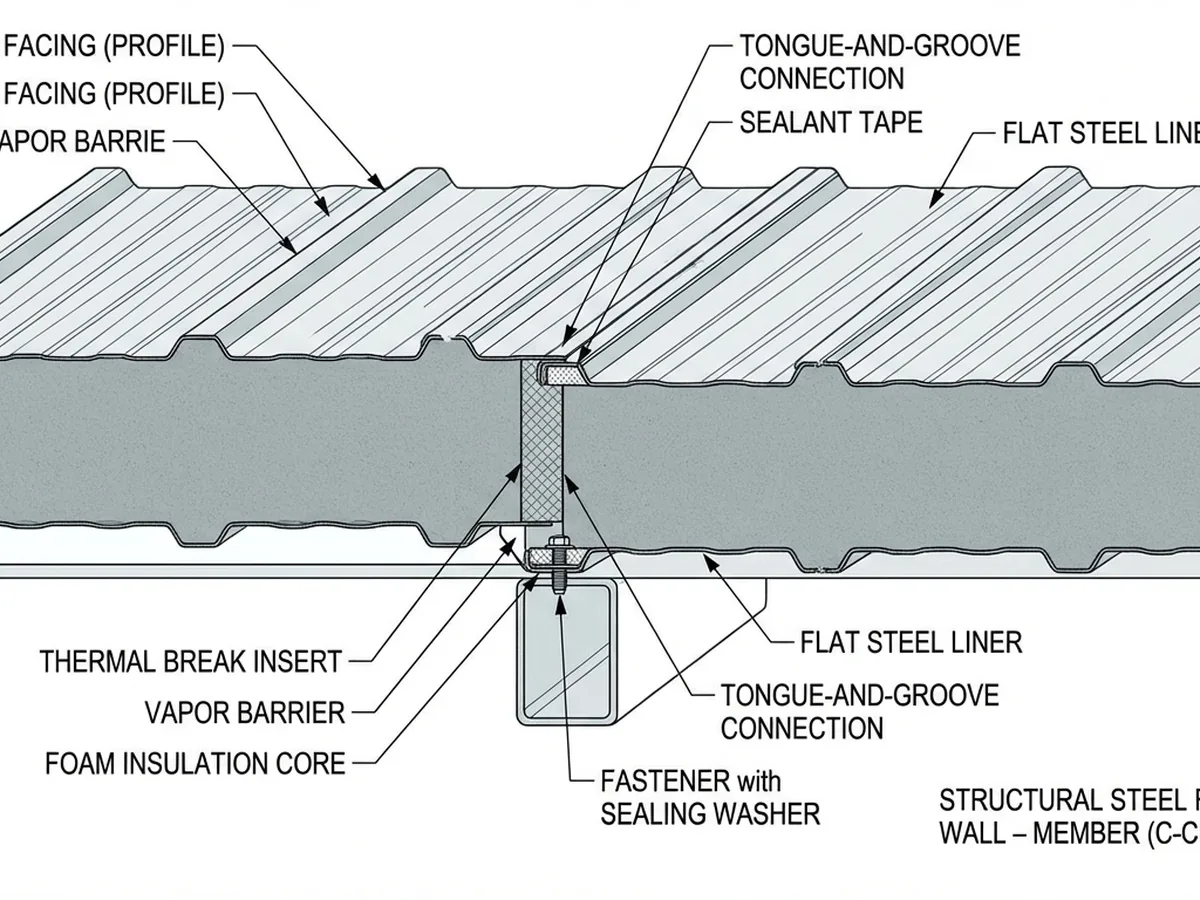
Sandwich panels — particularly PIR (Polyisocyanurate) and rockwool types — serve as a thermal insulation layer that significantly reduces heat transfer from the external environment into the factory. With thermal conductivity values as low as 0.022 W/mK, PIR panels can lower cooling loads by up to 40%.
Key benefits of sandwich panels for factory ventilation include:
- Reduced exhaust fan load — more stable internal temperatures mean fans don't need to run at maximum capacity continuously
- More efficient air distribution — insulated walls eliminate thermal hotspots that disrupt airflow patterns
- Condensation prevention — extreme temperature differences between inside and outside cause moisture buildup on uninsulated walls
- Better air cleanliness — smooth sandwich panel surfaces are easy to clean and don't accumulate dust like brick walls. For environments requiring strict contamination control, see our cleanroom solutions.
HVAC Ducting for Industrial Air Distribution
Ducting is the backbone of any air distribution system. For factory environments, material choice significantly affects system efficiency and durability.
- Pre-insulated ducting (PIR/Phenolic): Most energy-efficient solution with integrated insulation. Ideal for factories requiring temperature control, such as pharmaceutical or electronics manufacturing.
- Galvanized steel ducting: Durable and robust for general applications. Requires additional external insulation for thermal efficiency.
- Fabric ducting (textile duct): Even air distribution without drafts. Ideal for food factories as it's easily washable.
Duct sizing must be based on CFM (Cubic Feet per Minute) calculations for the specific space, not rough estimates. Incorrect sizing is the primary cause of uneven ventilation.
Exhaust Fans & Air Circulation: Calculating Your Factory's Needs
Ventilation capacity is measured in ACH (Air Changes per Hour) — how many times the entire room air volume is replaced within one hour. The general standard for manufacturing plants is 6-10 ACH, while areas with high pollutant levels (welding, painting) require 10-20 ACH.
Basic calculation formula:
- Calculate room volume: length × width × height (cubic meters)
- Determine ACH based on activity type
- Fan capacity (m³/h) = volume × ACH
- Add 20% safety factor to compensate for pressure loss in ducting
Example: Factory 20m × 30m × 6m = 3,600 m³. Target 8 ACH. Required fan capacity = 3,600 × 8 × 1.2 = 34,560 m³/h. This can be achieved with 4 exhaust fans, each with ~9,000 m³/h capacity.
Factory Ventilation Standards & Regulations in Indonesia
Key regulations governing workplace ventilation in Indonesia:
- Permenaker No. 5 of 2018 — Occupational Safety and Health for Work Environments, regulating temperature, humidity, and air velocity thresholds
- SNI 03-6572-2001 — procedures for designing ventilation and air conditioning systems in buildings
- Kepmenkes No. 1405 of 2002 — health requirements for office and industrial work environments, including indoor air quality standards
Compliance isn't just about legality — it's a long-term investment in productivity and worker health. Companies that neglect ventilation risk facing administrative sanctions from labor authorities, including operational shutdowns until corrective measures are implemented.
Checklist: 7 Steps to Optimize Your Factory Ventilation
- Audit existing conditions — measure temperature, humidity, and air velocity at multiple points throughout the factory
- Calculate heat load — identify heat sources from machinery, roof radiation, and worker occupancy
- Evaluate wall & roof insulation — if walls aren't using sandwich panels, calculate potential savings
- Define target ACH — adjust based on industry type and specific activities
- Design ducting layout — ensure even distribution with static pressure calculations
- Select exhaust & supply fans — specify according to calculated capacity
- Phased implementation + monitoring — install temperature and CO₂ sensors to track effectiveness. Conduct biannual evaluations to adjust the system as factory layout changes or new machinery is added.
FAQ: Common Factory Ventilation Questions
What does a factory ventilation system cost?
Costs vary by factory size and system complexity. For a 500-1,000 m² factory, estimates range from USD 10,000-25,000 including ducting, exhaust fans, and controls. Sandwich panels for walls are a separate investment calculated per square meter.
Can I use natural ventilation without exhaust fans?
Natural ventilation (windows, roof ventilators) may suffice for small factories with light activity. However, factories with heat-generating machinery, chemical processes, or high dust levels require mechanical ventilation as mandated by workplace safety regulations.
What is the lifespan of factory HVAC ducting?
Quality galvanized steel ducting can last 15-20 years with regular maintenance. Pre-insulated PIR ducting has a 10-15 year lifespan. Annual inspection and cleaning are strongly recommended to maintain efficiency.
Can sandwich panels be installed in an existing factory?
Yes, sandwich panels can be installed as retrofits on existing walls or as new internal partitions. Installation is relatively fast — a 500 m² factory typically completes within 1-2 weeks without halting production operations.
Need a factory ventilation consultation? Our team is ready to assist with audits, design, and complete installation. Get a free quote within 24 hours.
Contact Us via WhatsApp