
The Laminar Air Flow (LAF) cabinet is the backbone of pharmaceutical quality control and microbiology labs. It delivers ISO Class 5 clean air in a unidirectional, turbulence-free stream to protect samples and products. But when an LAF starts failing, the consequences go beyond downtime—contaminated pharmaceutical batches, ruined research samples, and major audit findings that can halt your production license.
In Indonesia, emergency LAF repairs can cost IDR 8-25 million per incident, not counting the cost of discarded production batches. The good news: most LAF problems show early warning signs and can be fixed before they escalate. This guide covers the 7 most common LAF issues faced by Indonesian labs and pharma facilities, with practical causes, symptoms, and solutions.
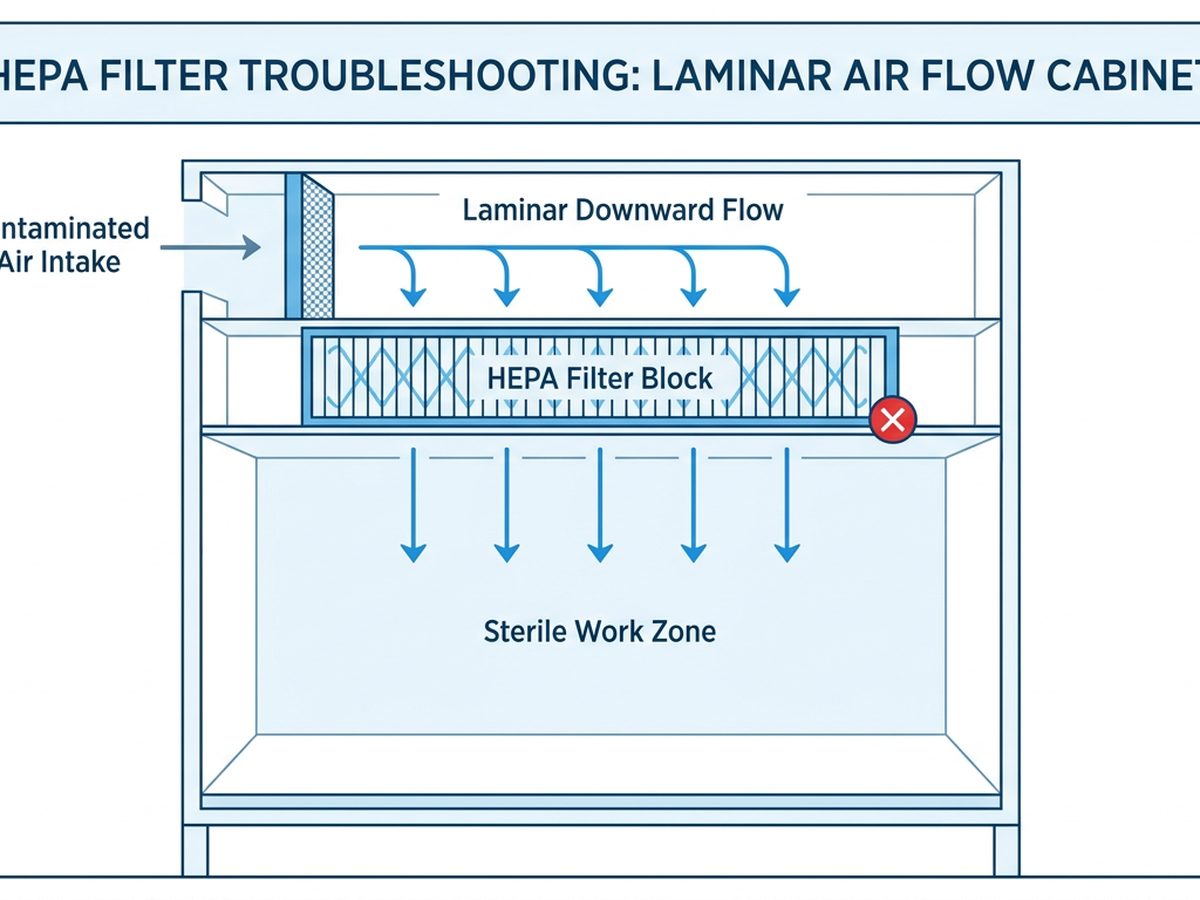
1. Clogged HEPA Filter — Drastic Airflow Drop
This is the single most common LAF problem. The HEPA filter captures particles down to 0.3 microns with 99.97% efficiency. Over time, contaminants accumulate and airflow begins to drop. The clearest early sign: your airflow velocity meter reads below the original specification—typically 0.45 m/s ± 20% for most LAF units.
Causes include neglected pre-filter replacement, a dusty lab environment, or a HEPA filter past its recommended service life—typically 2-3 years under normal operation. Left unchecked, an overloaded filter can tear, releasing trapped particles back into the sterile zone. Solution: replace pre-filters every 3-6 months, schedule HEPA replacement based on operational hours rather than calendar dates, and document velocity trends for early detection. Also read: HEPA Filter Replacement Schedule.
2. Blower Motor Issues — Abnormal Vibration and Noise
The blower motor drives the entire airflow system. Common failure symptoms: unusual humming or grinding noise, excessive cabinet vibration, and fluctuating airflow with no clear pattern. The most frequent root cause is worn bearings, impeller imbalance, or dust buildup on fan blades causing unbalanced load.
One often-overlooked detail: blower motors with non-sealed bearings require periodic lubrication. A dry motor runs hot and eventually burns out. For LAF units in 24/7 pharmaceutical environments, schedule motor inspections every 6 months. Replace the motor if current draw exceeds 20% above nameplate rating—that's a clear overload signal.
3. Seal Gasket Leaks — External Contamination Enters
The rubber gaskets around the HEPA filter housing and access panels are your last line of defense against contamination. Hardened, cracked, or loose seals let unfiltered air enter the work zone. Detect leaks with a simple smoke test: hold a smoke pen near the seals while the LAF is running. If smoke is drawn into the work zone, you have a leak.
Common causes: material aging (rubber becomes brittle after 2-3 years), chemical exposure during cleaning, or uneven filter installation. Solution: use silicone or food-grade neoprene seals, run smoke tests every 6 months, and always inspect seals after HEPA filter replacement.
4. UV Lamp Failure or Ineffectiveness — Incomplete Sterilization
The UV-C lamp sterilizes the work surface before and after use. Problems often go unnoticed: the lamp still glows but UV-C output has dropped dramatically after 6,000-8,000 operational hours. Without a UV intensity meter, you're relying on a visible glow that no longer kills microorganisms effectively.
Track UV lamp operational hours, replace every 6,000 hours or 12 months (whichever comes first), and validate with biological indicators—spore strip tests—at least annually. A lamp that glows is not necessarily a lamp that sterilizes.
5. Dirty Pre-Filter — HEPA Load Increases Rapidly
The pre-filter (coarse filter) is your first stage of particulate removal before air reaches the blower and HEPA. A clogged pre-filter forces coarse particles to the HEPA stage, shortening HEPA life dramatically while increasing motor power consumption and reducing airflow.
In Indonesia's humid environment, a dirty pre-filter also becomes a breeding ground for mold and bacteria. Replace pre-filters every 3 months under normal conditions, or more frequently in high-dust environments. A pre-filter costs roughly $3-10—far cheaper than premature HEPA replacement at $200-500.
6. Irregular Airflow Calibration & Validation — Failed Compliance Audits
LAF units in pharmaceutical and laboratory facilities must undergo periodic calibration and validation per GMP/GLP requirements. Classic compliance failures: airflow velocity calibration overdue, particle count validation expired, or certificates missing when auditors arrive.
Indonesia's BPOM and Ministry of Health are increasingly strict on facility inspections. An unvalidated LAF can lead to production suspension or marketing authorization delays. Minimum standard: airflow velocity calibration every 6 months, particle count testing every 6-12 months (ISO 14644 Class 5 for LAF work zones), and keep all certificates in an easily accessible file.
7. Improper Initial Installation — Cross-Contamination from Day One
Many LAF problems trace back to installation errors. Wrong positioning—too close to doors, facing air conditioning vents, or in high-traffic corridors—creates turbulence and cross-contamination from day one. LAF units also need a minimum 30 cm clearance from the rear wall for proper air intake.
Other installation mistakes: incorrectly connected exhaust ducting (for ducted LAF models), uneven cabinet leveling that disrupts laminar flow, and electrical connections that don't match motor specifications. Before purchasing an LAF, insist on a site survey and commissioning report from the vendor. Never accept handover until airflow velocity testing is completed on-site.
Maintenance Mistakes to Avoid
- Using aggressive chemicals for cleaning: Certain alcohols and disinfectants can damage seal gaskets and cabinet coatings. Use only manufacturer-recommended cleaning agents.
- Replacing HEPA filters without turning off the blower: This can cause loose particles from the old filter to enter the ducting. Always power down before replacement.
- Neglecting the operational logbook: Without recorded operating hours, you lose track of filter and UV lamp replacement schedules.
- Running LAF 24/7 without inspection: Even though LAFs are designed for continuous operation, weekly visual checks are mandatory.
FAQ
How often should LAF HEPA filters be replaced?
Typically every 2-3 years for normal 8-12 hour/day operation, or sooner if differential pressure exceeds 2x the initial reading. Monitor pressure gauge and airflow velocity weekly.
What are early signs of HEPA filter failure?
The earliest indicators: airflow velocity declining despite normal motor and pre-filter condition, rising pressure drop on the gauge, and increasing particle counts in the work zone during validation testing.
Is a UV lamp that still glows still effective?
No. UV-C output drops significantly after 6,000-8,000 hours even if the lamp still glows. Use a UV intensity meter or schedule preventive replacement.
What are average LAF repair costs in Indonesia?
HEPA filter replacement: IDR 3-8 million. Blower motor replacement: IDR 4-12 million. Full routine service (pre-filter, calibration, validation): IDR 2-5 million per visit. Costs vary by LAF brand and size.
Can in-house technicians service an LAF?
Surface cleaning and pre-filter replacement can be done in-house. However, HEPA replacement, airflow calibration, and particle count validation must be performed by certified technicians to maintain cleanroom integrity.
Conclusion
Unaddressed LAF problems create a domino effect—product contamination, failed compliance audits, and financial losses from discarded production batches. The key is early detection through routine monitoring: track weekly airflow velocity, HEPA pressure drop, UV lamp hours, and stick to your preventive maintenance schedule.
Need technical assistance with LAF troubleshooting at your facility? Our certified technicians provide inspection, calibration, and validation services compliant with ISO 14644 and GMP standards. Learn how to choose the right LAF before investing. Contact us today for a free consultation—we'll help ensure your LAF operates at peak performance and stays audit-ready.