

Why Conventional Factory Construction Falls Short
When planning a new factory, most business owners default to conventional methods — brick, concrete, or lightweight steel. But this approach brings three core problems: lengthy construction timelines (6-12 months), high labor costs, and poor thermal insulation without additional layers. In fast-moving markets, factory construction delays translate directly into lost production opportunities and revenue.
Industry data shows that construction timeline is one of the most critical factors determining new factory investment feasibility in Indonesia. Every month of delay can cost tens to hundreds of millions of rupiah in deferred production output.
A proven modern alternative: sandwich panels — a prefabricated wall and roof system that combines thermal insulation, lightweight structure, and rapid installation in a single product.
What Are Sandwich Panels and How Do They Work
Sandwich panels are composite construction materials consisting of two outer layers (typically galvanized steel or aluminum) with an insulating core in between — EPS (expanded polystyrene), PIR/PUR (polyurethane), or rockwool. This structure creates wall and roof panels that combine structural, thermal, and finishing functions in one component.
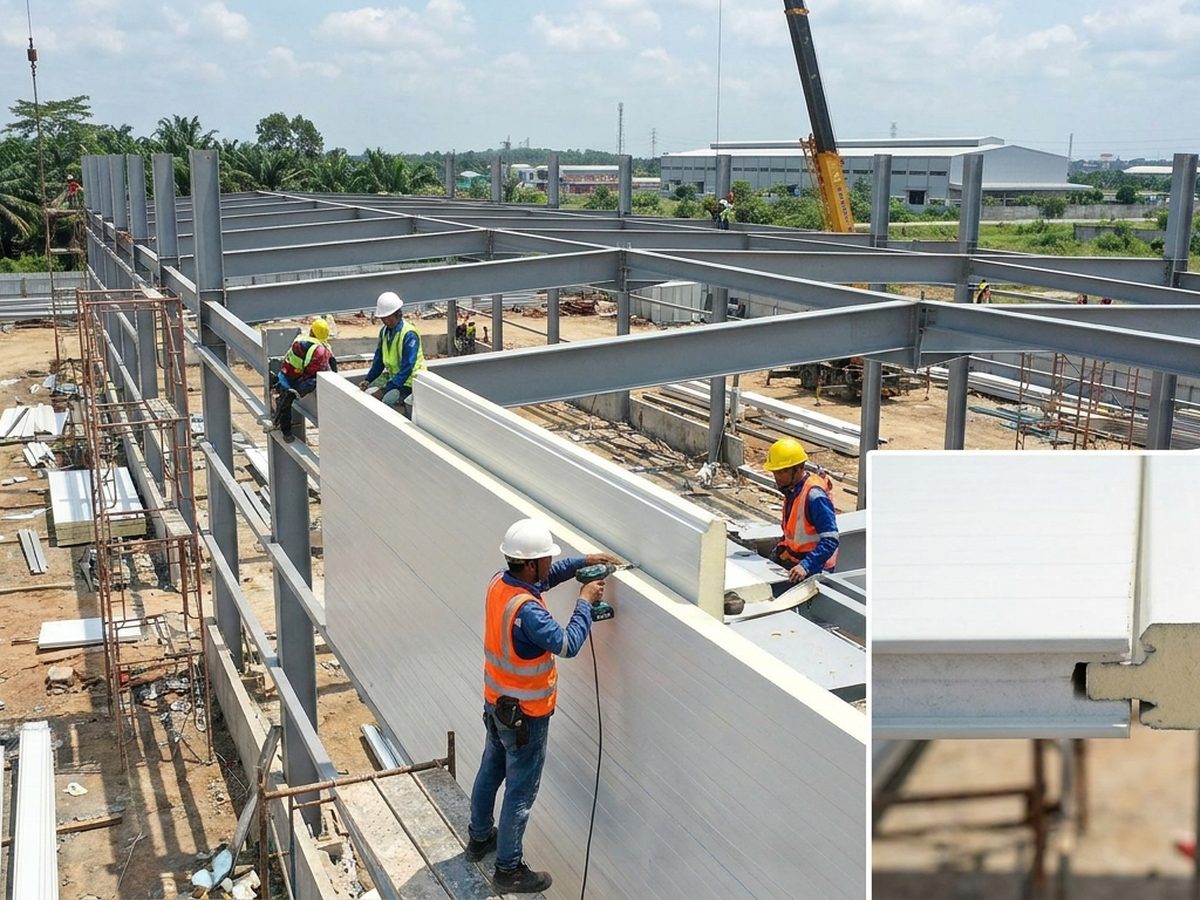
The working principle is straightforward: panels are factory-manufactured to precise dimensions, transported to the project site, and installed using a tongue-and-groove joint system. No plastering, painting, or additional insulation layers are needed — the wall is ready for use as soon as it is installed.
7 Key Benefits of Sandwich Panels for Factory Construction
1. Up to 3x Faster Construction Time
Factory construction using sandwich panels can be completed in 2-4 months, compared to 6-12 months with conventional methods. Panels are prefabricated off-site and only require on-site assembly. For a 1,000 m² factory, wall installation using sandwich panels can be finished in 2-3 weeks — versus 2-3 months for brick walls including finishing work.
2. Lower Total Construction Costs
While the per-square-meter material cost of sandwich panels may be higher than brick, total construction costs are actually lower due to:
- Labor savings: a team of 5-6 workers is sufficient for installation, versus 15-20 for brick construction
- No additional plastering, rendering, painting, or wall finishing costs
- Reduced foundation structural requirements due to significantly lighter panel weight
- Minimal on-site material waste
Overall, business owners can save 15-25% on total structure construction costs.
3. Superior Thermal Insulation — Lower Cooling Costs
The insulating core of sandwich panels provides exceptionally low thermal conductivity. A 50mm-thick PIR panel offers insulation equivalent to a 1.5-meter-thick brick wall. For factories requiring temperature control — such as food processing, pharmaceutical, or electronics manufacturing — this translates to significant AC electricity savings of up to 30-40% per year.
4. Lightweight Structure — More Economical Foundations
Sandwich panels weigh only 10-14 kg/m², compared to brick walls at approximately 250 kg/m². This dramatically reduced weight allows for simpler and more economical foundation designs. For factories on soft soil conditions, this is a decisive technical advantage.
5. Faster Time-to-Operation
Sandwich panel walls require no curing or drying time like concrete and plaster. Once panels are installed, the factory can move directly to machine installation and utility setup. No waiting for walls to dry — your factory can begin operations within days of completing the main structure.
6. Built-In Flexibility for Future Expansion
Growing businesses need expanding spaces. Sandwich panels enable rapid factory expansion thanks to their modular system. Panels can be dismantled, relocated, or added without damaging the existing structure. This flexibility is something permanent brick construction cannot offer — simply extend the steel frame and install new panels.
7. Fire, Water, and Weather Resistance
Modern sandwich panels come with various core options to match requirements. Rockwool panels offer fire ratings of up to 2 hours, ideal for factories with elevated fire risks. PIR panels resist moisture and do not absorb water like brick walls. Tight joint systems prevent rainwater leakage and dust infiltration, keeping the production environment clean.
Types of Sandwich Panels Suitable for Factories
- EPS Panel: Cost-effective, suitable for general warehouses and factories without special temperature requirements
- PIR/PUR Panel: Superior insulation, ideal for food factories, cold storage, and temperature-controlled production areas
- Rockwool Panel: High fire resistance, ideal for chemical plants, high-heat manufacturing, or areas requiring strict fire ratings
- Food Grade Panel: Hygienic surfaces with food safety certification, mandatory for food and beverage factories
Common Mistakes When Choosing Sandwich Panels
- Choosing based on the lowest price: Low-quality panels may warp or delaminate within 2-3 years, leading to costlier repairs
- Ignoring local climate conditions: Factories in coastal areas need extra anti-corrosion coating on steel layers
- Not considering future expansion needs: Choose a modular system that allows for easy additions down the road
- Selecting the wrong insulation thickness: Production areas with high heat loads need adequate panel thickness — consult an experienced supplier
Frequently Asked Questions (FAQ)
What does factory construction with sandwich panels cost per square meter?
Costs vary depending on panel type, thickness, and area. As a reference, for a standard factory using 50mm EPS panels, estimated material + installation costs range from IDR 350,000 to 550,000 per m² (installed). This price includes the supporting steel frame structure. Contact our team for a project-specific cost calculation.
How long do sandwich panels last in factory buildings?
Quality sandwich panels have a service life of 25-30 years with minimal maintenance. Galvanized steel layers with PVDF coating provide corrosion and UV protection. PIR and rockwool panels offer good dimensional stability and will not shrink over time like organic materials.
Are sandwich panels safe for factories with fire risks?
Yes. Choose rockwool-core panels (Class A fire rating, up to 2 hours) or PIR panels with FM Approved certification for applications requiring high fire resistance. Ensure fire rating specifications comply with industrial building regulations and applicable insurance standards.
Can sandwich panels be used for existing factory renovations?
Absolutely. Sandwich panels are frequently used to upgrade aging factory walls — installed as external cladding over existing walls or as a complete replacement. The renovation process is faster and causes minimal disruption to ongoing factory operations.
Conclusion
Sandwich panels offer a combination that is hard to beat for modern factory construction: fast, cost-effective, energy-efficient, and flexible. For business owners aiming to maximize ROI on factory investments, choosing sandwich panels as the primary building material is a strategic decision with direct impact on operational speed and long-term cost efficiency.
PT. Ruida Grup Indonesia supplies various types of sandwich panels for factory construction — from economical EPS panels to fire-rated rockwool panels. Contact our team for a free consultation and cost estimate tailored to your factory project requirements.