
Paper and board converting plants are still expanding in Indonesia. PT Hoi Fu Paper Packaging broke ground in Kendal Special Economic Zone on 2 May 2026 with roughly Rp1.12 trillion of investment and plans to hire up to 1,000 workers, about 95% of them from nearby communities. Every expansion of that kind ends at one technical question: what kind of wall protects board quality.
Bank Indonesia's PMI-BI index for paper, paper goods and printing reached its highest reading of 57.27% in the first quarter of 2026, then slowed to 50.53% in the second. Above 50 still means expansion, if a thin one. Kemenperin reports first-half 2026 exports of US$1.68 billion in pulp and US$2.35 billion in paper.
Humidity, not an ugly wall, is what erodes board
A packaging plant's money is not in a tidy wall, it is in stacking strength. Board moisture content rises with room relative humidity and compression strength falls with it. Gary A. Brown's thesis at Clemson University records that moisture rise as a second-order polynomial, with fibre weakening becoming readable above roughly 30% RH.
The International Safe Transit Association stresses the part most specifications miss: board strength depends on the moisture content of the board, not directly on ambient humidity. So what walls, joints and warehouse layout actually control is not the ECT value of the board but how fast the board takes up water from the surrounding air.
Industry sources put 32 ECT board at its nominal value around 7-8% moisture content, down to 85-90% of nominal at 12-13%, and losing more than half above 16%. Converters usually condition board to 8-10% before shipping. Those are industry practice figures, not the text of a standard.
The humidity numbers themselves conflict between suppliers: one quotes about 68% of nominal strength at 80% RH and 48% at 90% RH, another reports a 50-60% loss at 90% RH. Do not use them as design values; only the direction is consistent. Vendor guidance also estimates a 20-30% creep loss over 30 days of loaded storage, measured through ECT and TAPPI T804 for BCT.
ISO 187 is a test atmosphere, not a warehouse RH target
ISO 187:2022 sets the standard atmosphere for conditioning and testing paper, board and pulps at (23 ± 1) °C and (50 ± 2)% RH. Four hours of conditioning is usually enough where air circulation is good, while some materials need 48 hours or more. A 24-hour preconditioning step at 10-35% RH is optional.
This is where specifications go astray. Those 23 °C and 50% RH figures are conditions for testing samples, not an obligation for a production room or a warehouse, and no standard fixes the RH of a paper warehouse. A supplier writing them as a room specification is moving a laboratory number to the wrong place. Your quality team sets the target; the wall is then chosen to hold it.
Plant zones and the panel thickness used
Our line stops at 150 mm for every core. The U-values below are design estimates calculated to ISO 6946, not test data; manufacturer declared values use EN 14509.
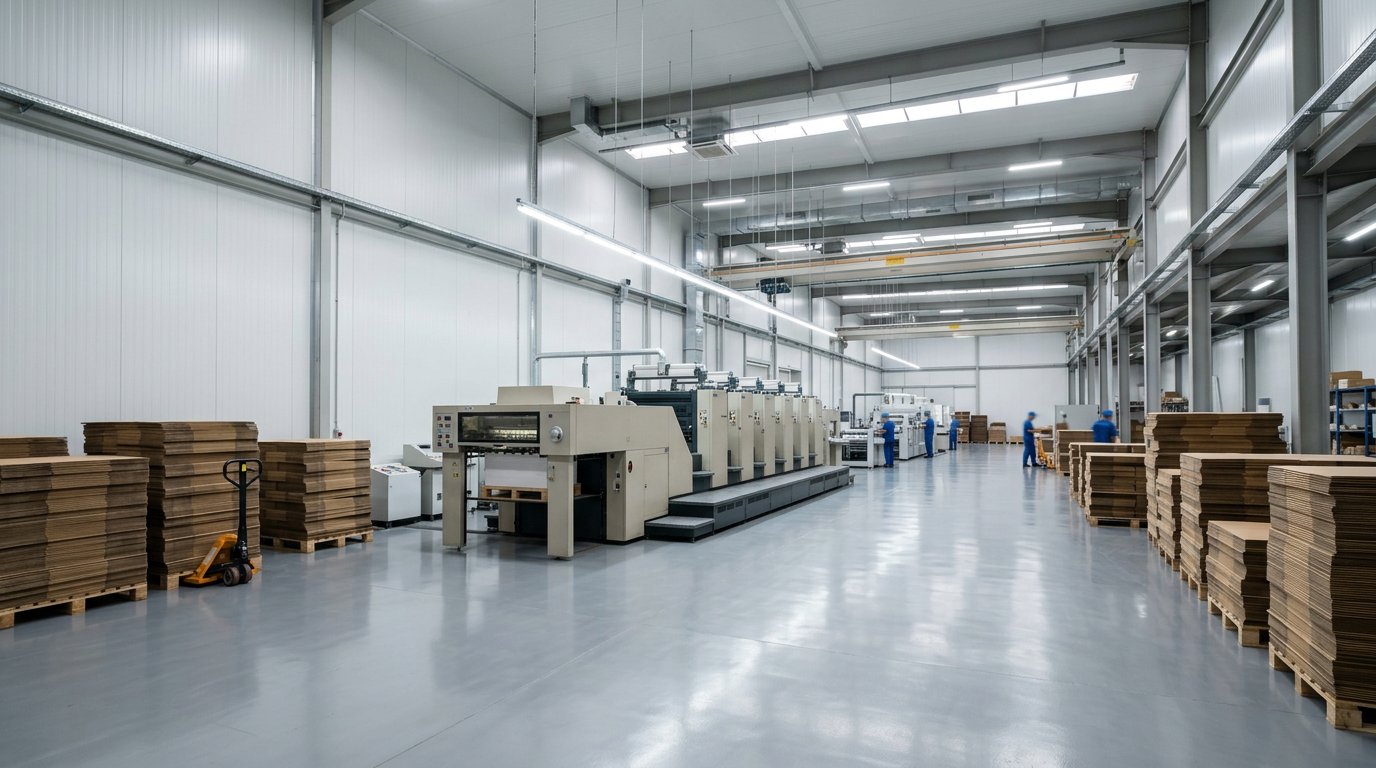
- Reel and finished carton storage: EPS partitions 50-75 mm, estimated U 0.63-0.43 W/m2K, there to separate zones and hold back outside air.
- Air-conditioned pressroom: EPS or PIR 75-100 mm. PIR at 100 mm is about 0.23 W/m2K, since its conductivity runs 0.022-0.026 W/mK.
- Humidity-controlled ink and substrate stores: PIR 100 mm, tight joints and doors that stay shut.
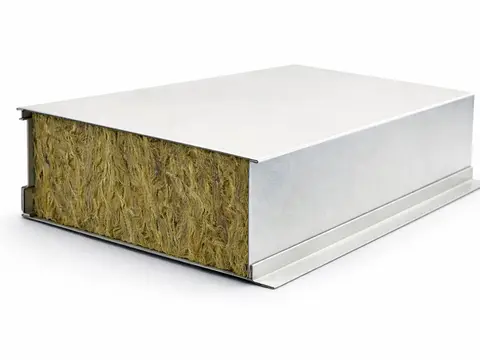
- Fire risk separation: rockwool 100-150 mm; indicative EI 60 from 80 mm and EI 120 from 120 mm, with exact ratings taken from assembly test reports.
Pressroom: dust, register and PVC cable
Print register and ink behaviour shift as sheets take up or give off water, so pressrooms are usually conditioned more tightly than stores. Panel walls help through flat surfaces that wipe clean, a low number of joints, and a skin that does not hold paper dust the way unsealed masonry does.
One detail is easy to miss in a cable-dense room: PVC-sheathed cable must not be in direct contact with polystyrene, because phthalate plasticiser can migrate, as set out in AS/NZS 3000:2018 clause 3.3.2.5. With EPS-core panels, run cable in conduit or tray rather than buried against the core.
PerBPOM 11/2026 governs materials, not walls
PerBPOM 11/2026 on food packaging took effect on 30 June 2026, replacing PerBPOM 20/2019. It covers packaging materials including paper and board, migration limits, permitted and prohibited food contact substances, and reusable and recycled packaging. New food contact substances need a scientific safety assessment to obtain written approval from the Head of BPOM.
It is worth saying plainly: that regulation never mentions walls, panels or buildings. So refuse any claim that a panel complies with PerBPOM 11/2026. What is true is that food contact packaging calls for clean, separated zones, and general food practice under CPPOB in Permenperin 75/2010 is the usual reference for that zoning.
Market price ranges, November 2026 survey
There is no official public price list for sandwich panels, and the spread between sources is very wide. The figures below come from a survey of public price lists on 14 November 2026, per m2, and have to be read together with their status.
- EPS material only: 50 mm Rp210,000-430,000; 75 mm Rp250,000-320,000 from a single source; 100 mm Rp290,000-575,000.
- PU or PIR material: Rp350,000-600,000. Rockwool material: Rp400,000-700,000.
- Standard wall installation: Rp65,000-95,000 on our own price page, Rp60,000-120,000 in the survey.
- One source estimates a 5-15% rise against the previous year, dated May 2026.
Do not mix material prices with installed prices in one table; the basis differs. Core choice is not only about price either, and the full comparison sits in EPS vs PU vs rockwool.
Outside the scope of our panel line
Our line is wall panels, partitions and ceilings. Roof panels are not sold.
Packaging plant rooms and stores are almost always built inside a building whose roof already stands, so what is bought really is the walls, partitions and ceilings.
FAQ: Frequently asked questions
What RH does a standard require for a paper warehouse?
No standard fixes the RH of a paper warehouse. ISO 187:2022 only sets a 23 °C and 50% RH atmosphere for conditioning and testing samples in a laboratory. The room target comes from your quality team and your product tolerance, and walls, joints and air handling are then chosen to hold it.
Which panel core suits board storage and a pressroom?
For zone separation and unconditioned stores, EPS at 50-75 mm is usually enough. Pressrooms and ink stores held to tighter conditions are better served by PIR at 75-100 mm, since its conductivity is lower. For fire risk separation, use rockwool at 100-150 mm.
Request a quotation for your plant
Every packaging plant has different zones, humidity targets and schedules, so panel thickness and core are best fixed after the layout has been read. Send us your zone drawings and requirements, discuss them with us, and request a quotation through our contact page.