

What Are Curved Sandwich Panels?
Curved sandwich panels are specially formed sandwich panels designed for arched roofs or walls with curved architectural designs. Unlike standard flat sandwich panels, these panels have a specific curvature radius that enables the construction of barrel vault roofs, domes, and other curved structures. Curved sandwich panels have become a popular solution for modern buildings that prioritize both aesthetics and energy efficiency. For a broader understanding, read our complete sandwich panel guide.
The manufacturing process of curved sandwich panels involves bending insulated sandwich panels (EPS, PIR, PUR, or Rockwool core) using specialized curving machines. The result is a panel with smooth curvature without damaging the insulation core structure. Curved panels are widely used in stadiums, airports, shopping centers, and industrial facilities requiring large spans without additional supporting columns.
Types of Curved Sandwich Panels
There are several types of curved sandwich panels based on core material and curvature shape:
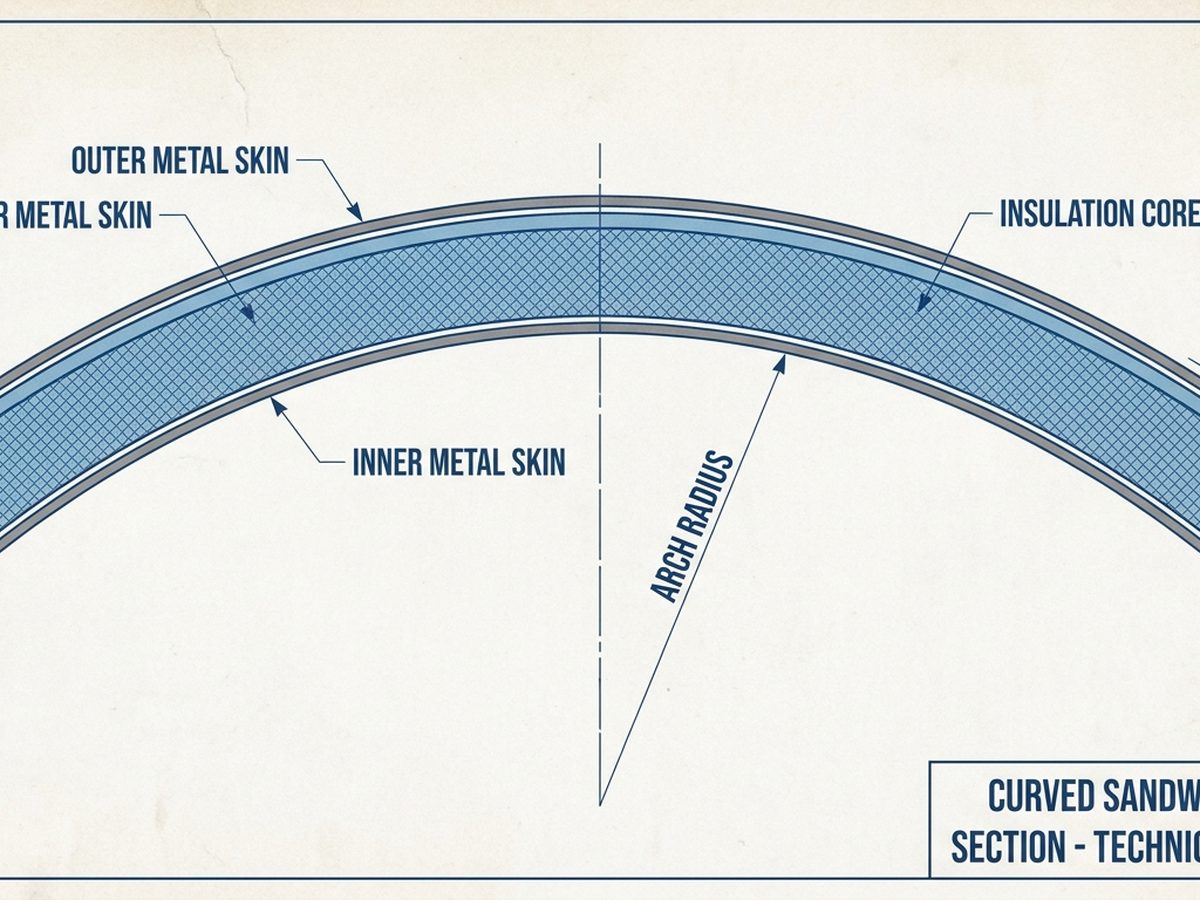
- PIR Curving Panel — Panel with Polyisocyanurate core that is fire-resistant and offers high thermal insulation. Suitable for buildings requiring high fire ratings.
- PUR Curving Panel — Panel with Polyurethane core offering excellent insulation properties, commonly used for curved cold storage designs.
- EPS Curving Panel — Panel with Expanded Polystyrene core, more economical, suitable for applications with moderate insulation requirements.
- Rockwool Curving Panel — Panel with rockwool core offering the highest fire rating, ideal for buildings with strict fire safety standards.
Based on curvature shape, curved panels are divided into:
- Barrel Vault — Half-circle or less curve, resembling a tunnel.
- Dome — Full curvature forming a dome shape.
- Conic/Curved Trapezoidal — Curvature with varying radius for more complex designs.
Key Technical Specifications
When selecting curved sandwich panels, consider these technical specifications:
- Curvature Radius — Smaller radius makes bending more difficult. Minimum radius varies depending on panel thickness and core type.
- Panel Thickness — Typically 50mm to 150mm for standard applications. Thicker panels require larger curvature radius.
- Metal Skin Thickness — Usually 0.5mm to 0.8mm for both outer and inner sides. Thicker skin provides better structural strength.
- Coating — PVDF, Polyester, or SMP coating options determine weather and corrosion resistance.
- Fire Rating — PIR and Rockwool have higher fire ratings compared to EPS.
- Core Density — Core density affects the bending strength of curved panels. PIR/PUR typically 38-45 kg/m³, Rockwool 100-150 kg/m³.
Advantages of Curved Sandwich Panels
Using curved sandwich panels provides several significant benefits:
- Architectural Aesthetics — Curved designs create a modern and dynamic building appearance. Perfect for landmarks and public facilities.
- Wide Span Without Columns — Curved structures can span up to 30 meters without supporting columns, optimizing interior space.
- Optimal Thermal Insulation — The insulation core in curved panels remains intact, maintaining thermal performance equal to flat panels.
- Fast Installation — Curved panels are manufactured to shape, reducing on-site bending work.
- Weather Resistance — Curved design reduces rainwater accumulation and improves natural drainage.
- Low Maintenance Cost — Durable coating and strong structure minimize maintenance needs.
Applications of Curved Sandwich Panels
Curved panels are widely used in various building types:
- Stadiums and Sports Arenas — Curved roofs for grandstand covers with wide spans.
- Airports and Terminals — Iconic roof structures with high aesthetics and optimal shelter function.
- Shopping Centers — Atriums with glass roofs and curved panels for natural lighting.
- Warehouses and Industrial Facilities — Aircraft hangars, logistics warehouses, and large production facilities.
- Cold Storage — Cold rooms with curved design for better air circulation.
- Places of Worship — Mosques, churches, and temples with domes or curved roofs.
Factors Affecting Price
The price of curved sandwich panels is influenced by several factors:
- Core Material Type — PIR and Rockwool are more expensive than EPS due to higher fire ratings and insulation performance.
- Radius Complexity — Small radius requires more precise bending processes, increasing production costs.
- Panel Thickness — Thicker panels require more material and slower production processes.
- Coating Type — Premium coatings like PVDF increase price but provide better durability.
- Order Volume — Large orders typically receive more competitive pricing.
- Delivery Location — Logistics costs vary based on distance from factory to project site.
As an estimate, curved sandwich panel prices range from IDR 180,000 to IDR 400,000 per square meter, depending on complete specifications.
How to Choose the Right Curved Panel
To select curved sandwich panels suitable for your project, consider these steps:
- Determine Structural Requirements — Calculate the required span and load the roof will bear.
- Choose Core Material — Match with thermal insulation needs and project fire rating requirements.
- Consult on Radius — Discuss with manufacturers about minimum radius that can be produced for desired panel specifications.
- Select Coating — Consider environmental conditions (near coast, industrial area) to choose appropriate coating.
- Request Sample — Ask for panel samples to verify quality before large orders.
- Compare Quotes — Get quotes from multiple suppliers for best pricing and service.
Frequently Asked Questions (FAQ)
Can all sandwich panel types be curved?
Not all. EPS core panels are easier to bend compared to PIR or Rockwool. However, modern technology allows bending of almost all panel types with appropriate radius.
What is the minimum radius for curved sandwich panels?
Minimum radius varies. For 50mm thick PIR panels, minimum radius is around 3-5 meters. Thicker panels require larger radius. Consult with manufacturers for specific details.
Are curved panels more expensive than flat panels?
Yes, the bending process adds production costs. However, savings on supporting structure and faster installation can offset the price difference.
How long does curved panel production take?
Production time depends on volume and complexity. For standard projects, production typically takes 2-4 weeks after final specifications are approved.
Are curved panels suitable for high-wind areas?
Yes, the aerodynamic design of curved panels actually reduces wind pressure on buildings compared to flat roofs. Ensure structural calculations account for local wind loads.
Consultation and Quote
Need curved sandwich panels for your project? Contact the SandwichPanels.id team for free consultation. We help you select the right specifications, calculate material requirements, and provide competitive quotes. Click the WhatsApp button below or visit our contact page.
SandwichPanels.id is a trusted sandwich panel distributor and installer in Indonesia with over 10 years of experience serving industrial, commercial, and infrastructure projects.