

Factory walls that have stood for 10 to 20 years often show serious deterioration: hairline cracks spreading across the surface, water seepage during heavy rainfall, and production floor temperatures that refuse to stabilize. For factory owners in Indonesia, these aren't just cosmetic problems — leaking, uninsulated walls can inflate cooling electricity bills by up to 30% and create unsafe working conditions for employees. See also our sandwich panel catalog for full specifications.
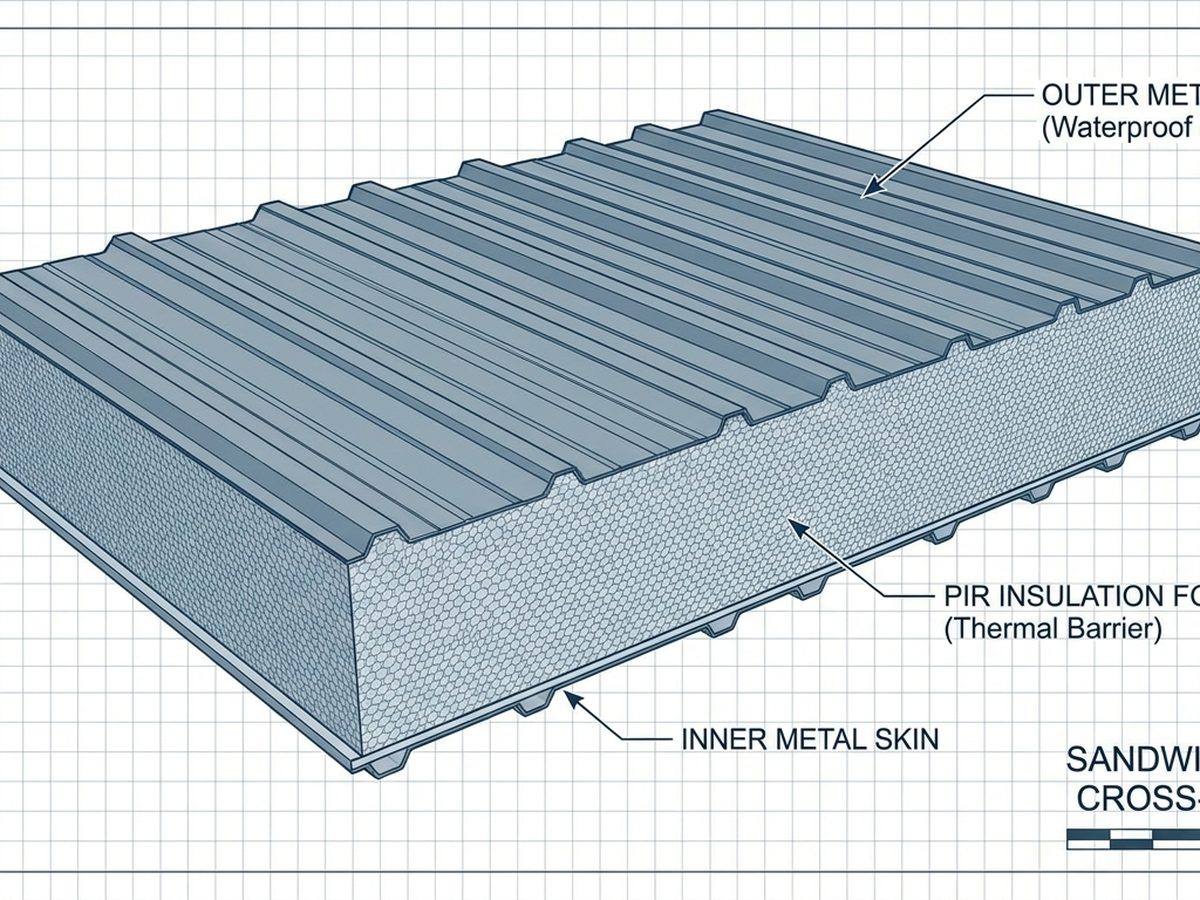
Renovating old factory walls with sandwich panels has become an increasingly popular solution due to fast installation, superior thermal insulation performance, and long-term durability. This article covers when it's time to upgrade, the renovation steps, and ROI calculations to help you make an informed decision.
When Do Factory Walls Need Renovation?
Not every old factory wall needs immediate replacement. However, certain indicators signal that renovation can no longer be delayed:
- Structural cracks — cracks wider than 2 mm that continue to widen, especially around column and beam joints, indicate structural movement requiring attention.
- Recurring water seepage — water stains and mold that reappear after waterproofing repairs suggest the wall has lost its integrity.
- Significant electricity bill increases — if your AC or cooling system works harder than usual without changes in production load, wall insulation has likely degraded substantially.
- Uncontrolled room temperature drift — production areas meant to stay at 24–26°C spike to 30°C+ during daytime hours.
- Walls older than 15 years — even if visually intact, conventional brick and concrete materials begin experiencing thermal degradation after 15 years in tropical climates.
Root Causes of Factory Wall Damage in Indonesia
Understanding the underlying problems helps you select the right renovation solution and prevent recurring damage:
- Extreme tropical temperature fluctuations — day-night temperature differences (up to 10°C in industrial zones) cause expansion-contraction cycles in wall materials, triggering micro-cracks.
- High humidity and heavy rainfall — Indonesia averages 2,500 mm of annual rainfall, continuously stressing exterior waterproofing.
- Production machinery vibration — factories with heavy equipment generate constant vibration that accelerates joint and plaster degradation.
- Low initial construction quality — many factories were built to standards that did not account for long-term thermal and mechanical loads.
- Steel frame corrosion — in coastal or chemical-environment areas, steel frames inside walls can rust and lose strength without visible external signs.
Why Sandwich Panels are the Best Renovation Solution
Sandwich panels consist of two metal skins (typically steel or aluminum) with an insulation core between them (EPS, PUR, or PIR). For factory wall renovation, these panels offer several advantages over conventional methods:
- Superior thermal insulation — a 50 mm PIR sandwich panel achieves a U-value of 0.40 W/m²K, far better than a 150 mm brick wall (U-value ~2.5 W/m²K). This translates to significant cooling energy savings.
- 3–5x faster installation — renovating 500 m² of factory walls with sandwich panels can be completed in 5–7 days, compared to 3–4 weeks with conventional brick.
- Minimal structural load — sandwich panels weigh 10–15 kg/m² versus brick walls at 250 kg/m², avoiding additional stress on aging existing foundations.
- Waterproof and mold-resistant — metal surfaces with PVDF coating absorb no water and provide no medium for mold growth.
- Industry-standard fire rating — PIR panels achieve fire ratings up to B1 (flame-retardant) per international standards.
- Design flexibility — available in various colors and profiles, and can be installed vertically or horizontally to accommodate existing structures.
Renovation Steps: Old Factory Walls to Sandwich Panels
The factory wall renovation process follows these stages:
- Structural audit — inspect existing steel or concrete frames to ensure they can support the new panels. Repair any structural damage before proceeding.
- Surface cleaning and preparation — remove loose plaster, clean rust from steel frames, and apply anti-corrosion treatment to the substrate.
- Secondary frame installation (if needed) — horizontal or vertical steel girts are installed as mounting points for sandwich panels on the existing structure.
- Sandwich panel installation — panels are installed bottom-to-top or from corners, using a tongue-and-groove system that interlocks panels. Apply butyl sealant at every joint for complete waterproofing.
- Accessory finishing — flashing at corners, wall-roof intersections, door and window openings is installed to ensure no gaps remain.
- Quality check — water leakage testing, thermal bridging inspection with a thermal camera, and final visual inspection.
Renovation Cost Estimates
Renovation costs for factory walls with sandwich panels vary based on core material (EPS/PUR/PIR), panel thickness, and existing structural conditions. Here are rough estimates for a 500 m² area:
- EPS sandwich panel 50 mm: IDR 250,000–350,000/m² (including accessories)
- PUR sandwich panel 50 mm: IDR 350,000–450,000/m²
- PIR sandwich panel 50 mm: IDR 450,000–600,000/m² (for cold storage or areas with high fire rating requirements)
- Secondary framing + installation labor: IDR 150,000–250,000/m²
- Old wall demolition (if needed): IDR 50,000–100,000/m²
Total estimated renovation cost for 500 m² with PIR panels: IDR 300–425 million. However, this should be viewed as an investment — monthly energy savings can reach IDR 8–15 million for factories with active cooling systems.
Renovation ROI: When Does the Investment Pay Back?
ROI calculation for factory wall renovation with sandwich panels:
- AC electricity savings: average 25–35% reduction in monthly bills. For a factory with IDR 30 million/month electricity bills, savings of approximately IDR 7.5–10.5 million/month.
- Reduced maintenance costs: sandwich panel walls don't need repainting every 2–3 years (saving IDR 15–25 million per cycle).
- Productivity improvement: stable working temperatures (24–26°C) versus uncontrolled highs (30°C+) increase worker output by 5–10% according to thermal productivity studies.
- Property value: factories with modern wall systems command higher valuations for lease or sale.
With conservative assumptions, renovation capital is recovered within 18–30 months, after which you enjoy net savings every month.
Mistakes to Avoid During Renovation
- Skipping the structural audit — installing new panels on weakened frames only delays collapse. Always conduct a structural inspection first.
- Choosing the cheapest material without considering application — EPS is adequate for non-thermal partitions, but for production areas requiring temperature control, PUR or PIR is the minimum choice.
- Neglecting joint waterproofing — panel joints are the weakest point. Low-quality sealant will leak within 1–2 years.
- Not providing adequate ventilation — sandwich panels are extremely airtight. Without proper mechanical ventilation, internal humidity can rise and cause condensation.
- Using contractors without panel installation experience — sandwich panel installation requires different techniques from conventional construction. Minor alignment errors can cause systemic leakage.
FAQ: Factory Wall Renovation with Sandwich Panels
Can sandwich panels be installed directly over existing brick walls?
Yes, sandwich panels can be installed as cladding over existing brick walls using a secondary frame system (sub-frame). However, severely deteriorated brick walls should be demolished first to avoid future collapse risks. Consult with a contractor to determine the best option based on your structural conditions.
How long does renovation take for a 1,000 m² factory?
For 1,000 m² of wall area, sandwich panel renovation typically takes 7–14 working days, depending on existing structural complexity and the number of openings (doors, windows, vents). By comparison, conventional brick renovation would take 4–6 weeks for the same area.
Do I need to halt factory operations during renovation?
Not necessarily. Exterior wall renovation with sandwich panels can be done in stages (one side at a time) without stopping internal production operations. However, the area being renovated must be barricaded for worker safety. For interior renovation, the affected section should be temporarily vacated (2–3 days per section).
How do sandwich panels perform during earthquakes?
Sandwich panels have a lightweight profile (10–15 kg/m²) that is highly advantageous in seismic contexts. Inertial loads during earthquakes are far lower than with massive brick walls, reducing collapse risk. The panels also have slight flexibility that helps absorb vibration. Proper structural connections to the main building frame remain essential.
Is there special maintenance required after renovation?
Sandwich panel maintenance is relatively minimal. Simply clean surfaces with low-pressure water every 6–12 months to remove industrial dust. Inspect joint sealant every 2 years and replace if signs of degradation appear. Panels with quality PVDF coating can last 15–20 years without repainting.
Conclusion
Renovating old factory walls with sandwich panels is an investment that delivers tangible operational savings — from electricity bills dropping 25–35% to near-zero maintenance costs for 15+ years. With fast installation and minimal operational disruption, this solution suits factory owners looking to boost efficiency without halting production.
If your factory walls are showing the damage signs described above, don't wait until the deterioration worsens. Contact our team for a free consultation and site survey — we'll help you plan a renovation that fits your budget and operational needs.