

What Is a Modular Operating Theatre?
A Modular Operating Theatre (MOT) is a prefabricated surgical suite system designed to meet the highest sterility and safety standards in hospital environments. Unlike conventional operating rooms built with wet construction methods, an MOT uses sandwich panels, hermetic doors, and dedicated cleanroom HVAC systems assembled in a modular configuration.
The advantages of MOTs include fast installation, superior contamination control, and the ability to meet international standards — but these benefits only apply when the installation complies with regulations and obtains proper certification from Indonesian health authorities.
Indonesian Ministry of Health (Kemenkes) Regulations for MOT
The Indonesian Ministry of Health sets forth several regulations that every healthcare facility operating an MOT must comply with. These regulations cover room design, technical specifications, HVAC systems, and operational procedures.
Minister of Health Regulation No. 24 of 2025 on Surgical Facilities
The latest ministerial regulation specifically governs modular operating theatre requirements. Key compliance points include:
- Operating room classification based on sterility level: Class A (ultra-clean) for orthopedic surgery and transplants, Class B (clean) for general surgery, and Class C (semi-clean) for minor procedures.
- Positive air pressure of at least 15 Pa to prevent contaminant infiltration from surrounding areas.
- HEPA H14 filtration system with 99.995% efficiency for 0.3-micron particles — mandatory for Class A and B.
- Air change per hour (ACH) minimum 20 ACH for general OR and 25-30 ACH for ultra-clean OR.
SNI and ISO Standards for MOT
In addition to Kemenkes regulations, MOTs in Indonesia must comply with national and international standards:
- SNI ISO 14644-1:2024 — Cleanroom cleanliness classification by particle concentration. Class A MOT must achieve at minimum ISO Class 5 (equivalent to the old Class 100).
- SNI ISO 14644-3:2024 — Cleanroom test methods including filter leak testing, airflow, and recovery time.
- SNI ISO 14644-4:2024 — Guidelines for cleanroom design, construction, and start-up.
MOT Certification Process in Indonesia
MOT certification is not a single step — it is a series of tests and validations performed in stages. Here is the certification workflow:
Stage 1: Design Qualification (DQ)
The initial stage where MOT design documents are verified against regulatory requirements. Experts evaluate wall panel specifications, HVAC systems, hermetic doors, and room layout.
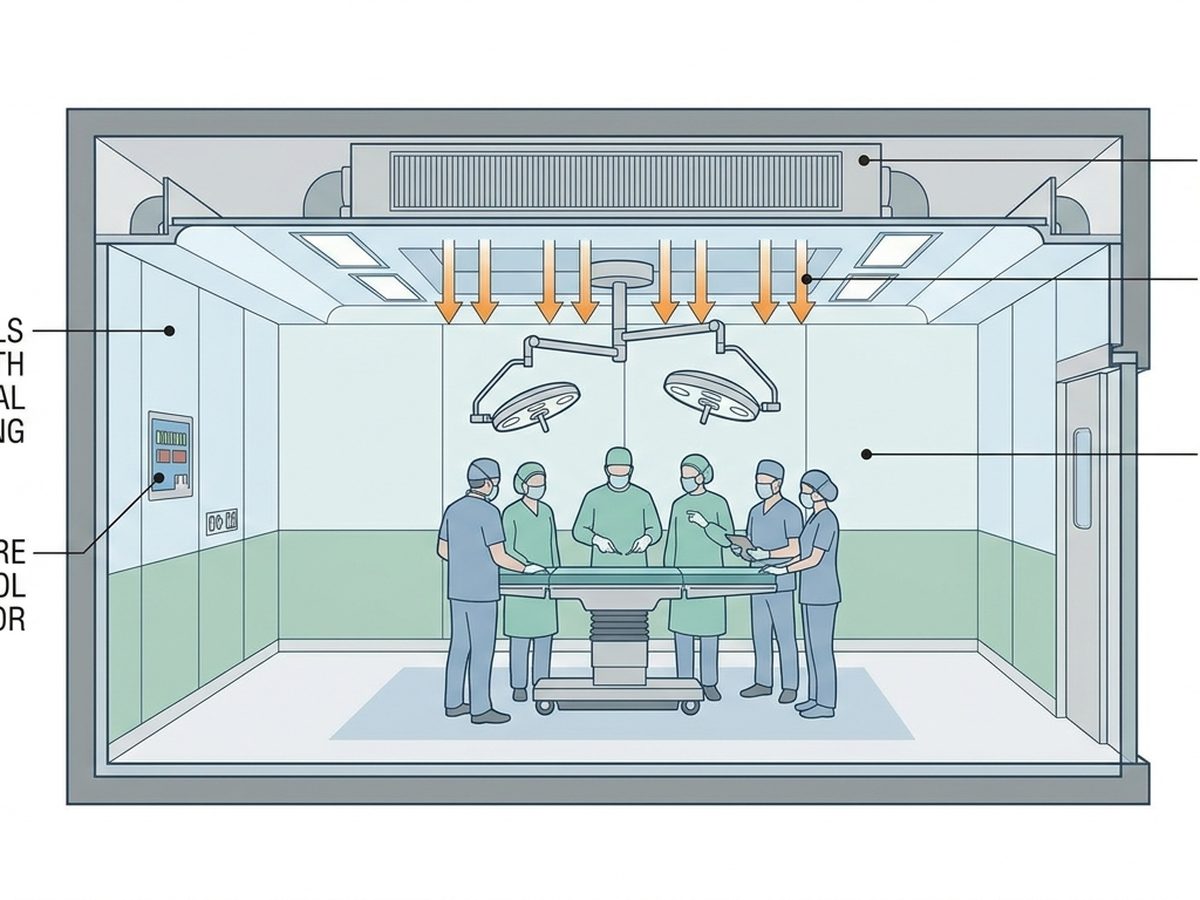
Required documents:
- Shop drawings with detailed dimensions and materials
- Technical specifications of all components
- HVAC load calculations and airflow patterns
- Material and personnel flow diagrams
Stage 2: Installation Qualification (IQ)
Verification that MOT installation matches approved design specifications. Inspectors will check:
- Sandwich panel joint integrity (no gaps or leaks)
- Hermetic door installation (seals, interlocks, sensors)
- HVAC system and ducting installation per design
- Control and monitoring systems (temperature, humidity, pressure)
Stage 3: Operational Qualification (OQ)
Testing MOT systems under operational conditions to ensure all parameters function within specified limits:
- HEPA filter leak test (DOP / PAO test)
- Airflow velocity test — minimum 0.45 m/s for laminar ceiling
- Differential pressure test between rooms
- Recovery time test — time needed for the room to return to clean state after contamination
- Noise test (maximum 45 dBA for Class A)
- Lighting test (minimum 1000 lux at the surgical area)
Stage 4: Performance Qualification (PQ)
Testing under real operational conditions to validate that the MOT maintains sterile conditions during procedures:
- Microbial monitoring (settle plates and active air sampling)
- Particulate count monitoring during simulated procedures
- Cleaning and disinfection protocol validation
- 72-hour continuous operation endurance test
Required Documents and Licenses
After completing all qualification stages, the hospital must submit the following documents to relevant authorities:
- Certificate of Operational Fitness from Kemenkes — must be renewed every 2 years
- IQ/OQ/PQ reports signed by certified inspectors
- Calibration certificates for all measurement instruments (pressure gauge, particle counter, airflow meter)
- HEPA filter certificates from the manufacturer with complete traceability
- Hospital Operational License that includes MOT facilities
- Staff training documentation on MOT operational procedures
Penalties and Consequences of Non-Compliance
Hospitals operating MOTs without certification or failing to meet regulatory standards face serious consequences:
- Warning letters from local health authorities
- Temporary suspension of operating room operations until non-conformities are resolved
- Administrative fines per applicable regional regulations
- Revocation of operational license for severe or repeated violations
- Legal liability in cases of malpractice caused by MOT system failure
Case Study: MOT Certification at a Private Hospital
A private hospital in Surabaya underwent MOT certification for two Class A operating theatres in early 2025. The project used 100 mm thick PIR sandwich panels, automated hermetic doors, and an HVAC system with HEPA H14 filters. The full certification process took 4.5 months: construction 3 weeks, IQ/OQ 3 weeks, PQ 2 weeks, and Kemenkes administration 6 weeks.
The main challenge was differential pressure calibration — pressure differences between rooms were temporarily unstable due to a small leak in the ceiling joint. After joint repair and retesting, all parameters successfully met standards. The total certification cost was approximately IDR 180 million, including testing, consultants, and administrative fees. This experience underscores the importance of selecting an experienced contractor who understands the entire certification process from start to finish.
Choosing a Certified MOT Contractor
Selecting the right contractor is a critical step to ensure MOT certification success. Consider these criteria:
- Proven track record — request references for operating and certified MOT projects
- Certified engineering team — ensure cleanroom design/engineering certifications
- Certified materials — all components (panels, doors, filters) must have manufacturer certificates
- Warranty and after-sales support — including periodic calibration and re-certification services
- Local regulatory knowledge — contractor must be familiar with Kemenkes and local health office regulations
Related Articles: MOT Component Guide — Hospital Panels — Hermetic Doors
Frequently Asked Questions
How long does the MOT certification process take from start to finish?
The complete process from design to certificate of operational fitness typically takes 3-6 months, depending on project complexity and document readiness. Physical construction and installation: 2-4 weeks. IQ/OQ/PQ stage: 2-4 weeks. Kemenkes administrative process: 1-2 months.
Does an MOT need periodic re-certification?
Yes. The Certificate of Operational Fitness is valid for 2 years. Additionally, routine testing is mandatory: HEPA filter leak test every 6 months, particle count every 3 months, and instrument calibration annually. All test results must be documented for audit purposes.
What is the difference in MOT regulations for public vs private hospitals?
There is no difference — all hospitals in Indonesia, whether public or private, must comply with the same Kemenkes regulations. The certification process is also identical for both types of institutions.
Do existing MOTs installed before new regulations still need certification?
Yes. Existing MOTs must undergo re-certification to ensure compliance with the latest standards. Kemenkes provides a 12-month transition period from the issuance of new regulations for existing facilities to adjust.