

Sandwich panel doors are crucial components in constructing cold storage, cleanrooms, and industrial spaces requiring thermal insulation and high cleanliness standards. Unlike conventional doors, these are specifically designed to work with sandwich panel walls, creating an integrated and efficient room system.
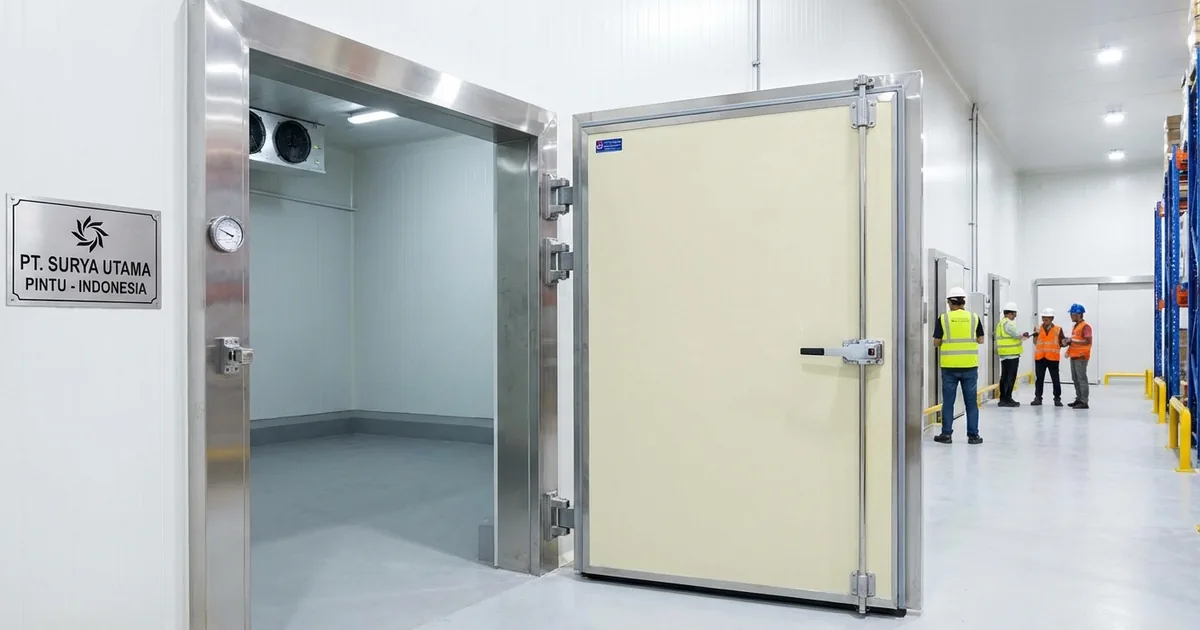
This article provides an in-depth discussion of various types of sandwich panel doors, specification comparisons, and factors to consider before purchasing. This information will help you make the right decision for your industrial or commercial facility project.
Key Differences Between Sandwich Panel Doors and Conventional Doors
Sandwich panel doors have different characteristics compared to standard doors. Their internal structure consists of metal skin layers with insulation core in between, similar to sandwich wall panels. This design provides several advantages:
- Superior thermal insulation — Reduces heat transfer by up to 80% compared to hollow metal doors
- High structural resistance — Can withstand impacts and pressure from industrial equipment
- Seamless installation — Specially designed to be flush with panel wall surfaces
- Perimeter seal options — Rubber seal system around the frame to prevent air leakage
Sandwich panel door frames are typically made from extruded aluminum or galvanized steel with more substantial thickness. This is necessary to support the heavier weight of the door due to the insulation material inside.
Comparison Table of Sandwich Panel Door Types
| Door Type | Core Material | Thickness | Primary Application | Price Range |
|---|---|---|---|---|
| EPS Panel Door | Expanded Polystyrene | 50–100 mm | Dry storage, office rooms | Affordable |
| PU Panel Door | Polyurethane | 80–150 mm | Cold storage, chiller rooms | Mid-range |
| PIR Panel Door | Polyisocyanurate | 100–200 mm | Freezers, blast freezers | Premium |
| Rockwool Panel Door | Mineral wool | 50–150 mm | Fire-rated areas, boiler rooms | Mid-to-high |
Door type selection must be matched with room temperature requirements. Doors with PIR core are suitable for freezers reaching -40°C, while EPS is sufficient for light cooling rooms above 10°C. For professional cold storage panel needs, consult with our technical team.
Advantages of Sandwich Panel Doors for Cold Storage
Cold storage facilities have special requirements that cannot be met by standard doors. Sandwich panel doors are designed to address these challenges:
1. Maximum Energy Efficiency
Cold loss through doors is one of the biggest sources of energy waste in cold storage. Sandwich panel doors with PU or PIR core have low thermal conductivity (lambda) values, around 0.022–0.026 W/mK. This means heat transfer from outside to inside is minimal.
In commercial cold storage facilities, using the right doors can reduce compressor electricity consumption by 15–20% per year.
2. Protection Against Condensation
Extreme temperature differences between the cooling room and outer area often cause dew or freezing on door surfaces. Sandwich panel doors with thermal break on the frame prevent cold spread to the outer part, reducing the risk of condensation that could damage hinge and handle mechanisms.
3. Durability in Extreme Conditions
Low temperatures make materials brittle. Sandwich panel doors use metal and insulation tested to withstand repeated freeze-thaw cycles. Special coating layers also protect against corrosion due to high humidity.
Weaknesses and Limitations of Sandwich Panel Doors
Despite having many advantages, this type of door also has several limitations to consider:
- Higher weight — Requires stronger hinges and hardware, as well as specialized labor during installation
- Higher initial cost — Unit prices can be 2–3 times higher than standard hollow metal doors
- Periodic seal maintenance — Rubber seals need inspection and replacement every 2–3 years to maintain insulation performance
- Size limitations — Maximum sizes are limited by panel structural capabilities, usually maximum 1200×2400 mm for single leaf
For projects with limited budgets, consider using sandwich panel doors only in areas that truly need high insulation, while other areas can use conventional doors.
Advantages of Sandwich Panel Doors for Cleanrooms
Cleanrooms have different requirements than cold storage, but sandwich panel doors remain the top choice for several reasons:
1. Easy-to-Clean Surfaces
Smooth, non-porous metal surfaces prevent dust and microorganism accumulation. Unlike wood or composite material doors, metal surfaces can be disinfected with chemical liquids without risk of damage.
2. Integration with Wall Systems
Sandwich panel doors are designed for flush mounting with cleanroom walls. There are no gaps or corners that could become contaminant collection points. Precision frames ensure airtight sealing without gaps.
3. Hermetic Seal Options
For high-class cleanrooms (ISO 5 and below), door options with hermetic seal are available — an inflatable rubber system that presses the door surface to the frame when closed, creating a perfect seal. This prevents particle entry from less clean areas.
Suitable for What Types of Projects
Based on installation experience across various industries, sandwich panel doors are most suitable for:
- Cold storage warehouses and food distribution — Maintaining the cold chain
- Pharmaceutical and biotechnology facilities — Cleanrooms with GMP and FDA standards
- Hospitals and laboratories — Sterilization areas, operating rooms, and isolation
- Electronics factories — Dust-sensitive component production rooms
- Food processing industries — Processing, chilling, and freezer areas
If your project is a general warehouse without special temperature requirements, or standard office space, sandwich panel doors may be over-specification and not cost-effective.
Checklist Before Ordering Sandwich Panel Doors
Before placing an order, ensure you have verified the following points:
- Rough opening size — Ensure 10–15 mm tolerance for adjustment during installation
- Door swing direction — Left hand or right hand, swing inward or outward
- Hardware requirements — Handle, lock, closer, hinge type (standard or heavy duty)
- Temperature specifications — Minimum temperature the room will reach
- Certification needs — Fire rating, food grade certificate, or cleanroom compliance
- Estimated usage frequency — To determine the right hinge and closer type
- Installation conditions — Whether there is crane or equipment to lift the heavy door
FAQ About Sandwich Panel Doors
Can sandwich panel doors be installed on brick or concrete walls?
Technically possible, but not ideal. Sandwich panel doors are designed for integration with modular panel systems. If installed on brick walls, special frame adapters are needed and the final result will not be seamless. Consider using standard hollow metal doors for brick walls.
What is the lifespan of sandwich panel doors?
With proper maintenance, sandwich panel doors can last 15–20 years. Factors that most often reduce lifespan are seal damage and hardware corrosion. Regular maintenance every 6 months is highly recommended.
Can custom-sized sandwich panel doors be made?
Yes, most suppliers accept custom orders. However, there are maximum single leaf size limitations (usually 1200 mm wide × 2400 mm high). For larger sizes, double leaf doors or sliding door systems are required.
How to maintain sandwich panel doors?
Maintenance includes: surface cleaning with neutral detergent, inspection of rubber seal condition, lubrication of hinges and locks, and inspection of coating layer cracks. Do not use abrasive cleaners that could scratch the surface.
Conclusion and Recommendations
Sandwich panel doors are the right investment for facilities requiring strict temperature and cleanliness control. Although initial costs are higher, energy savings and long-term durability make them cost-effective.
For cold storage projects, choose doors with PU or PIR core with minimum 100 mm thickness. For cleanrooms, prioritize smooth surfaces and hermetic seal options. Always verify compatibility with the panel wall system being used.
Need specific consultation for your project? Our team is ready to help you choose the optimal sandwich panel door configuration. Contact us via WhatsApp or the contact form for further discussion.