

What Is a Pass Box and Why It Matters for Cleanrooms
A pass box — or pass through box — is a material transfer device installed between rooms with different cleanliness levels in a cleanroom facility. Its function is straightforward but critical: it allows the transfer of items, samples, or components without simultaneously opening doors that connect two zones, thereby preventing cross-contamination and maintaining pressure differentials.
In pharmaceutical facilities, hospitals, microbiology labs, and semiconductor plants, a pass box is a mandatory component of cleanroom design. Without it, every time a technician opens a door between zones, positive air pressure drops, external particles enter, and the controlled environment loses sterility.
Per ISO 14644 standards, each cleanroom zone must maintain airborne particle counts within defined limits. A pass box enables safe material flow without compromising validated environmental parameters.
Two main pass box types exist: static and dynamic. Each has different mechanisms, costs, and applications. Choosing the wrong type can lead to cleanroom validation failures or unnecessary operating costs. Let us break down the differences point by point.
Static Pass Box: Characteristics and How It Works
A static pass box is the most basic version of this device. Its design consists of a stainless steel box (SUS304 or SUS316) with two doors featuring a mechanical interlock. The operating principle: when door A is opened, door B is automatically locked, and vice versa.
Key characteristics of a static pass box:
- No air filtration system — no HEPA filter or internal blower
- Pure mechanical interlock — relies on a lever or simple electromagnetic system
- SUS304 material — corrosion-resistant, easy to clean with standard cleanroom disinfectants
- Tempered glass doors — allow visual inspection before opening the opposite side
- Optional UV light — 254nm UV-C lamp for surface sterilization between transfers (add-on, not standard)
A static pass box is suitable for material transfer between rooms with identical cleanroom classifications or from an uncontrolled area to an ISO 8–ISO 7 cleanroom. It costs less, requires minimal maintenance, and is simple to install — it only needs to be flush-mounted in the partition wall between zones.
One important note: because it lacks a HEPA filter, a static pass box cannot reduce particle contamination levels inside the box itself. Particles carried in with materials remain in the chamber until the transfer is complete. For applications with higher contamination risk, the dynamic model becomes the more appropriate choice.
Dynamic Pass Box: Advanced Features and HEPA Mechanism
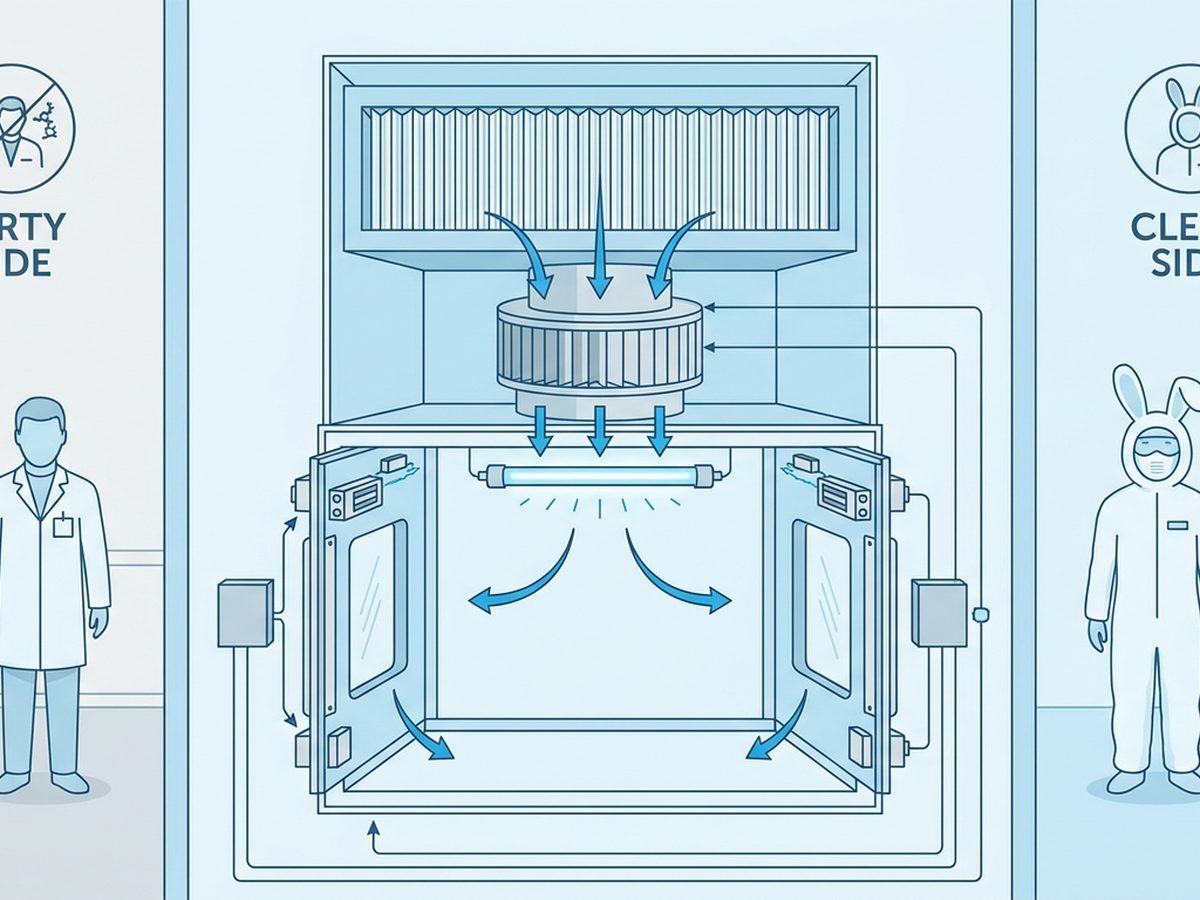
A dynamic pass box takes the basic static design and adds an active air filtration system. Inside the unit, a HEPA or ULPA filter connected to a blower creates vertical or horizontal laminar airflow within the chamber. The air inside the box is continuously filtered so particles entering with materials are captured by the filter before transfer to the cleanroom side.
Key features of a dynamic pass box:
- HEPA filter H13/H14 — 99.97%–99.995% efficiency for particles ≥0.3μm; some models use ULPA for higher efficiency
- Centrifugal blower — maintains laminar airflow in the chamber, typically 0.3–0.5 m/s
- Electromagnetic interlock with PLC control — more precise locking with LED door status indicators
- Differential pressure gauge — monitors pressure inside the chamber vs. external environment
- Built-in UV-C lamp — standard on most dynamic models
- DOP/PAO test port — for periodic HEPA filter integrity validation
Dynamic pass boxes are designed for material transfer from an uncontrolled area directly into ISO 5–ISO 7 zones without contamination risk. During the transfer cycle, air inside the box is continuously filtered so particles carried with materials do not settle on surfaces.
Power consumption for dynamic pass boxes ranges from 150–400 watts, depending on blower capacity and unit size. Operating costs are higher than static models, but the difference is small compared to the cost of a failed production batch due to cross-contamination — which can reach tens of thousands of dollars per incident in pharmaceutical manufacturing.
Head-to-Head Comparison: Static vs Dynamic
Here is a direct comparison of both types based on the parameters most relevant to purchasing decisions:
| Parameter | Static Pass Box | Dynamic Pass Box |
|---|---|---|
| Air Filtration | None | HEPA H13/H14 |
| Target Cleanroom Class | ISO 7–8 | ISO 5–7 |
| Interlock System | Mechanical / electromagnetic | Electromagnetic + PLC |
| UV Sterilization | Optional | Standard |
| Power Consumption | 10–20W (UV only) | 150–400W |
| Price (estimated) | $500–$1,200 | $1,500–$3,700 |
| Maintenance | Surface cleaning + UV replacement | HEPA replacement every 12–18 months + validation |
| Installation | Flush-mount in wall | Flush-mount + electrical connection |
The most significant difference lies in the filtration system and upfront cost. Static pass boxes can be 50–70% cheaper but are only suitable for cleanrooms with moderate cleanliness requirements. Dynamic boxes are mandatory when transferring materials to ISO 5 zones or when working with sterile products.
When to Choose Static (and When to Upgrade to Dynamic)
The decision between static and dynamic ultimately comes down to three main factors: target cleanroom classification, type of materials transferred, and regulatory requirements.
Choose a static pass box when:
- Your cleanroom is ISO 7–ISO 8 class (GMP Grade C–D)
- Materials transferred are already double-bagged and cleaned externally
- Transfer occurs between two zones with identical classifications
- Budget is limited but you still need interlock to prevent simultaneous door opening
- Applications: pharmaceutical warehouse to clean corridor, gowning room to non-sterile production area
Choose a dynamic pass box when:
- Your cleanroom is ISO 5–ISO 6 class (GMP Grade A–B)
- Materials transferred are semi-finished products not yet in sterile packaging
- Transfer occurs from an uncontrolled (unclassified) area directly into a clean zone
- Your facility must comply with cGMP/BPOM, FDA, or EU GMP Annex 1
- Applications: QC lab to sterile filling room, component transfer from warehouse to aseptic zone
If you are uncertain between the two, start by checking the cleanroom classification required by your industry regulations. For a complete guide on ISO 14644 cleanroom classification, we have covered it in detail.
Installation Guide and Interlock Requirements
Proper pass box installation is just as important as choosing the correct type. Here is an installation checklist to follow:
- Flush wall mounting — the pass box must be mounted flush with the cleanroom wall, with no gaps where particles can accumulate. The joint between the pass box frame and the wall must be sealed with food-grade or cleanroom-grade silicone sealant
- Ergonomic height — standard mounting height is 900–1,100 mm from floor to unit base (centerline), adjusted to operator posture
- Interlock must function — before commissioning, verify that BOTH doors CANNOT be opened simultaneously. For dynamic models, also verify that the HEPA blower activates automatically when the "dirty" side door is opened
- Third-party validation — after installation, perform smoke testing and particle count testing inside the chamber to ensure no leaks and performance meets specifications
- BMS integration — on dynamic models with PLC, the pass box can be integrated into the Building Management System for real-time door status and differential pressure monitoring
For facilities already in operation, the air shower maintenance principles also apply to pass boxes — scheduled validation and filter replacement are key to maintaining a controlled environment.
Cost, ROI, and Budget Considerations
Pass box ownership costs extend beyond the unit price. Let us calculate the total cost of ownership (TCO) over a 3-year period:
- Static pass box: $500–$1,200 (unit) + $150–$300/year (UV lamp replacement + seal checks) = $950–$2,100 / 3 years
- Dynamic pass box: $1,500–$3,700 (unit) + $400–$800/year (HEPA replacement, blower maintenance, validation) = $2,700–$6,100 / 3 years
At first glance, these numbers make dynamic pass boxes appear expensive. But compare with the potential loss from cross-contamination in an ISO 5 cleanroom — a single failed sterile product batch can cost $7,000–$35,000 in rejected products, investigations, and re-validation. In this context, the price difference for a dynamic pass box is cheap insurance against a much larger risk.
For ISO 7 cleanrooms producing non-sterile medical devices or electronic components, a static pass box is sufficient and provides the best ROI. For a complete overview of pass box options we offer, see our cleanroom pass box specifications and pricing guide. The key is matching device specifications to your facility's actual requirements — do not over-spec just because "it is safer," but also do not under-spec for zones that genuinely need active filtration.
FAQ: Common Questions About Static vs Dynamic Pass Boxes
Can a static pass box be used for pharmaceutical cleanrooms?
Yes, as long as the cleanroom is ISO 7–8 class (GMP Grade C–D) and transferred materials are properly cleaned and double-bagged. For ISO 5 sterile pharmaceutical cleanrooms, you must use a dynamic pass box with HEPA filtration.
How often should the HEPA filter in a dynamic pass box be replaced?
The standard replacement interval is every 12–18 months, depending on usage frequency and environmental contamination levels. Earlier replacement may be necessary if the differential pressure shows a significant increase or DOP test results fail.
Is a special permit required for pass box installation?
No special government permit is required. However, for pharmaceutical and medical device facilities, pass box installation must be documented in cleanroom validation as part of Installation Qualification (IQ) documentation according to cGMP/BPOM standards.
How to Order & Consult at SandwichPanels.id
At SandwichPanels.id, we provide static and dynamic pass boxes with customizable specifications — from chamber size, material (SUS304/SUS316), interlock type, to HEPA filter grade options (H13, H14, or ULPA).
Every unit we supply includes:
- Material certificates and welding inspection reports
- FAT (Factory Acceptance Test) documentation for dynamic models
- Installation and commissioning technical support from our engineering team
- 12-month component warranty
Need help determining the right pass box for your cleanroom? Our engineering team is ready to analyze your requirements and provide specification recommendations at no consultation cost.