

Cleanroom Pass Box for Logistics: Size & Specification Guide
The Material Transfer Problem in Industrial Cleanrooms
Picture a pharmaceutical facility with an ISO 7 cleanroom area. Every day, dozens of raw material cartons need to enter the sterile zone, while finished products must exit without carrying contaminants. Without a proper transfer system, a single door opening can introduce thousands of dust particles into the cleanroom — potentially compromising an entire production batch.
This is not a minor issue. In semiconductor facilities, a single 0.5-micron particle on a wafer can cause millions of dollars in defects. In pharmaceutical plants, cross-contamination can lead to product recalls and regulatory sanctions. This is where pass boxes become critical as a safe material transfer solution.
What Is a Pass Box and Why It Matters for Cleanroom Logistics
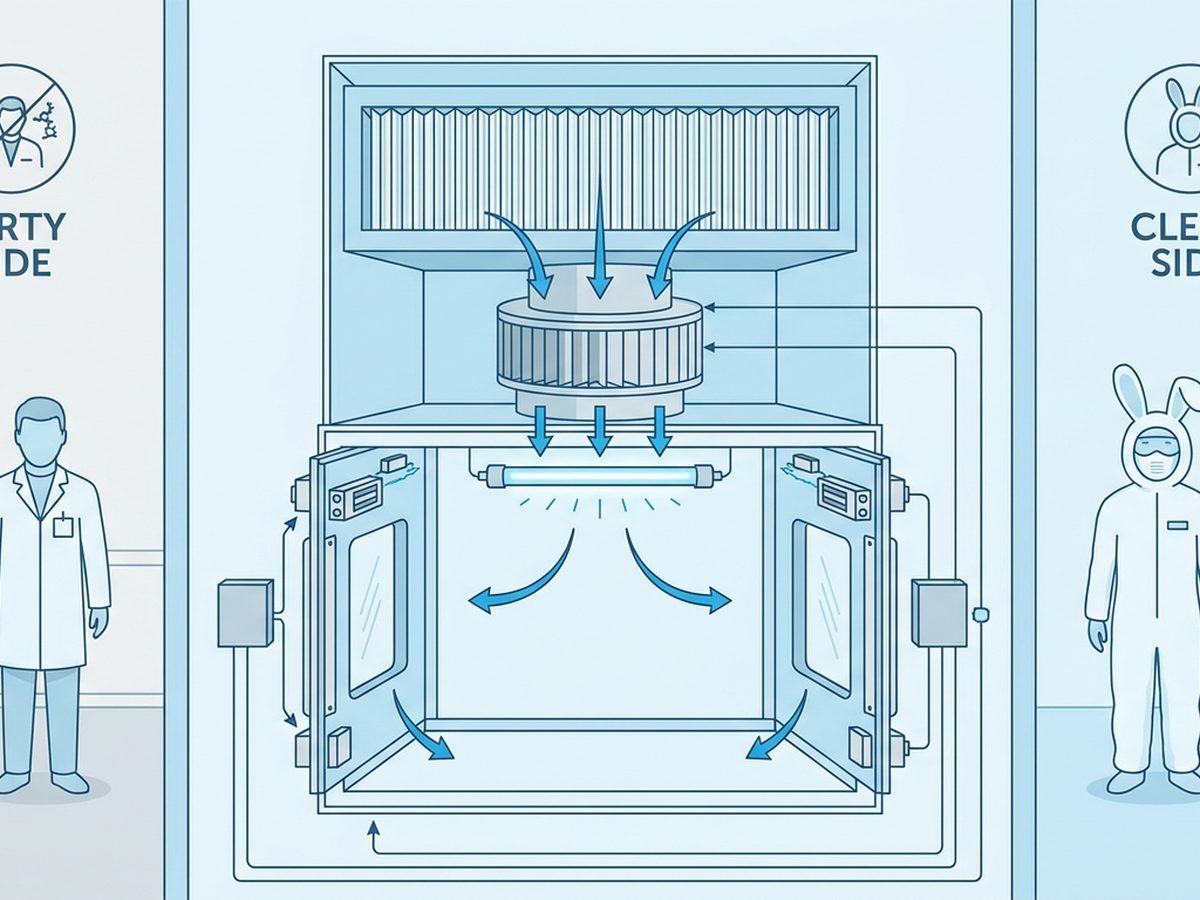
A pass box is a transfer chamber with two doors (one on the unclean side, one on the clean side) that allows materials to move between rooms without opening direct access between areas. The concept is straightforward: place items inside the box through the unclean-side door, the door locks electromechanically, materials undergo decontamination (typically via UV or HEPA-filtered air), and then the clean-side door opens.
For logistics and material handling contexts, pass boxes serve a more specific role than general-purpose use. Key differences include:
- Higher transfer volumes — dozens to hundreds of items per shift
- Larger item dimensions — cartons, containers, small trolleys, machine components
- Throughput requirements that directly impact production schedules
- Integration with conveyors or automated material handling systems
Without the right pass box, bottlenecks at material transfer points can slow down the entire production line. Conversely, choosing a pass box that is too small or the wrong type means you must still open cleanroom doors manually — defeating the whole purpose of contamination control.
Types of Pass Boxes for Material Handling
For logistics needs, three main variants require careful differentiation:
Static Pass Box
Suitable for material transfer between two areas with the same cleanliness classification (e.g., ISO 7 to ISO 7). It has no air filtration system of its own, relying solely on electromechanical door interlock. Advantages: low cost, simple installation. Disadvantage: does not clean the air inside the chamber.
Dynamic Pass Box
Equipped with a HEPA filter and blower that circulates clean air inside the chamber. Ideal for transfers from uncontrolled areas to cleanrooms (e.g., warehouse to ISO 7). Air inside the box is replaced and filtered before the clean-side door opens. This is the most recommended type for logistics routes linking non-cleanroom areas to cleanrooms.
Cargo / Large Pass Through
Designed for oversized materials — pallets, drums, machine components, or full trolleys. Chamber dimensions can reach 2 × 2 × 2 meters, with doors wide enough for forklifts or pallet jacks. Typically uses reinforced 304 stainless steel construction with heavy-duty interlock systems. Some models come with integrated roller conveyors.
Type selection must match your material flow, not just your budget. Using a static pass box for warehouse-to-cleanroom transfers is a costly mistake that occurs frequently.
Size Specifications: From Compact to Cargo
Pass box size is the most critical parameter in material handling contexts. Choosing the wrong size is the number one cause of bottlenecks at cleanroom transfer points. Here is an application-based guide:
| Application | Chamber Dimensions (W × D × H) | Recommended Type |
|---|---|---|
| Lab sample / document transfer | 600 × 600 × 600 mm | Static |
| Pharma raw materials (small containers) | 800 × 800 × 800 mm | Dynamic |
| Electronic / semiconductor components | 900 × 900 × 900 mm | Dynamic |
| Product cartons / intermediate bulk | 1200 × 1200 × 1200 mm | Dynamic |
| Pallets, drums, machine components | 1500 × 2000 × 2000 mm | Cargo / Pass Through |
| Wheeled trolleys / racks | 2000 × 2500 × 2500 mm (custom) | Cargo with floor rails |
One commonly overlooked factor: always add a 15-20% margin beyond your largest item's dimensions. Items do not always enter in perfect orientation, and operators need hand clearance to place materials safely.
Materials and Construction of Industrial Pass Boxes
The pass box body material must meet two simultaneous demands: cleanability and structural durability against heavy use. For high-volume logistics applications, material recommendations are:
- Stainless Steel 304: Standard for most cleanroom applications. Corrosion-resistant, easy to clean, good mechanical strength. Suitable for pharma, food, and general electronics.
- Stainless Steel 316L: For aggressive environments such as chemical cleanrooms or pharma facilities with exposure to strong disinfectants (VHP, chlorine dioxide). Higher corrosion resistance.
- Powder-coated steel: Only for non-critical areas (unclean side) as a cost-saving measure. Not recommended for chamber interiors.
Construction details that must be verified:
- Weld seams must be seamless and polished (Ra ≤ 0.8 μm for interior surfaces)
- Interior corners must be coved (rounded) — sharp 90° angles are unacceptable
- Doors must have EPDM or food-grade silicone gaskets
- Tempered glass (minimum 8 mm) for observation windows if needed
- No exposed bolts, screws, or crevices inside the chamber
Safety Features: Interlock, UV, and HEPA
Pass boxes for logistics applications must have safety features that exceed minimum standards. This matters because high usage frequency increases the risk of system failure:
- Electromagnetic Interlock: A mechanism preventing both doors from opening simultaneously. Look for systems with door position sensors (not just timers) and clear LED indicators on both sides. For GMP applications, an audible alarm is required if a door is forced open.
- UV-C Germicidal Lamp: 254 nm UV lamp for surface decontamination. For logistics purposes, ensuring even UV coverage throughout the chamber (no blind spots) is critical. An adjustable UV timer (5-30 minutes) is a standard feature.
- HEPA H14 Filter: In dynamic pass boxes, HEPA filters with 99.995% efficiency at 0.3 microns guarantee chamber air matches the target cleanroom class. The blower must provide a minimum of 20 air changes per hour inside the chamber.
- Differential Pressure Gauge: Monitors HEPA filter condition in real time — an essential indicator for preventive filter replacement scheduling.
- Magnetic Door Switch with Feedback: Sends signals to the BMS (Building Management System) for centralized monitoring — essential in large facilities.
Common Mistakes When Choosing a Logistics Pass Box
Based on our experience handling cleanroom projects, here are the most common mistakes and how to avoid them:
- Choosing size based on price rather than need: An undersized pass box will become a permanent bottleneck. Solution: measure all items to be transferred, take the largest, add 20%.
- Using a static pass box for transfers between different zones: This violates a basic cleanroom principle. If source and destination zones have different classifications, a dynamic pass box is mandatory.
- Ignoring floor load capacity: Large cargo pass boxes can weigh 300-500 kg. Ensure the cleanroom floor structure can support it.
- Not considering operator workflow: A pass box placed too low or too high causes ergonomic injuries and slows transfers.
- Skipping commissioning and validation: Every pass box must undergo DQ/IQ/OQ/PQ according to GMP protocols before use. Skip this step and you risk inspection failure.
- Lack of operating SOPs: Operators often do not know the minimum UV cycle duration or chamber cleaning procedures — resulting in contamination despite correct hardware.
FAQ: 5 Common Questions About Logistics Pass Boxes
1. Can a cargo pass box handle full pallets?
Yes, cargo pass boxes are designed for this. Standard pallet chamber dimensions are 1500 × 2000 × 2000 mm. Ensure it has a flush floor so a pallet jack can enter without obstruction. For heavy loads, specify a reinforced floor with a minimum 1000 kg capacity.
2. How long should the UV cycle be for decontamination?
It depends on the facility protocol — typically 15-20 minutes for pharmaceutical applications and 5-10 minutes for electronics. UV-C at 254 nm requires minimum contact time for log 3 reduction (99.9%). Validation must be performed with a biological indicator (Geobacillus stearothermophilus) to verify effectiveness.
3. Can pass boxes integrate with automated conveyors?
Yes, for high-volume applications. Pass boxes with integrated roller conveyors enable automated transfer from material handling systems. This requires signal coordination with the PLC and interlock so the conveyor stops when the door is open. Custom engineering is needed for each installation.
4. How do you properly clean the pass box interior?
Use a disinfectant compatible with stainless steel (avoid chlorine-based products on SS 304 to prevent pitting). Procedure: dry wipe → wet wipe with disinfectant → allow contact per instructions → dry wipe. Frequency: end of every shift for high-volume logistics. Document in a cleaning log for audit purposes.
5. What is the HEPA filter lifespan and when should it be replaced?
Pass box HEPA filter lifespan is generally 12-18 months under normal use. Replacement indicators: differential pressure rises to 2× the initial value, or DOP/PAO test failure. For high-frequency logistics applications, schedule replacement every 12 months or when pressure drop reaches 250 Pa (whichever comes first).
Conclusion & Recommendations
A cleanroom logistics pass box is not just an accessory — it is a critical component that determines operational efficiency and regulatory compliance. Choosing the right pass box means simultaneously considering three key factors: chamber dimensions matching your largest material, type (static/dynamic) matching the classification difference between areas, and safety features adequate for high throughput.
For most cleanroom logistics lines — whether in pharmaceuticals, food processing, semiconductors, or precision manufacturing — a dynamic pass box with a minimum 900 × 900 × 900 mm chamber and HEPA H14 is a solid starting point. If you handle pallets or machine components, a custom cargo pass box is an investment that will pay off in long-term operational efficiency.
Need help selecting the right pass box for your cleanroom logistics needs? Contact our team for a free consultation or visit our cleanroom product page for detailed specifications.