

Why Food Processing Facility Walls Must Meet Special Standards
Food processing facilities—from large-scale industrial kitchens, bakery plants, cold storage facilities, to packaged beverage production rooms—face challenges not found in conventional buildings. Walls subject to moisture, hot water spray, chemical cleaners, and extreme temperatures are normal conditions in daily food industry operations.
Conventional wall materials like plaster or gypsum are not designed to withstand these environments. Small cracks, porous fibers, or rough surfaces become breeding grounds for Salmonella, Listeria, and E. coli bacteria that can contaminate food products. A single contamination incident can trigger a mass product recall costing billions of rupiah.
Choosing the right wall material is not merely an aesthetic or construction matter—it is a critical component of an integrated food safety system. This is where antibacterial and food grade sandwich panels have become the preferred solution among food producers who take product safety standards seriously.
What Are Antibacterial and Food Grade Sandwich Panels?
Sandwich panels are wall and roof elements consisting of two metal face sheets (typically painted galvanized steel) with insulation fill in between. For food industry applications, these panels come in two special variants with distinct characteristics.
Antibacterial panels use face sheets coated with an active antibacterial coating—usually containing silver ions or organic antibacterial compounds—that actively inhibits bacterial growth on the panel surface. This coating withstands routine cleaning with disinfectants and does not peel easily under normal food facility operational conditions.
Food grade panels refer to panels whose materials and coatings meet international food safety standards, meaning they contain no harmful compounds that could migrate into food products through direct or indirect contact. Food grade certification proves that the panel material is safe for use in areas that come into contact with or are adjacent to food products.
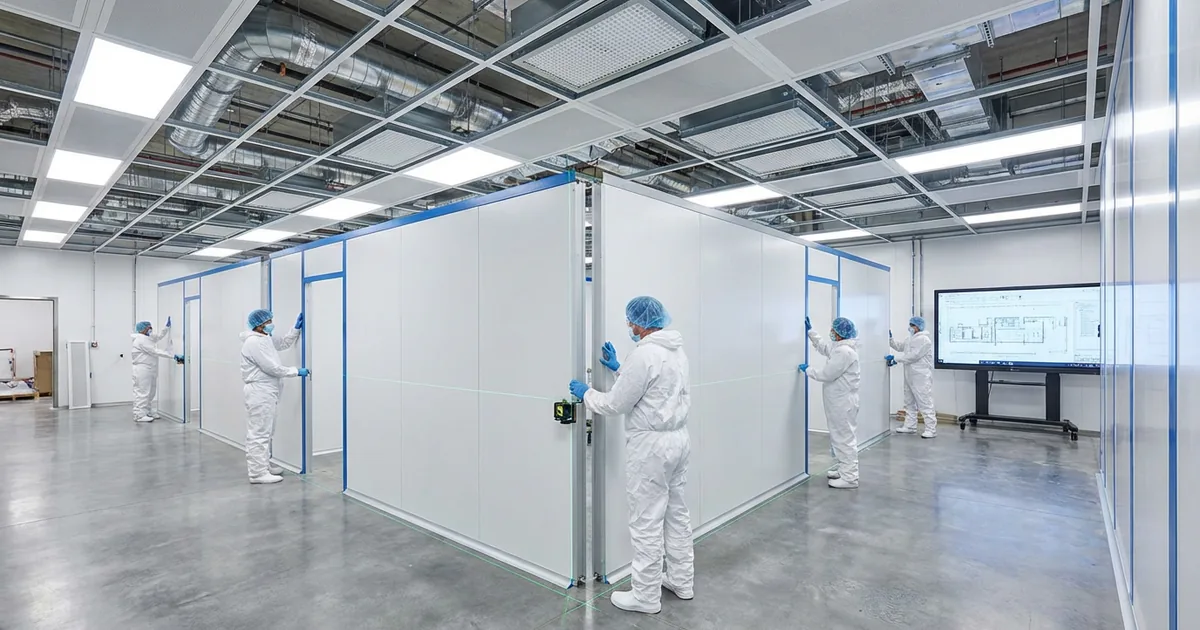
Both panel types can use the same core material (PU, EPS, or Rockwool), but the difference lies in the face sheet specifications and coating. Core selection depends on thermal insulation requirements—PU and EPS for ambient and chilled temperatures, Rockwool for areas requiring fire resistance ratings.
Technical Specifications: Antibacterial vs Food Grade Panels
The following compares key technical parameters to understand before choosing between antibacterial panels and food grade panels for food facility projects:
- Antibacterial coating surface: Antibacterial panels feature active coatings with silver ions (Ag+) or zinc pyrithione that have been clinically proven to inhibit ≥99% of common bacteria within 24 hours
- Food grade certification: Food grade panels must hold certification from recognized bodies such as NSF, FDA, or BPOM—proving that coatings and materials are safe for food production environments
- Smooth surface finish: Food grade panel surface finish is typically Ra ≤0.8 μm to prevent particle accumulation and facilitate effective sanitation
- Chemical corrosion resistance: Resistance to organic acids (vinegar, citric acid), alkalis (NaOH, KOH), and quaternary ammonium disinfectants commonly used in the food industry
- Inter-panel joints: Hidden-screw or tongue-and-groove systems to eliminate gaps that become contamination and bacteria accumulation points
- Non-porous surface: Non-porous structure prevents liquid absorption and mold growth on the panel substrate
For panels with PU (polyurethane) core, an additional advantage is resistance to temperatures down to -30°C—ideal for frozen food cold storage facilities. The correct core density also contributes to panel structural rigidity, preventing denting or deformation from production equipment impact.
Regulatory Standards for Food Processing Facilities in Indonesia
Food production facilities in Indonesia must comply with several regulations that directly affect the choice of wall and roof construction materials. Understanding these regulations is essential before selecting panel specifications.
CPPB (Cara Produksi Pangan yang Baik) from BPOM requires that surfaces in production rooms be smooth, easy to clean, non-absorbent, and not a place for contaminants to thrive. This regulation does not specify particular materials, but antibacterial sandwich panels naturally meet all these requirements.
GMP (Good Manufacturing Practice) adopted from Codex Alimentarius requires building elements with surfaces that can be effectively cleaned and disinfected. Sandwich panels with hidden-screw joint systems and radius corner profiles meet these requirements better than conventional construction.
- BPOM RI: CPPOB guidelines (Cara Produksi Pangan Olahan yang Baik) for processed food production
- SNI ISO 22000: Food safety management system standards for the entire food chain
- Codex Alimentarius: FAO/WHO international standards for food production facilities
- FSSC 22000 / BRC: Global standards for food product suppliers to modern retail chains
Non-compliance with these standards can result in BPOM audit findings, loss of production permits, or disqualification as a supplier to retailers requiring BRC or FSSC 22000 certification.
Available Panel Products for Food Facilities
For food production facilities requiring panels with active antibacterial properties, ARJUNA Antibacterial Sandwich Panel is available with an antibacterial coating that has been tested and proven effective at inhibiting bacterial growth on panel surfaces under normal food industry operational conditions.
For food product cold storage or chilled areas requiring a combination of thermal insulation and food grade safety, NARADA Food Grade Sandwich Panel comes with specifications meeting food grade material standards for walls and ceilings in temperature-controlled production areas.
Both products are available with hidden-screw installation systems that produce a flat surface without gaps, suitable for strict sanitation requirements at GMP and HACCP facilities. Our technical team is ready to assist with material quantity calculations and wall layout planning for new food facility projects or renovations.
Tips for Selecting the Right Panel for Industrial Kitchens and GMP Facilities
Selecting panels for food facilities is not simply about price per square meter. Several technical and operational criteria must be systematically evaluated:
- Determine the application zone: Wet processing areas need higher water resistance than dry processing areas. Cold storage areas require strong thermal insulation and anti-condensation capability.
- Verify relevant certifications: Ensure the panel has food grade certification from bodies recognized by BPOM or the GMP auditing standard to be used in facility certification.
- Evaluate the joint system: For optimal hygiene, prefer hidden-screw or interlocking joint systems that produce a bolt-head-free surface—eliminating contamination accumulation points.
- Consider panel thickness: 50–100mm standard thickness for interior walls; cold storage areas below -10°C require at least 100–150mm for adequate insulation.
- Corner radius profile: Panels with coved corner profiles are far easier to clean and verify than 90-degree corners that are difficult to reach with cleaning tools.
- Chemical cleaner compatibility: Confirm that panel coating is resistant to the types of disinfectants used in the facility's sanitation SOP—particularly chlorine, quaternary ammonium, and peracetic acid.
FAQ: Frequently Asked Questions About Antibacterial and Food Grade Panels
Are antibacterial panels truly effective at inhibiting bacterial growth in real food facility conditions?
Yes, but with an important note: active antibacterial coating inhibits bacterial growth on the panel surface, not replacing routine sanitation procedures. Antibacterial panels provide additional protection between cleaning schedules—particularly preventing biofilm that can form within 4–6 hours of bacterial exposure on moist surfaces. Scheduled sanitation per SOP remains mandatory.
What panel thickness is recommended for food cold storage production room walls?
For 0°C to -5°C temperatures (chilled storage), 75–100mm PU core thickness is adequate. For -10°C to -25°C (frozen storage), use 100–150mm panels. For deep freeze below -25°C, 150–200mm thickness is recommended. These calculations assume standard interior-to-exterior delta T; extreme climate conditions require specialized insulation calculation.
Can food grade sandwich panels be cut and adjusted on-site without voiding their certification?
On-site panel cutting is permitted and commonly done, but note that cut areas must be protected with food grade compatible edge sealant to prevent cut PU or EPS core from being exposed to contamination or moisture. Food grade certification applies to unmodified panel materials; on-site modifications should follow procedures recommending adequate edge protection at all cut sections.
For technical consultation on selecting antibacterial or food grade panels that meet your food facility's regulatory requirements, contact our technical team via WhatsApp. We assist from technical consultation to material delivery to your project site.