

PIR Sandwich Panel Price 2026: Complete Investment and Specification Guide
In the rapidly evolving industrial construction industry, energy efficiency and fire safety have become the highest priorities for developers of warehouses, factories, and cold storage facilities. One of the most sought-after and recommended materials is the PIR (Polyisocyanurate) sandwich panel. As we approach 2026, the demand for this material is expected to rise significantly, driven by stricter industrial building regulations and safety standards. This article will provide a comprehensive analysis of PIR sandwich panel prices in 2026, their technical specifications, and comparison with other materials. Also read about sandwich panel prices per meter 2026 to plan your budget efficiently.
PIR is recognized as the advanced evolution of polyurethane (PU). With a more stable chemical structure, PIR offers superior fire resistance and a higher thermal insulation value (R-value). For those planning industrial facilities, understanding PIR pricing and specifications is crucial to optimizing your project budget and long-term operational costs. You can also explore PIR material properties and applications in our previous guide.
2026 PIR Sandwich Panel Price List per Square Meter
PIR sandwich panel prices in 2026 are heavily influenced by core thickness, steel skin specifications, and coating quality. Below is an estimate of average prices based on panel thickness for the 2026 market:
| Panel Thickness (mm) | Primary Industrial Application | Estimated Price (USD Equivalent) |
|---|---|---|
| 50 mm | Partition Walls, Dry Warehouses | $30 - $35 per m² |
| 75 mm | Processing Rooms, Cleanrooms | $37 - $42 per m² |
| 100 mm | Cold Storage (Chiller Room) | $44 - $50 per m² |
| 120 mm | Freezer Rooms (Extreme Temperature) | $51 - $58 per m² |
| 150 mm | Blast Freezers (Deep Freeze) | $60 - $68 per m² |
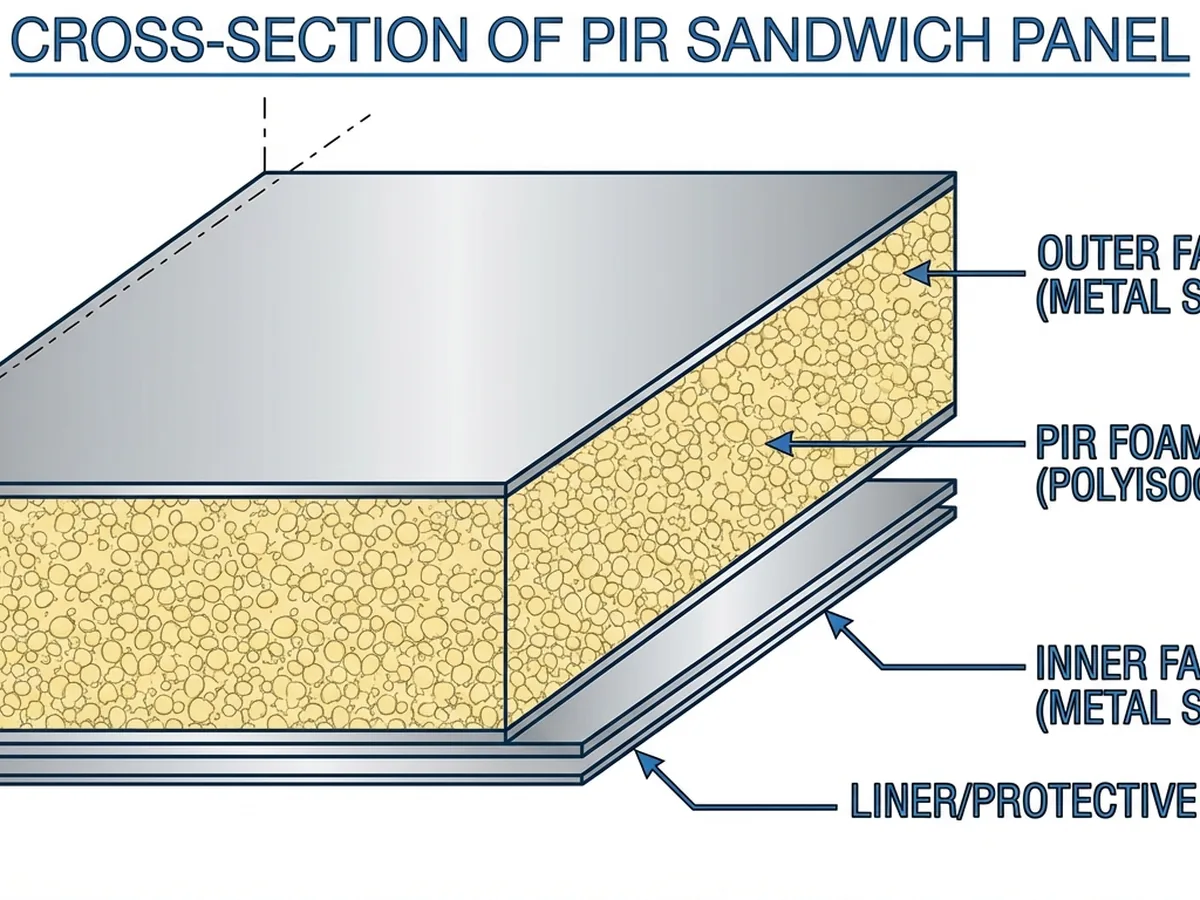
A detailed discussion on the technical specifications of PIR includes an average density of 42 kg/m3. This ensures reliable structural strength for high walls without the need for excessive additional framing. In terms of energy efficiency, the thermal conductivity of PIR is approximately 0.020 W/m.K, making it one of the most efficient insulation materials in the construction industry today. Using PIR panels also helps in achieving Green Building certifications due to its ability to maintain temperatures with minimal energy consumption. Furthermore, PIR panels exhibit excellent resistance to moisture, preventing mold growth and maintaining structural integrity over decades of use in humid climates. This long-term durability is essential for industrial assets.
A detailed discussion on the technical specifications of PIR includes an average density of 42 kg/m3. This ensures reliable structural strength for high walls without the need for excessive additional framing. In terms of energy efficiency, the thermal conductivity of PIR is approximately 0.020 W/m.K, making it one of the most efficient insulation materials in the construction industry today. Using PIR panels also helps in achieving Green Building certifications due to its ability to maintain temperatures with minimal energy consumption. Furthermore, PIR panels exhibit excellent resistance to moisture, preventing mold growth and maintaining structural integrity over decades of use in humid climates. This long-term durability is essential for industrial assets.
A detailed discussion on the technical specifications of PIR includes an average density of 42 kg/m3. This ensures reliable structural strength for high walls without the need for excessive additional framing. In terms of energy efficiency, the thermal conductivity of PIR is approximately 0.020 W/m.K, making it one of the most efficient insulation materials in the construction industry today. Using PIR panels also helps in achieving Green Building certifications due to its ability to maintain temperatures with minimal energy consumption. Furthermore, PIR panels exhibit excellent resistance to moisture, preventing mold growth and maintaining structural integrity over decades of use in humid climates. This long-term durability is essential for industrial assets.
A detailed discussion on the technical specifications of PIR includes an average density of 42 kg/m3. This ensures reliable structural strength for high walls without the need for excessive additional framing. In terms of energy efficiency, the thermal conductivity of PIR is approximately 0.020 W/m.K, making it one of the most efficient insulation materials in the construction industry today. Using PIR panels also helps in achieving Green Building certifications due to its ability to maintain temperatures with minimal energy consumption. Furthermore, PIR panels exhibit excellent resistance to moisture, preventing mold growth and maintaining structural integrity over decades of use in humid climates. This long-term durability is essential for industrial assets.
A detailed discussion on the technical specifications of PIR includes an average density of 42 kg/m3. This ensures reliable structural strength for high walls without the need for excessive additional framing. In terms of energy efficiency, the thermal conductivity of PIR is approximately 0.020 W/m.K, making it one of the most efficient insulation materials in the construction industry today. Using PIR panels also helps in achieving Green Building certifications due to its ability to maintain temperatures with minimal energy consumption. Furthermore, PIR panels exhibit excellent resistance to moisture, preventing mold growth and maintaining structural integrity over decades of use in humid climates. This long-term durability is essential for industrial assets.
A detailed discussion on the technical specifications of PIR includes an average density of 42 kg/m3. This ensures reliable structural strength for high walls without the need for excessive additional framing. In terms of energy efficiency, the thermal conductivity of PIR is approximately 0.020 W/m.K, making it one of the most efficient insulation materials in the construction industry today. Using PIR panels also helps in achieving Green Building certifications due to its ability to maintain temperatures with minimal energy consumption. Furthermore, PIR panels exhibit excellent resistance to moisture, preventing mold growth and maintaining structural integrity over decades of use in humid climates. This long-term durability is essential for industrial assets.
A detailed discussion on the technical specifications of PIR includes an average density of 42 kg/m3. This ensures reliable structural strength for high walls without the need for excessive additional framing. In terms of energy efficiency, the thermal conductivity of PIR is approximately 0.020 W/m.K, making it one of the most efficient insulation materials in the construction industry today. Using PIR panels also helps in achieving Green Building certifications due to its ability to maintain temperatures with minimal energy consumption. Furthermore, PIR panels exhibit excellent resistance to moisture, preventing mold growth and maintaining structural integrity over decades of use in humid climates. This long-term durability is essential for industrial assets.
A detailed discussion on the technical specifications of PIR includes an average density of 42 kg/m3. This ensures reliable structural strength for high walls without the need for excessive additional framing. In terms of energy efficiency, the thermal conductivity of PIR is approximately 0.020 W/m.K, making it one of the most efficient insulation materials in the construction industry today. Using PIR panels also helps in achieving Green Building certifications due to its ability to maintain temperatures with minimal energy consumption. Furthermore, PIR panels exhibit excellent resistance to moisture, preventing mold growth and maintaining structural integrity over decades of use in humid climates. This long-term durability is essential for industrial assets.
A detailed discussion on the technical specifications of PIR includes an average density of 42 kg/m3. This ensures reliable structural strength for high walls without the need for excessive additional framing. In terms of energy efficiency, the thermal conductivity of PIR is approximately 0.020 W/m.K, making it one of the most efficient insulation materials in the construction industry today. Using PIR panels also helps in achieving Green Building certifications due to its ability to maintain temperatures with minimal energy consumption. Furthermore, PIR panels exhibit excellent resistance to moisture, preventing mold growth and maintaining structural integrity over decades of use in humid climates. This long-term durability is essential for industrial assets.
A detailed discussion on the technical specifications of PIR includes an average density of 42 kg/m3. This ensures reliable structural strength for high walls without the need for excessive additional framing. In terms of energy efficiency, the thermal conductivity of PIR is approximately 0.020 W/m.K, making it one of the most efficient insulation materials in the construction industry today. Using PIR panels also helps in achieving Green Building certifications due to its ability to maintain temperatures with minimal energy consumption. Furthermore, PIR panels exhibit excellent resistance to moisture, preventing mold growth and maintaining structural integrity over decades of use in humid climates. This long-term durability is essential for industrial assets.
ROI Case Study: PIR Implementation in a 1000m² Cold Storage
Consider building a 1000m² cold storage facility. Investing in PIR might be $15,000 more expensive than using EPS initially. However, due to PIR's exceptional thermal efficiency, your cooling system's energy consumption will decrease by about 25% every month. If your monthly electricity bill is $4,000, monthly savings would reach $1,000. In just 15 months, the initial investment difference is fully recovered (payback period), and subsequent years yield pure profit from significant energy savings.
Conclusion
PIR sandwich panel prices in 2026 reflect their quality, safety, and long-term efficiency. While initial costs are higher, the energy savings and fire safety offered make it a highly profitable investment. For the best prices, ensure volume orders and negotiate directly with primary manufacturers via sandwichpanels.id.