

A cold storage room for vaccines and pharmaceutical products is not just another walk-in cooler. Unlike a frozen food warehouse, this kind of facility must hold a strict 2-8°C range around the clock, run on a validated monitoring system, and satisfy Good Distribution Practice (GDP/CDOB) regulations enforced by Indonesia's BPOM. A small gap in wall insulation, a leaking panel joint, or an uncalibrated sensor can spoil an entire vaccine batch and cause a facility to fail its compliance audit.
This article covers the temperature standards and regulations that apply, the right sandwich panel specification for a vaccine room, the monitoring system that becomes fully mandatory in 2026, and a realistic cost estimate for building a compliant pharmaceutical cold storage from day one.
Why Pharma Cold Storage Differs From Ordinary Cold Storage
A typical food cold storage room only needs to stay below freezing or around 0-4°C, with fairly loose tolerance. Pharmaceutical cold storage is far stricter: most vaccines and thermolabile products must sit within 2-8°C at all times, never freezing and never exceeding the upper limit. A temperature excursion lasting only minutes can permanently damage vaccine potency without any visible physical change.
Because of that, the building design cannot simply copy an ordinary frozen warehouse. Every panel joint, door, and pipe penetration must be engineered to prevent cold bridging and outside-air infiltration, since even a minor leak can push the temperature in a corner of the room away from the reading on the main thermostat.
Power resilience is another factor planners often overlook. A pharma cold room should have an automatic backup generator and battery backup for the monitoring unit, since a power outage of just a few hours can push room temperature past 8°C before staff can react. Generator sizing must account for the compressor's peak load when the unit restarts after power returns, not only its normal daily load.
Temperature Standards and Regulations: BPOM CDOB & WHO PQS
Under BPOM Regulation No. 6 of 2020 on CDOB (Indonesia's Good Distribution Practice), cold chain products must be stored in a cold room or chiller that maintains 2-8°C, equipped with continuous temperature monitoring using calibrated sensors and deviation alarms. Common field practice sets the alarm threshold tighter, around 2.5-7.5°C, so the team has time to react before the temperature actually leaves the regulator-mandated range.
At the international level, WHO runs the Performance, Quality and Safety (PQS) prequalification scheme for vaccine cold chain equipment. Categories relevant to facility planning include:
- E003 — Vaccine refrigerators and freezers
- E004 — Cold rooms and freezer rooms at facility scale
- E005 — Temperature monitoring devices
- E006 — Cold boxes and vaccine carriers for transport
Starting in 2026, the PQS E003 specification requires an integrated electronic temperature-recording capability (data logger) on every unit, rather than treating it as an optional add-on device — a change with direct implications for the technical spec of any newly built cold room.
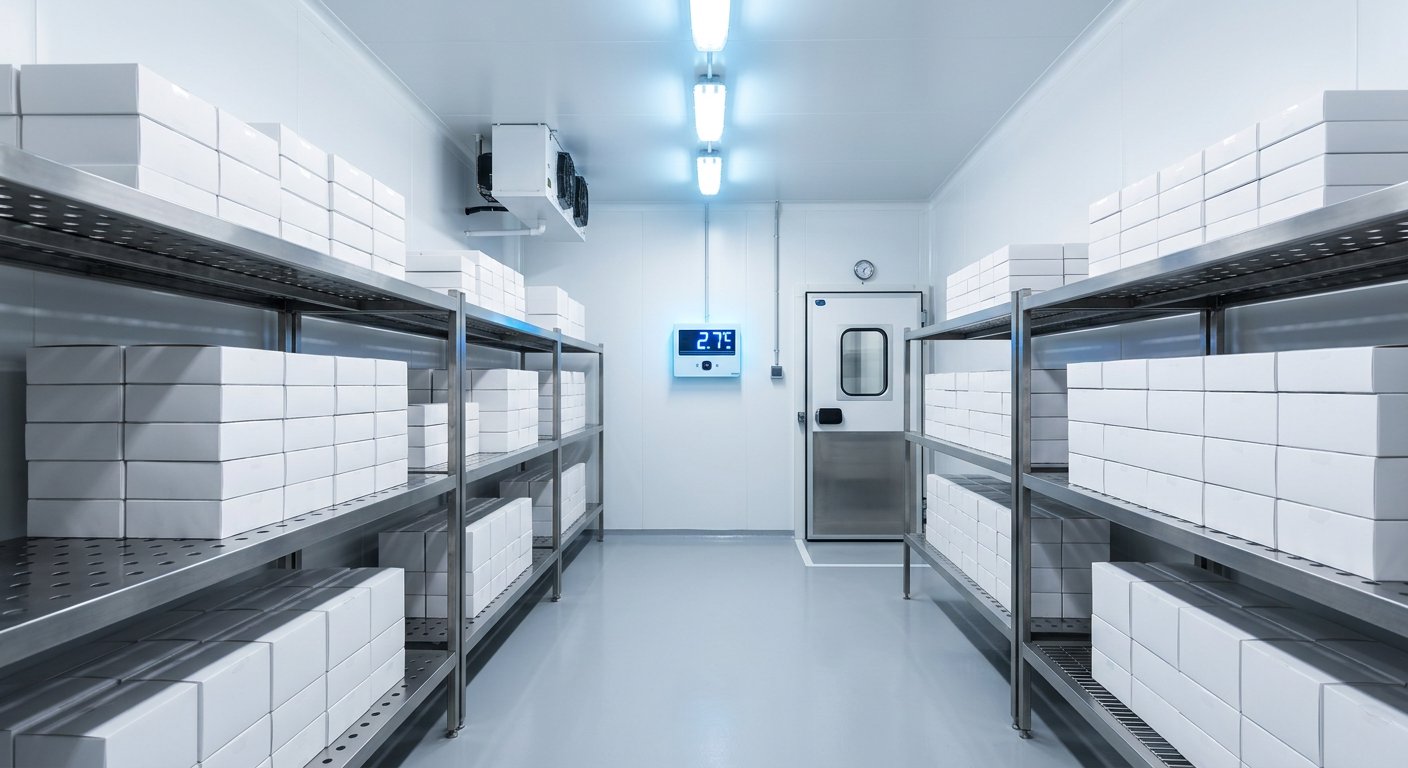
Sandwich Panel Specification for a Vaccine Room
For a 2-8°C range, 100 mm PU (polyurethane) panels on walls and ceiling are generally effective at blocking heat transfer from outside, provided foam density and panel skin quality are maintained. The lower the target temperature — for example a freezer zone inside the main cold room — the thicker the panel needs to be so the refrigeration unit's workload stays efficient and the outer wall surface does not start freezing.
Beyond thickness, joint detailing is the real determinant of performance. A tongue-and-groove system with dedicated sealant at every seam prevents moisture and warm air infiltration, and also avoids the condensation that can trigger mould on wall surfaces. For a deeper look at panel types, thickness options, and price ranges for cold storage generally, read the cold storage sandwich panel specification guide on sandwichpanels.id.
The interior panel surface should ideally be food-grade and non-porous, easy to disinfect without damaging the protective coating — the same principle applied to a GDP-compliant pharma warehouse. Wall material standards for pharmaceutical warehouses are covered in the pharma warehouse CPOB wall panel guide.
Door design deserves equal attention. Sliding or swing doors with a tight rubber gasket and an anti-condensation heater strip around the frame help prevent warm-air infiltration every time the door opens, while also reducing ice build-up on the door track. For high foot-traffic facilities, a small anteroom before the main door helps dampen sudden temperature swings inside the primary storage space.
Temperature Monitoring & Mandatory EMS in 2026
Beyond good panel insulation, regulators and the PQS scheme increasingly emphasize the Equipment Monitoring System (EMS) requirement — a system that records temperature electronically and continuously, with an audit-ready history available at any time. Starting in 2026, all vaccine storage equipment under the WHO PQS scheme is being pushed toward mandatory integrated EMS, no longer an optional extra.
For a newly built pharma cold storage facility in Indonesia, this means planning from day one for sensor placement across multiple zones of the room (not just one point near the cooling unit), a data-logger cabling path that does not compromise panel integrity, and an alarm system that can send remote notifications when temperature deviates outside working hours.
Cost Estimate for Building Pharma Cold Storage
Cold storage construction cost per square meter in Indonesia generally ranges from IDR 6,000,000 to IDR 20,000,000, depending on panel thickness, refrigeration equipment type, monitoring system complexity, and project scale. For pharmaceutical and vaccine applications, cost tends to sit toward the upper end of that range because of the added EMS system, multi-point sensors, and the IQ/OQ/PQ validation and qualification process required before a facility can be used to store products.
Larger-volume projects typically get a more competitive price per square meter thanks to economies of scale in panel installation and refrigeration systems. Conversely, a small room with the same strict validation requirements can end up proportionally more expensive.
FAQ
What panel thickness is recommended for vaccine cold storage?
For a 2-8°C range, 100 mm PU panels on walls and ceiling are generally sufficient as long as foam density and joint quality are maintained. Zones requiring lower temperatures need extra thickness to keep the refrigeration unit's workload efficient.
Does vaccine cold storage need an automatic temperature monitoring system?
Yes. BPOM's CDOB regulation requires continuous temperature monitoring with deviation alarms, and the WHO PQS scheme starting in 2026 mandates an Equipment Monitoring System (EMS) with integrated electronic recording on vaccine storage equipment.