

What Is a Pass Box and Why It Matters for Pharma & Food Cleanrooms
A pass box — also known as a pass-through chamber or transfer hatch — is a material transfer device between cleanroom zones, designed to minimize cross-contamination. It is a critical component in pharmaceutical and food industry facilities that must comply with ISO 14644 and GMP (Good Manufacturing Practice) standards.
In pharmaceutical cleanrooms, every transfer of raw materials, test samples, or production equipment between different cleanliness zones (e.g., ISO 8 to ISO 7) must go through a pass box. Without the right pass box, opening doors between rooms directly can cause particle level spikes and BPOM audit failures.
For the food industry, pass boxes prevent microbiological contamination when moving ingredients from preparation areas to sterile packaging zones. Data from the FDA Food Safety Modernization Act indicates that 23% of food product recalls are linked to contamination control failures during material transfer processes.
Choosing the right pass box goes beyond buying a stainless steel box — technical specifications must match your cleanroom classification, the materials being transferred, and your usage frequency. See also our comprehensive guide on cleanroom wall materials for a full understanding of the cleanroom equipment ecosystem.
Types of Pass Boxes: Static, Dynamic, and UV
Generally, cleanroom pass boxes fall into three main categories:
1. Static Pass Box
A static pass box has no active air filtration system. It is suitable for transfers between rooms with the same ISO classification or from a cleaner zone to a less clean zone. Lower cost and minimal maintenance, but not recommended for transfers from contaminated areas to sterile areas without manual cleaning procedures. Learn the differences in detail in our article on static vs dynamic pass boxes.
2. Dynamic Pass Box
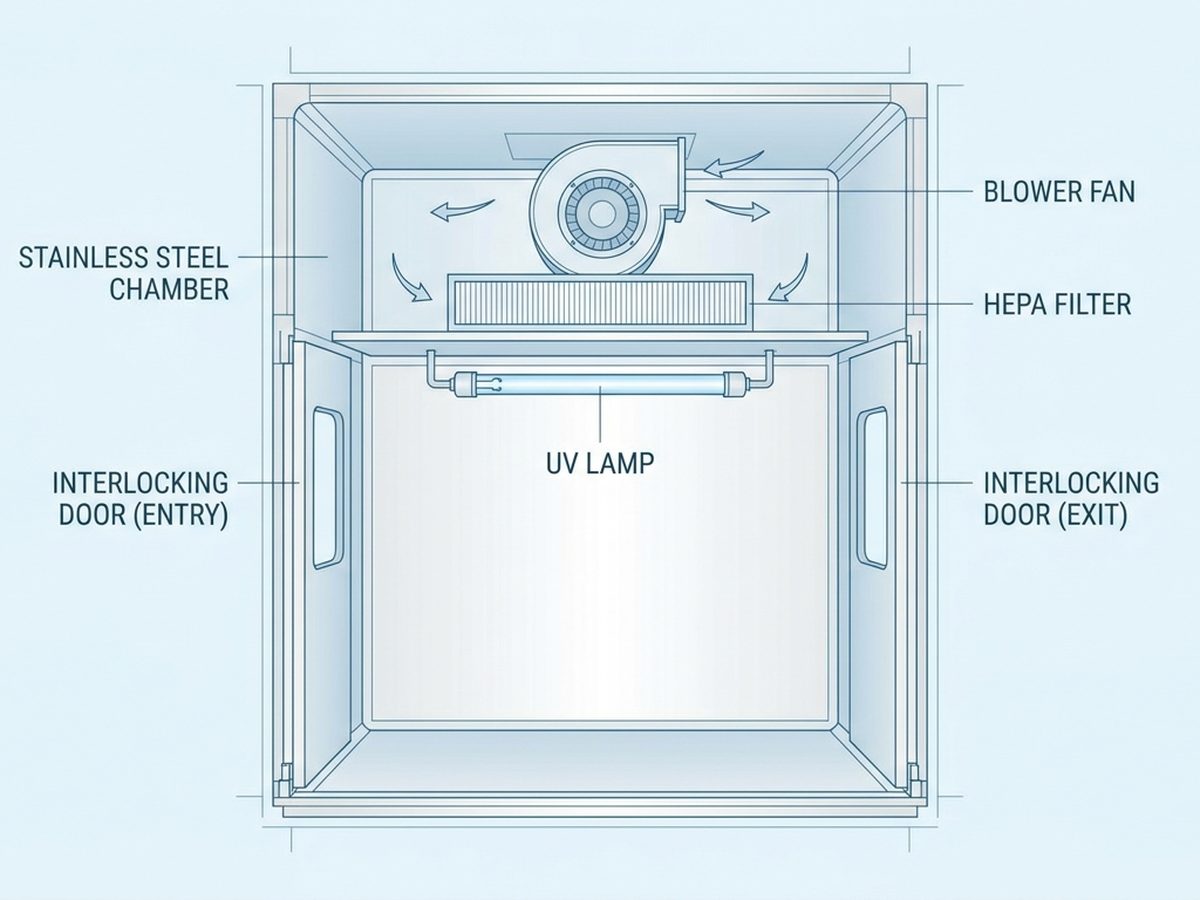
Equipped with a HEPA filter and blower that continuously supplies clean air into the chamber. A dynamic pass box is mandatory when transferring materials from a lower ISO zone to a higher ISO zone (e.g., ISO 8 to ISO 7). The HEPA-filtered air creates positive pressure that prevents external particles from entering.
3. UV Pass Box
Equipped with a UV-C germicidal lamp (254 nm) for surface sterilization of transferred items. Essential for pharmaceutical facilities handling sterile materials and food industries requiring packaging decontamination. UV exposure typically lasts 15–30 minutes per cycle, with an interlock safety feature that prevents the door from opening while UV is active.
ISO 14644 and GMP Standards to Meet
Pass boxes for pharmaceutical and food industries must comply with strict requirements:
- ISO 14644-1:2015 — Air cleanliness classification based on particle concentration. The pass box must maintain room classification on both sides without adding contamination.
- ISO 14644-3:2019 — Cleanroom test methods including filter leakage test and airflow velocity test for dynamic pass boxes.
- GMP Annex 1 (EU) — Requires interlocked pass boxes for sterile production facilities, with routine validation of UV effectiveness and filter integrity.
- CPOB 2018 (BPOM Indonesia) — Good Manufacturing Practice guidelines in Indonesia mandate validated and documented material transfer systems.
A standards-compliant pass box should come with material certificates, filter leak test reports (DOP/PAO test), and operational validation protocols.
Pass Box Materials: Stainless Steel vs Other Options
The construction material of the pass box significantly affects durability, cleanability, and resistance to cleaning chemicals:
| Material | Advantages | Disadvantages | Suitable For |
|---|---|---|---|
| SS304 | Corrosion-resistant, easy to clean, food-grade | Mid-range cost | Standard pharma & food cleanrooms |
| SS316L | Acid & chloride resistant, electropolished surface | Higher cost | Sterile pharma, aggressive chemicals |
| Powder Coated Steel | Economical | Scratch-prone, not resistant to strong disinfectants | Non-critical areas only |
| PVC/Plastic | Lightweight, anti-static | Less rigid | ESD areas, electronics industry |
For pharmaceutical and food cleanrooms, SS304 at minimum — and SS316L if the process involves aggressive disinfectants such as hydrogen peroxide vapor (HPV) or chlorine-based sanitizers.
Pass Box Sizes: Matching Your Transfer Needs
Pass box dimensions should be matched to the largest item being transferred. Common standard sizes available:
- Small: 600 × 600 × 600 mm — for vials, ampoules, lab samples
- Medium: 800 × 800 × 800 mm — for raw material containers, small equipment
- Large: 1000 × 1000 × 1000 mm and above — for drums, packaging cartons, production equipment
- Custom: Tailored to specific cleanroom layout requirements
Rule of thumb: internal dimensions should be at least 20% larger than the largest item to pass through, allowing easy loading and unloading without touching the chamber walls. For larger logistics needs, see our guide on cleanroom pass boxes for logistics.
Interlock Features: Preventing Cross-Contamination
The interlock system is the most critical safety mechanism on a pass box. Two types are available:
- Mechanical Interlock: Uses cables and levers — both doors cannot physically open at the same time. Economical but requires periodic maintenance.
- Electromagnetic Interlock: Uses sensors and solenoid locks. Both doors are electronically locked; one door can only open when the other is fully closed. More reliable and mandatory for sterile pharmaceutical applications.
Important additional features: door status indicator (red/green LED), automatic UV timer, and emergency release for emergency situations. Ensure the interlock has been tested to IEC 61508 safety integrity standards.
Comparing Pass Box Requirements: Pharma vs Food Industry
Not all pass boxes are suitable for every industry. Here is a comparison of specific needs:
| Aspect | Pharma | Food |
|---|---|---|
| Cleanroom Classification | ISO 5–8 (Grade A–D) | ISO 7–8 generally |
| Pass Box Type | Dynamic + UV (mandatory for sterile) | Static with UV (sufficient for most cases) |
| Material | SS316L electropolished | SS304 food-grade |
| Validation | Full IQ/OQ/PQ, DOP test | Cleaning validation, swab test |
| Certification | BPOM CPOB, EU GMP Annex 1 | HACCP, ISO 22000 |
| UV Frequency | Every transfer cycle | Per batch or per shift |
Checklist: 7 Things to Check Before Buying a Pass Box
- Target cleanroom classification — Determine the ISO class on both sides of the pass box. If there is more than a 1-level difference, a dynamic pass box is mandatory.
- Transfer material dimensions — Measure the maximum dimensions of items to be transferred; add a 20% margin.
- Construction material type — Ensure compatibility with the chemical resistance required against the disinfectants you use.
- Interlock system — Electromagnetic for critical applications; verify safety certification.
- Filtration — HEPA H13 minimum for dynamic pass boxes; check replacement filter availability locally.
- UV lamp — If needed, ensure UV intensity ≥ 200 μW/cm² and an hour-meter for scheduled replacement.
- Documentation and after-sales — Ensure the supplier provides FAT/SAT protocols, installation manuals, and local technical support.
Common Mistakes When Choosing a Pass Box and How to Avoid Them
Based on cleanroom project experience in Indonesia, here are the most frequent mistakes:
- Choosing a static pass box for different-level zones — Consequence: ISO validation failure. Solution: always evaluate cleanroom pressure cascade before selecting the type.
- Ignoring interior material finish — Rough surfaces become particle accumulation points. Ensure Ra ≤ 0.8 μm for pharmaceutical applications.
- Not considering expansion — Buying a pass box that is too small. Purchase with a 30% capacity margin to anticipate production increases.
- Skipping FAT (Factory Acceptance Test) — Always request a FAT report before shipment, including filter leak test and interlock function test.
- No cleaning protocol — The pass box must be included in the cleanroom's routine cleaning schedule; document cleaning frequency and methods.
FAQ: Common Questions About Cleanroom Pass Boxes
What's the difference between static and dynamic pass boxes for pharma cleanrooms?
A static pass box has no active filtration system and is suitable for same-ISO zones. A dynamic pass box is equipped with a HEPA filter and blower, mandatory when transferring from a lower ISO zone to a higher one. For sterile pharmaceutical production, a dynamic pass box is the minimum standard required by CPOB and EU GMP Annex 1.
Is UV light mandatory for cleanroom pass boxes?
Not always mandatory. UV light is required if you are transferring materials that need surface decontamination, such as sterile drug primary packaging or ready-to-eat food ingredients. For non-sterile applications, a pass box without UV can be used as long as manual cleaning procedures are consistently applied.
What's the ideal pass box size for the food industry?
For medium-scale food processing, a size of 800 × 800 × 800 mm is generally sufficient for transferring raw materials in standard containers. However, if you are moving drums or large cartons, consider 1000 × 1000 × 1000 mm or a custom size. Always add a 20% margin over the largest item dimension.
How to ensure the pass box meets GMP standards?
Ensure the pass box has: (1) material certificate for SS304/316L, (2) DOP/PAO test report for HEPA filter integrity (if dynamic), (3) validated interlock system, (4) complete IQ/OQ/PQ protocols, and (5) surface roughness ≤ 0.8 μm Ra for pharmaceutical applications. Request this documentation from the supplier before purchase.