

Warehouse Renovation Cost: Sandwich Panel vs Brick Quick Answer
When owners compare warehouse renovation cost using sandwich panels vs brick, they often focus only on material price per square meter. That is too narrow. In real projects, sandwich panels are usually more cost-effective over a 5 to 10 year period because installation is faster, structural load is lighter, maintenance is lower, and thermal performance is more predictable.
If your warehouse must keep operating during renovation, downtime becomes a major cost item. That is where sandwich panels usually outperform brick walls. Brick can still make sense for small areas, non-insulated utility zones, or projects that intentionally want a conventional masonry appearance.
For broader budgeting context, review the warehouse construction cost guide and the comparison of EPS, PU, PIR, and rockwool cores before requesting a final quotation.

What Really Drives Warehouse Renovation Cost?
Before comparing numbers, you need to understand the real cost drivers. Many buyers think only about wall material, while the final warehouse renovation budget is also shaped by the existing frame, target room temperature, project schedule, fire requirements, and finishing expectations.
- Total renovation area and wall height
- Condition of the existing steel or concrete structure
- Panel core selection: EPS, PU, PIR, or rockwool
- Required thermal insulation, hygiene, or fire resistance
- Openings such as loading doors, windows, and internal partitions
- Operational shutdown cost while construction is in progress
For standard logistics warehouses, EPS panels are often chosen because they balance speed and budget. For temperature-sensitive spaces, PU or PIR panels are usually more rational. Rockwool panels become attractive when fire performance and acoustic control matter more than the lowest initial cost.
Initial Cost per Square Meter: Looking Beyond Raw Material Price
Brick or lightweight block may look cheaper at the raw material stage. The problem is that a brick wall is never just brick. You still need mortar, plaster, skim coat, paint, curing time, scaffolding, and more labor coordination. Once those items are included, the early price advantage often shrinks.
Typical sandwich panel renovation cost components
- EPS wall panels 50 to 100 mm: roughly IDR 450,000 to IDR 650,000 per m²
- PU or PIR panels: roughly IDR 650,000 to IDR 950,000 per m² depending on thickness and specification
- Accessories such as trims, flashing, sealant, and fasteners must be included
- Factory-finished surfaces reduce the need for extra finishing work
Typical brick wall renovation cost components
- Core wall material may appear cheaper at first glance
- Plastering, skim coat, and paint usually add substantial cost
- Existing surface correction can increase preparation cost
- Wet work creates a longer and less predictable finishing sequence
This is why decision makers should compare system cost instead of unit cost. Sandwich panels are usually easier to estimate because the scope is cleaner and more standardized from the beginning.
Installation Speed, Downtime, and Site Risk
This is the section that changes the conclusion in many warehouse projects. Renovation is not only about buying material. It is about protecting business continuity. Brick work is slower, messier, and more disruptive because it relies on multiple wet-work stages and a larger work area.
Sandwich panels are installed as a modular dry system. A smaller crew can usually cover more area in less time. The site stays cleaner, zoning is easier, and the renovation can often be phased without stopping all warehouse activity. For active logistics or manufacturing operations, that difference is financially significant.
- Sandwich panels: faster progress, cleaner site, simpler replacement of damaged sections
- Brick walls: slower daily output, more finishing steps, higher risk of disrupting nearby operations
- Light panel weight also reduces the chance of overloading an older structure
If every day of delayed warehouse use affects revenue, downtime should be treated as part of the renovation budget. In many cases, saving two to four weeks of site time is enough to offset the apparent material premium of sandwich panels.
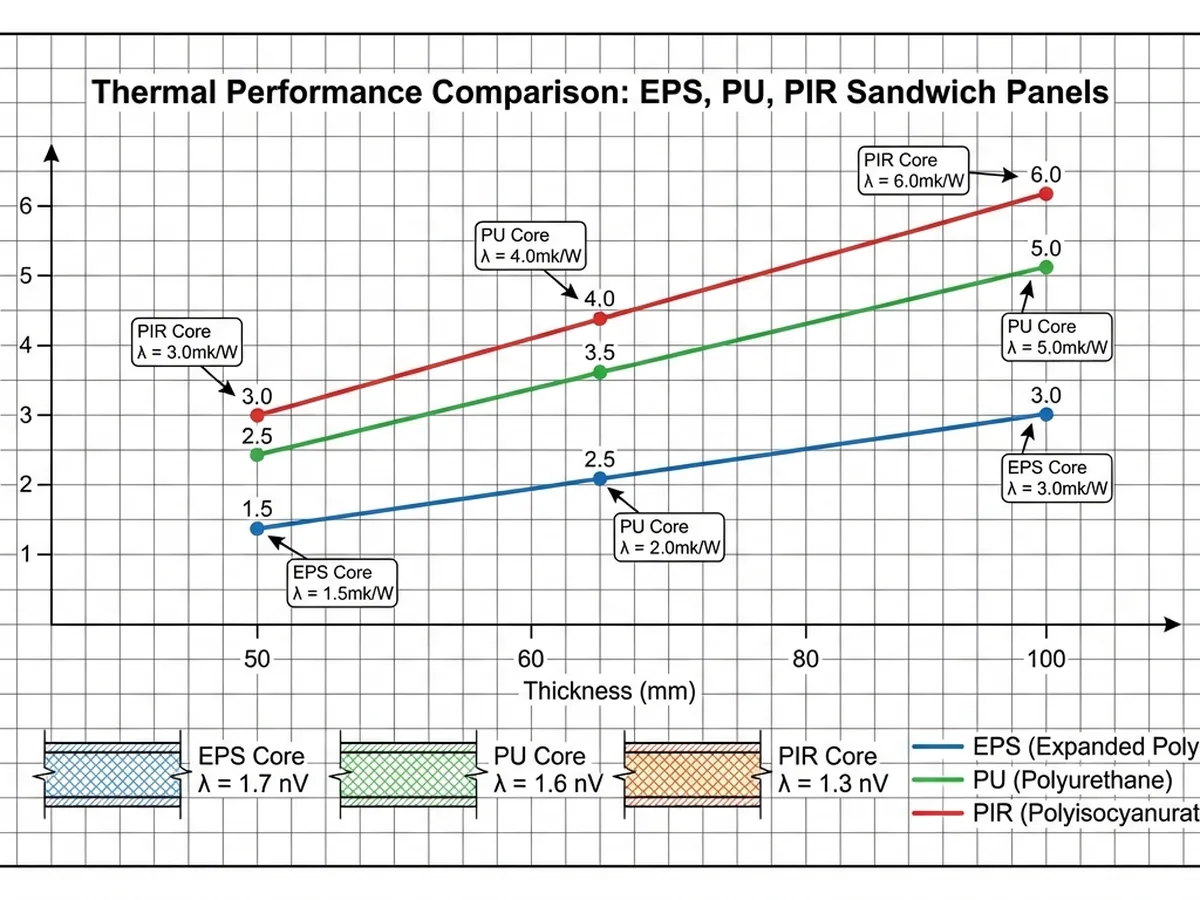
10-Year Total Cost of Ownership Scenario
Assume you are renovating a 500 m² warehouse and want a cleaner envelope, more stable indoor temperature, and lower maintenance. A basic total cost of ownership model is more useful than a simple purchase-price comparison.
Sandwich panel scenario
- Material and accessories: around IDR 275 million to IDR 325 million
- Installation: around IDR 90 million to IDR 120 million
- Shorter operational disruption due to modular dry installation
- Lower long-term maintenance, usually cleaning plus local replacement if damage occurs
Brick wall scenario
- Core wall material may start lower
- Plaster, skim coat, paint, and surface correction increase total project cost
- Longer disruption because the work sequence is slower and curing time is needed
- Future repainting and crack repair are more likely to recur
If the warehouse uses ventilation equipment, evaporative cooling, or air conditioning, a better-insulated wall system can also reduce monthly operating cost. That benefit may not be dramatic in the first week, but it becomes meaningful across years of use.
When Is Brick Still the Better Choice?
Brick is not automatically the wrong answer. It can be reasonable for small renovations, service rooms, low-spec storage areas, or buildings that need a traditional architectural finish. Some local teams are also more familiar with conventional masonry, which can influence labor comfort and execution preference.
Still, the comparison must remain disciplined. If the brick option later requires repainting, anti-moisture treatment, and repeated crack repair, the project may end up costing more than expected. The best option is not the one with the cheapest unit rate, but the one with the healthiest lifecycle economics.
Choosing the Right Core: EPS, PU, PIR, or Rockwool
Not every warehouse needs the highest-spec panel. EPS is often the most economical choice for general warehouses that prioritize speed and budget control. PU and PIR are better for stronger thermal performance, especially in spaces that need temperature stability or lower energy loss.
Rockwool is more relevant when the project puts a higher value on fire resistance and acoustic performance. So when you compare sandwich panel vs brick, you should also compare the right panel core. Overspecifying the core for a standard warehouse can raise cost without creating proportional business value.
- EPS: economical for general warehouse renovation
- PU: better thermal insulation for temperature-sensitive spaces
- PIR: strong balance of thermal efficiency and improved fire performance
- Rockwool: better for fire resistance and sound control priorities
Checklist Before Requesting a Renovation Quotation
To get a realistic quotation, prepare the project data first. A price based only on floor area can be misleading because it may ignore demolition scope, site access, opening details, and performance requirements.
- Measure the length, width, and wall height of the renovation area
- Decide whether the warehouse will stay operational during construction
- Define temperature, hygiene, and fire safety expectations
- List all doors, windows, loading docks, and internal partitions
- Specify whether you need walls, ceiling, roof, or a combined system
- Compare proposals based on total scope, not only panel price
If you want to review system options first, visit the sandwich panel product page. If you already have drawings or existing dimensions, you can send them directly through the contact page for an initial recommendation.
FAQ: Sandwich Panel vs Brick for Warehouse Renovation
Is sandwich panel always more expensive than brick?
No. Panel material may start higher, but total project cost is often more competitive once finishing, labor speed, downtime, and maintenance are included.
How long does a 500 m² sandwich panel renovation take?
The exact duration depends on layout and openings, but modular dry installation is generally much faster than brick because there is no long wet-work finishing sequence.
Is EPS enough for a standard warehouse?
For many logistics warehouses, yes. If higher thermal control or fire performance is required, PU, PIR, or rockwool may be more appropriate.
Are brick walls structurally stronger for warehouses?
Wall performance depends on the full system, including the supporting structure and building objective. Panels are often stronger from an operational perspective because they are lighter, faster to modify, and easier to maintain.
Conclusion and Next Step
If your goal is a warehouse renovation that is fast, clean, easier to maintain, and more efficient in operation, sandwich panels usually provide better value than brick. Brick still has valid use cases, but for active warehouse environments, the total cost picture often favors the panel system once downtime, energy, and maintenance are counted properly.
The best next step is to compare proposals with the same specification basis. Do not compare unfinished brick cost against a complete sandwich panel package. Ask for detailed material scope, installation method, accessories, project duration, and post-renovation operating assumptions.
Need a faster estimate? Send your wall area, height, and warehouse use target through the consultation form. Our team can help determine whether EPS, PU, PIR, or rockwool is the right fit for your budget and performance target.