

Most project owners obsess over sandwich panel thickness and core material, then treat screws, sealant, and flashing as cheap afterthoughts bought wherever is convenient. Yet these accessories decide whether a sandwich panel wall or roof actually stays watertight, survives strong wind loads, and lasts 15-20 years. Even the best panel will leak and corrode early if installed with screws lacking a rubber washer or sealant with the wrong specification.
This guide covers the main types of sandwich panel accessories, what each one does, how to choose the right combination for your project (warehouses, cold storage, cleanrooms, closed livestock housing), and the technical standards installers reference on site. If you still need to compare core materials first, see our complete guide to sandwich panel types on SandwichPanels.id before picking accessories.
Why Sandwich Panel Accessories Deserve Real Attention
A sandwich panel wall works as a system, not a single sheet. Joints between panels, screw penetration points, and the interface between panels and the supporting frame are the most vulnerable spots for air and water leakage. Industry estimates put accessory costs — screws, sealant, flashing, and trim — at roughly 10-15% of total panel material cost, yet failures in these small components cause damage far out of proportion to that cost share.
The most common accessory failures on site are screws installed without an EPDM washer, letting water seep through the penetration hole; generic non-silicone sealant that turns brittle and cracks within a year; and flashing installed without sufficient overlap, letting rainwater in at corner joints. All of these are preventable by matching accessories to the panel manufacturer's specification instead of buying whatever is cheapest at the nearest hardware store.
Types of Sandwich Panel Accessories and Their Functions
Every sandwich panel project, whether wall or roof, needs five core accessory groups:
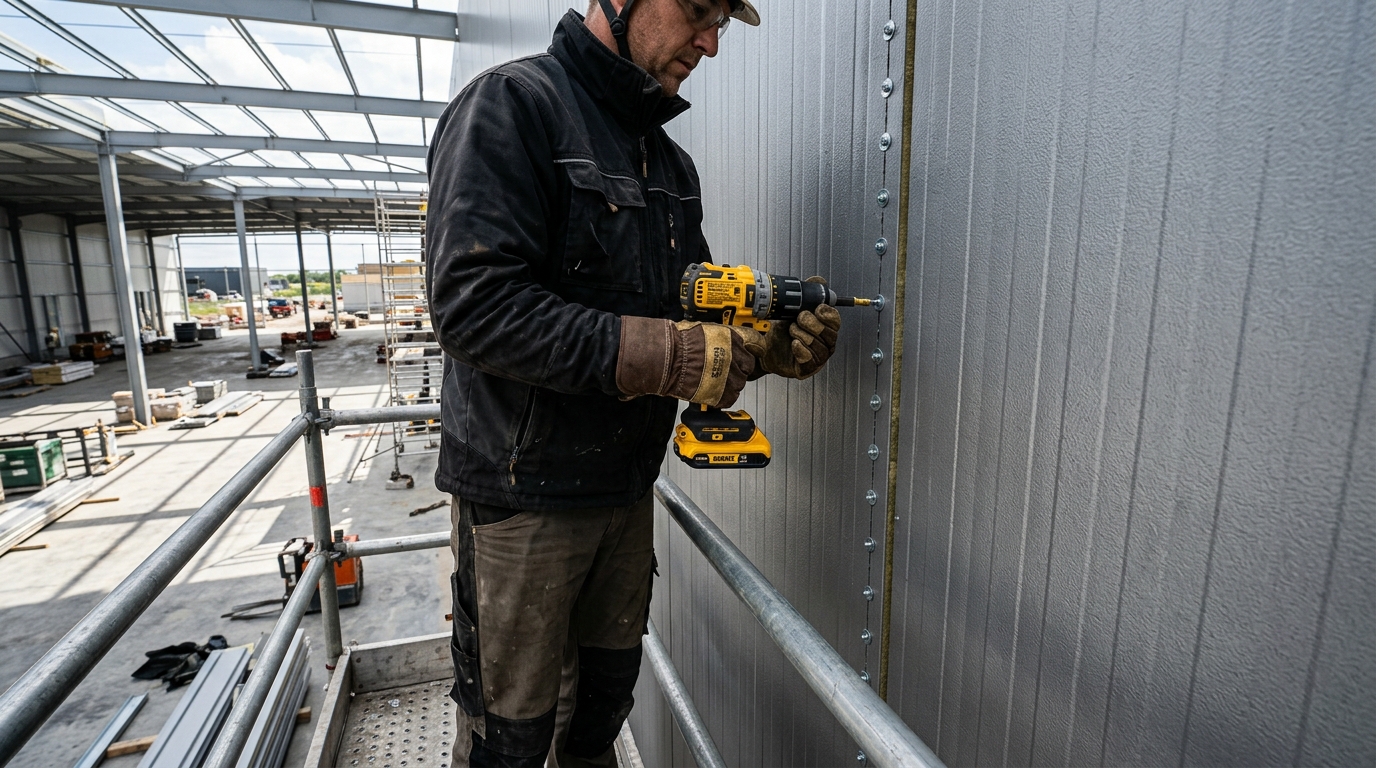
- Self-drilling screws: fasten the panel to the structural frame, fitted with an EPDM washer to seal the penetration hole tightly.
- Silicone sealant: seals joints between panels and gaps around flashing for airtight, watertight performance.
- Metal flashing: protective sheet metal at building corners, roof-to-wall junctions, and around door or window openings.
- Aluminum or galvanized corner trim: protects panel edges from impact while giving a clean finished look.
- EPDM gaskets: additional rubber seals on pressurized joints, common in cold storage and cleanroom applications.
Self-Drilling Screws
Screws must be long enough to pass through the outer skin, the insulation core, and embed at least 20-30 mm into the steel frame for strong wind-load grip. Standard spacing is roughly 30-50 cm at panel edges and 50-100 cm across the middle, depending on local wind load and manufacturer guidance. Light-steel screws in Indonesia should reference SNI 4096:2007 so thread grip is tested and resists slipping when driven through the frame's steel sheet.
Sealant and Flashing
Silicone sealant is preferred for its elasticity and UV resistance compared to generic acrylic sealant, which turns brittle quickly under direct sun exposure. Flashing must be installed with overlap following the direction water flows — the upper piece over the lower one — so rain drains outward instead of seeping into the joint. This sealant-and-flashing combination is what makes a panel system genuinely rainproof per the EN 14509 standard.
How to Choose the Right Sandwich Panel Accessories
Don't source accessories separately from the panel system itself. Follow these steps to make sure the accessory combination truly fits your panel type and project conditions:
- Check the panel manufacturer's recommendation for screw type and quantity per square meter based on the core thickness used.
- Choose structural-grade, exterior-rated silicone sealant, not a general household multipurpose sealant.
- For cold storage or cleanroom applications, confirm gaskets and sealant are food-grade or rated for extreme temperatures as the room requires.
- Match flashing and trim material — aluminum versus galvanized steel — to the site's weather exposure and corrosion risk.
- Ask your supplier to bundle accessories with the panel order so material compatibility is guaranteed and warranty terms remain valid.
If your project involves in-house installation, review the correct work sequence in our step-by-step sandwich panel installation guide so accessories go in at the right points from the start.
Technical Standards and Specifications for Accessories
The European EN 14509 standard requires sealant material at panel joints to meet at least EPDM rubber properties, and flashing must be designed to be rainproof with suitable sealant and fasteners. In Indonesia, light-steel screws should ideally reference SNI 4096:2007, while the base metal thickness (BMT) of supporting frame components should be at least 0.40 mm per SNI 8399:2017 so the frame does not bend when screws are tightened.
For projects requiring formal certification — government warehouses, pharmaceutical facilities, export-grade cold storage — make sure every accessory has written specifications from the supplier, not just the panel itself, since auditors frequently inspect joint details and screw penetration points during building quality inspections.
Schedule periodic inspection of screw joints and sealant, at least once a year for buildings in coastal areas or industrial sites with high chemical exposure. Sealant that has hardened, shows fine cracks, or turned dull yellow signals it needs replacing before an actual leak develops and damages the insulation core behind it.
Estimated Cost of Sandwich Panel Accessories in 2026
As a rough 2026 benchmark, supporting material costs (screws, sealant, flashing, and other accessories) run around IDR 100,000-200,000 per square meter on top of the main panel cost, or about 10-15% of total material value. This figure rises on projects with many corners, openings, and complex joints, since flashing and sealant needs grow significantly compared to a long, plain wall run.
SandwichPanels.id supplies a complete accessory package — self-drilling screws, silicone sealant, flashing, corner trim, and gaskets — matched to the exact panel specification sold, so contractors don't need to hunt down extra components from a different hardware supplier.
FAQ
What is the ideal screw spacing for installing sandwich panel walls?
Standard spacing is roughly 30-50 cm at panel edges and 50-100 cm across the middle, depending on local wind load and the panel manufacturer's guidance. Projects in high-wind areas or tall buildings usually need tighter screw spacing to keep grip on the frame strong.
Can regular sealant replace panel-specific silicone sealant?
It's not recommended. Acrylic or generic sealant tends to turn brittle and crack after repeated exposure to sun and rain, causing the joint to leak again within a short time. Structural silicone sealant is more elastic, UV-resistant, and aligns with EN 14509 for long-term exterior use.
What's the difference between flashing and corner trim on sandwich panels?
Flashing seals joint gaps to keep them watertight and is typically installed at roof-to-wall junctions, building corners, and around openings. Corner trim mainly protects panel edges from physical impact and improves appearance, though both are often installed together at the same corner points.