

Why Panel Accessories Matter as Much as the Panels Themselves
Many contractors and project owners focus on choosing the best sandwich panels — but forget that installation quality heavily depends on the accessories used. Aluminium flashing, trim, sealant, and fasteners are the small components that determine whether your wall and roof panels are truly watertight, durable, and aesthetically finished.
Without the right accessories, the joints between panels become weak points — rainwater enters, wind penetrates, and thermal insulation degrades significantly. In Indonesia's tropical climate with high rainfall and humidity, proper aluminium flashing and sealant are even more critical to protect industrial building integrity over the long term.
In fact, leakage damage at joints often costs more to repair than the initial investment in quality accessories. This guide covers everything you need to know about sandwich panel accessories for Indonesian industrial, warehouse, cold storage, and cleanroom projects.
Types of Sandwich Panel Accessories
Here are the four main categories of accessories you must consider for every sandwich panel project:
1. Aluminium Flashing
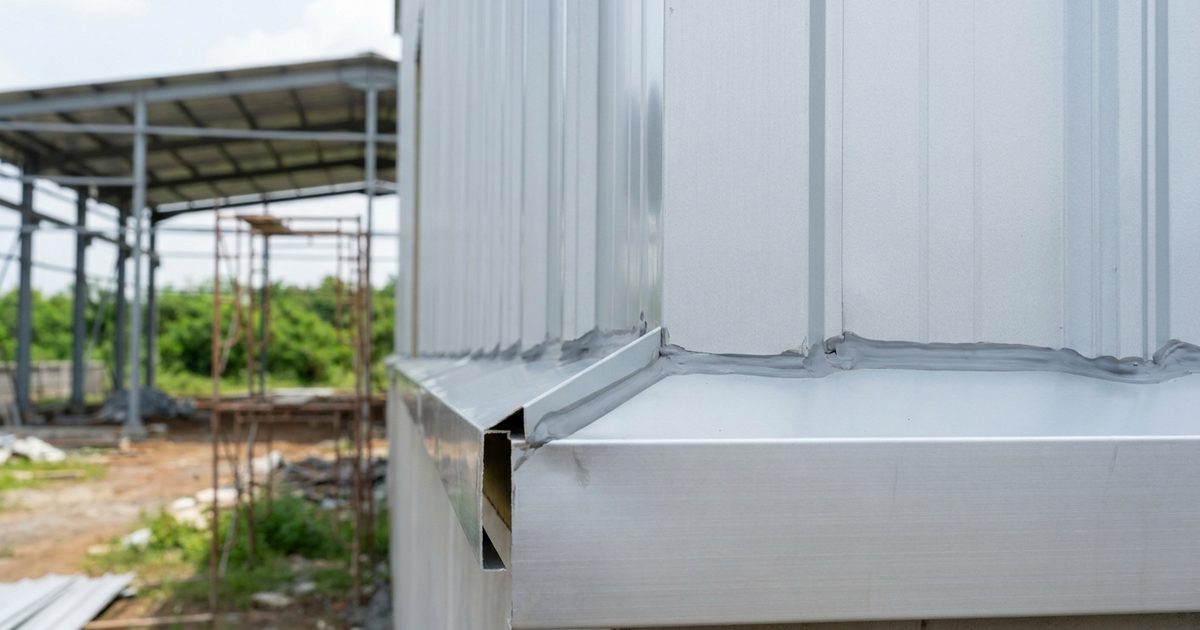
Aluminium flashing seals gaps at corners, wall-roof junctions, and transition areas between panels and other structural elements. Aluminium is chosen because it is lightweight, corrosion-resistant, and easy to shape to building angles. The recommended standard thickness ranges from 0.4 mm to 0.8 mm, depending on installation location and weather exposure.
Most common flashing types:
- Corner flashing — seals external and internal building corners
- Ridge flashing — covers the roof peak where two panel sides meet
- Eave flashing — covers the lower roof edge
- Base flashing — seals the wall-to-floor or wall-to-foundation junction
- Door/window flashing — seals gaps around door and window openings
2. Trim (Joint Cover Profiles)
Trim is a finishing component installed along vertical and horizontal joints between panels. It serves a dual purpose: aesthetics and protection. Without trim, panel joints appear rough and become water entry points.
Trim comes in two main configurations: external trim for the building exterior and internal trim for the interior side. Precise trim installation also helps conceal differential thermal expansion between panels.
3. Sealant
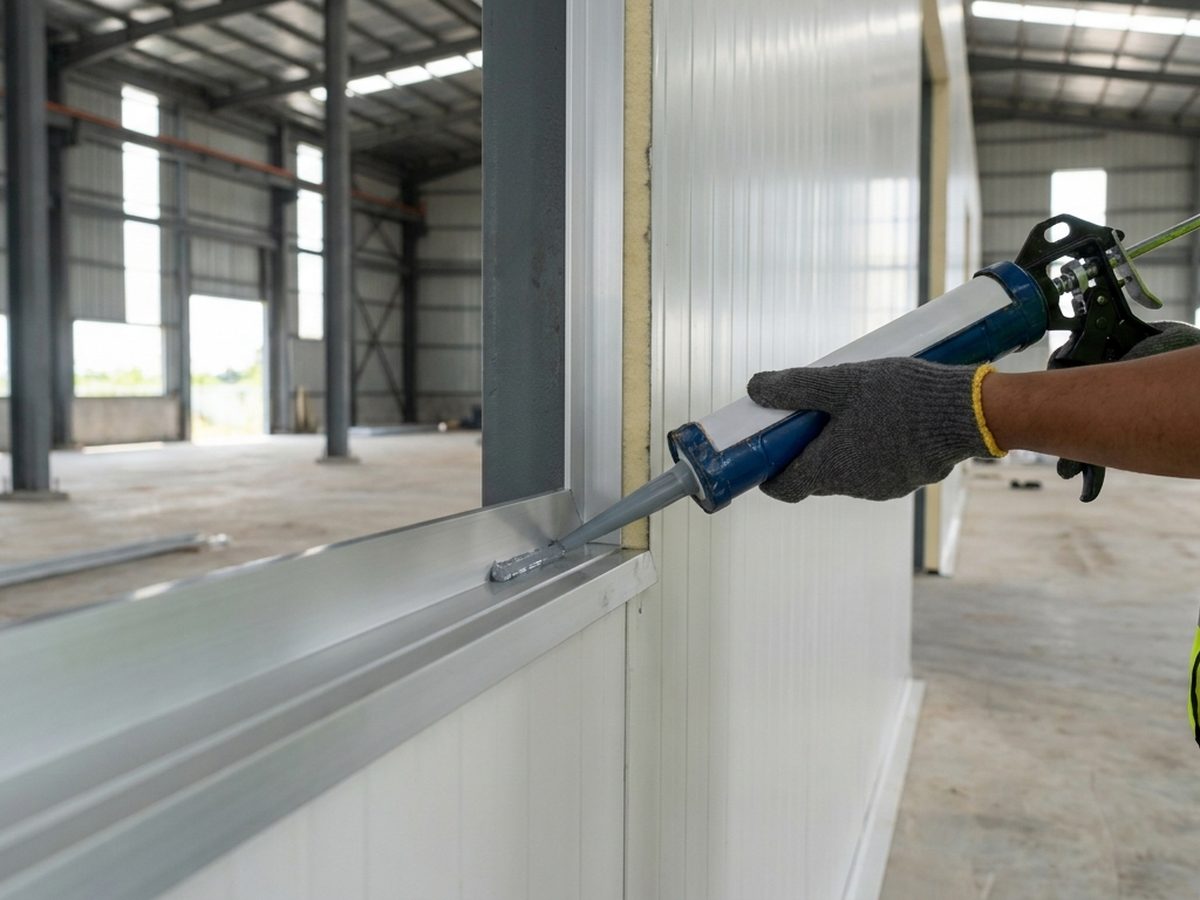
Sealant is an elastic, weather-resistant gap-filling material. Every flashing and trim joint must be sealed to ensure complete waterproofing. Polyurethane (PU) sealant is the best choice for exterior applications due to its high elasticity and strong adhesion to both aluminium and metal sandwich panel surfaces.
Sealant selection criteria:
- Compatible with panel coating (PVDF, PE, FOODSAFE)
- UV-resistant for outdoor applications
- Elasticity ≥ 25% to accommodate thermal expansion
- Temperature resistance from -20°C to +80°C for cold storage and roofing
4. Fasteners (Special Screws and Bolts)
Sandwich panel fasteners are not the same as standard construction screws — using the wrong screws can damage panels, cause leaks, and void manufacturer warranties. Self-drilling screws with EPDM washers are the industry standard; the rubber washer seals the screw hole so water cannot enter.
Screw heads must have corrosion-resistant coating — minimum zinc-plated, ideally stainless steel for coastal areas or cleanroom applications. Fastener spacing and penetration depth must follow the panel manufacturer's specification sheet to avoid over-tightening or under-tightening.
Choosing Accessories by Project Type
Not all projects need the same accessory specifications. Here is a practical guide based on building type:
| Project Type | Flashing Material | Sealant | Fastener |
|---|---|---|---|
| General Factory | Aluminium 0.4 mm, PE coated | Standard PU sealant | Self-drilling zinc-plated |
| Warehouse | Aluminium 0.4-0.5 mm | Standard PU sealant | Self-drilling zinc-plated |
| Cold Storage | Aluminium 0.6 mm, food-grade coating | Low-temp PU sealant | Stainless steel, thermal-break |
| Cleanroom | Aluminium 0.6 mm, PVDF coating | Anti-microbial PU sealant | Stainless steel flush-head |
| Roofing | Aluminium 0.6-0.8 mm, PVDF | UV-resistant PU sealant | Self-drilling, long-life washer |
Common Installation Mistakes
Based on field experience, here are the five most frequent mistakes:
- Skipping sealant behind flashing — flashing that is just screwed down without a sealant layer underneath will almost certainly leak within 6-12 months, especially during high-intensity rainy season
- Flashing overlap too short — joints between flashing pieces must overlap at least 100 mm to prevent water seepage
- Using standard screws without EPDM washers — regular construction screws will rust and water will penetrate through screw holes
- Ignoring thermal expansion — aluminium expands 2.4 mm per meter per 100°C. Without expansion gaps, flashing can warp and sealant joints can detach
- Neglecting internal corner accessories — interior corners are the highest water accumulation areas; internal corner flashing with double sealant is mandatory. See also our cold storage wall panel specifications for more technical details. Corner leaks often go undetected until ceiling or wall damage becomes severe.
FAQ About Sandwich Panel Accessories
Are sandwich panel accessories sold separately or as a package with panels?
Accessories are generally sold separately because every project has different requirements. However, we provide complete panel + accessories packages calculated from shop drawings so flashing, trim, sealant, and fastener quantities are precisely determined.
Can I cut aluminium flashing on-site?
Yes. Aluminium flashing can be cut with metal shears or a thin grinder disc. However, we recommend cutting with precision tools like a portable bending machine for clean angles that preserve the coating. For large volumes, we can supply pre-cut flashing to your specifications.
How long does sandwich panel sealant last?
Quality PU sealant can last 10-15 years in indoor applications and 7-10 years outdoors. We recommend visual inspection every 2 years to check for cracks or detachment in critical areas such as roof corners and window flashing.
What is the difference between aluminium flashing and galvalume flashing?
Aluminium is lighter, more corrosion-resistant, and easier to shape than galvalume. However, for projects with limited budgets and low corrosion risk such as dry interior warehouse spaces, galvalume can be an economical alternative.
Can accessories be color-matched to the panels?
Yes. Aluminium flashing can be coated in the same RAL color as your sandwich panels — whether PE or PVDF coating. This is important for maintaining consistent facade aesthetics.
Conclusion
Sandwich panel accessories are not just add-ons — they are the front line of defense against leaks, corrosion, and insulation degradation. Investing in quality aluminium flashing, precise trim, and premium sealant will save repair costs many times over in the long run.
By choosing the right accessories from the start, you not only protect your building investment but also ensure optimal insulation performance for decades. Each panel construction project — factory, warehouse, cold storage, or cleanroom — has specific accessory requirements. Consult your project needs with our team for a tailored accessory package that fits your design and budget. Or reach us on WhatsApp for a free consultation and cost estimate.