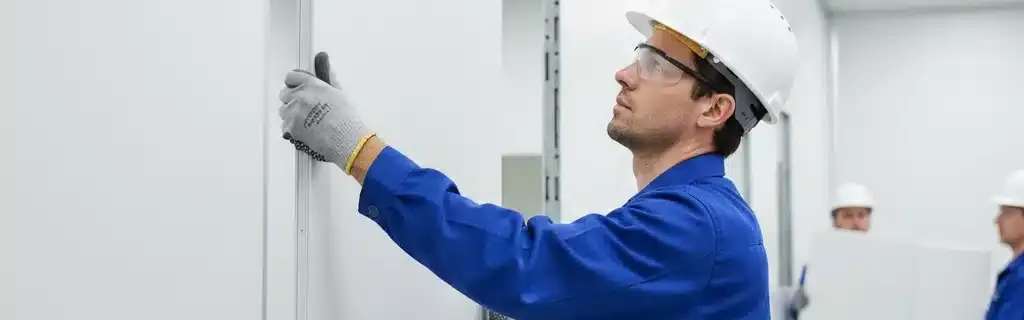

Air Shower for Electronics Factories: Prevent Particle Contamination & Production Defects
In electronics manufacturing — PCB assembly, semiconductors, microprocessing chips — micron-sized particles spell disaster. A single 0.5-micron dust particle landing on a silicon wafer can scrap an entire production batch. This is where air showers serve as the first line of defense between the contaminated external environment and the sterile production zone.
Consider this: you invest hundreds of thousands of dollars in SMT (Surface Mount Technology) machines or lithography scanners, only for entire production runs to be rejected because of dust particles from an operator's cleanroom suit. This is not a rare scenario — it's a daily reality for electronics factories without proper contamination control systems. Air showers are a proven solution that reduces defect rates by 60-80% in high-precision electronics manufacturing.
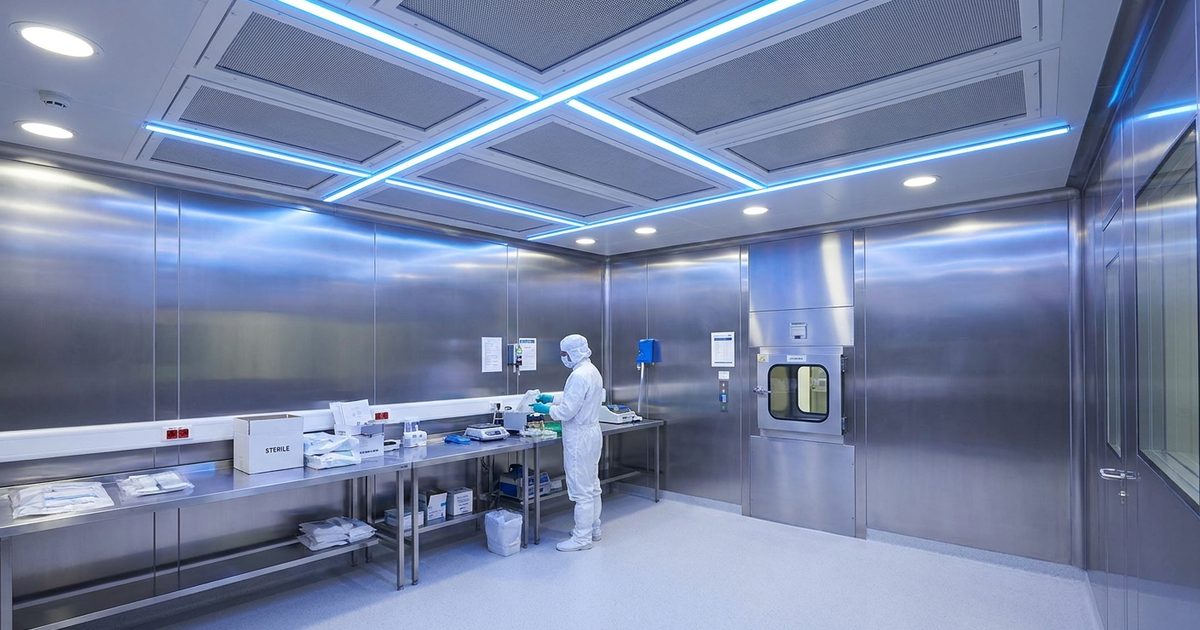
Why Electronics Factories Are Vulnerable to Particle Contamination
Electronics production involves ultra-precision processes. Particles as small as 0.3 microns — invisible to the naked eye — can cause various serious issues:
- Short circuits on densely packed PCB traces — trace pitch can be as narrow as 50 microns on modern multilayer PCBs
- Lithography defects on semiconductor wafers — a single particle can block the photolithography process and ruin an entire die
- Bonding failures in IC wire bonding — contamination prevents perfect adhesion between wire and pad
- ESD (Electrostatic Discharge) triggered by charged particles — voltages as low as 100V can damage MOSFET and CMOS components
- Solder joint failures — particles in the pad area can cause cold solder joints or solder bridging
Contamination sources include human operators (skin flakes, clothing fibers), material movement, cardboard packaging, and outside air entering through doors. Industry data from IEST shows that 70-80% of cleanroom contamination in electronics facilities originates from personnel moving in and out of production areas. The average person sheds 100,000 particles per minute when stationary and up to 2 million particles when walking.
How Air Showers Remove Particles
An air shower is an interlock chamber installed at cleanroom entry points. Unlike bathroom showers, the term "shower" here refers to high-pressure air jets. The working mechanism is structured and battle-tested:
- Personnel enter the chamber; the rear door locks automatically via electromagnetic interlock — both doors cannot open simultaneously (safety interlock)
- Motion/PIR sensors detect presence and activate 0.75-1.5 kW centrifugal blowers
- HEPA/ULPA filters purify air to 99.99% at 0.3 microns — grade H14 for HEPA, U15 for ULPA
- High-pressure nozzles blast clean air from multiple angles (top, left-right sides, front-back) at 20-28 m/s — strong enough to dislodge adhered particles but safe for personnel
- Particles detach from clothing and body surfaces, then get drawn into the exhaust system through pre-filters and exhausted
- Cycle duration: 15-30 seconds, adjustable via PLC — once complete, a green indicator lights up and the front door opens automatically to the clean zone
Advanced models for the electronics industry include ionizer bars — arrays of electrodes generating positive and negative ions to neutralize electrostatic charges (ESD). This is critical in semiconductor production because static charges can attract particles to wafer surfaces and also damage ESD-sensitive components. Some high-end models also feature real-time monitoring systems that log cycle counts, filter pressure, and air velocity for compliance audits.
Right Air Shower Specs for the Electronics Industry
Not every air shower suits electronics manufacturing needs. Here are the key specs to examine when selecting a unit for your facility:
| Parameter | Electronics Industry Recommendation | Important Notes |
|---|---|---|
| Filter | HEPA H14 or ULPA U15 (99.995% @ 0.12μm) | ULPA mandatory for IC/semiconductor fabrication |
| Nozzle air velocity | 22-28 m/s | Below 20 m/s ineffective; above 30 m/s may damage cleanroom garments |
| Number of nozzles | Minimum 12-18 multi-directional | 360° coverage: top 4-6, sides 6-8, rear 2-4 |
| Body material | Stainless steel 304 (minimum) | SS316 for aggressive environments; avoid powder-coated steel (peeling = particle source) |
| Control | PLC + 7" touchscreen | Adjustable cycle time, air speed, delay, auto/manual mode |
| ESD features | Ionizer bar, conductive flooring, grounding strap | Ion balance must be <±30V, decay time <5 seconds |
| Interlock | Electromagnetic with emergency release | Fail-safe: mains failure = manual door opening |
| Lighting | LED 300-500 lux | Dust-resistant, IP65 minimum |
| Noise level | <72 dB(A) | Measured at 1 meter from the unit |
| Dimensions | Single-person: 1200×1000×2100mm (min) | Adjust for corridor width and personnel traffic |
Cleanliness Standards You Must Meet
Electronics factories must comply with stringent standards to maintain production quality and satisfy global customer requirements:
- ISO 14644-1 Class 5-7: For ISO Class 5, maximum 3,520 particles ≥0.5μm per m³. Air showers must maintain transition integrity from uncontrolled areas (ISO 8-9) to production zones (ISO 5-7) without compromising cleanroom classification.
- ANSI/ESD S20.20: International standard for electrostatic discharge control. Requires floor surface resistance <10⁹ Ω, verified grounding system, and documented ESD control program. Air showers for electronics must be part of the EPA (ESD Protected Area).
- SEMI S2: Equipment safety standard specific to the semiconductor industry. Covers emergency stop (E-stop) with <500ms response time, electrical safety per IEC 60204-1, and ergonomic evaluation.
- IEST-RP-CC012: Recommended practice for cleanroom design, including air shower type selection, gowning room zone placement, and differential pressure cascade between zones.
- ISO 14644-2: Periodic monitoring specifications — air shower particle count testing should be performed every 6-12 months to ensure filter and nozzle performance remains optimal.
Single vs Double Stage Air Shower Comparison
One of the most important technical decisions is choosing between single and double-stage air showers. Semiconductor and high-precision electronics factories often opt for double-stage due to stricter cleanliness requirements:
| Aspect | Single Stage | Double Stage |
|---|---|---|
| Configuration | 1 chamber, 1 blow cycle | 2 sequential chambers (gowning + air shower), 2 separate cycles |
| Total duration | 15-25 seconds | 30-50 seconds (configurable) |
| Particle efficiency | 85-95% surface particle reduction | 98-99% — first chamber removes large particles, second cleans residue |
| Cost range | USD 5,000-12,000 | USD 10,000-23,000 |
| Best for | ISO 7-8, PCB assembly, passive components | ISO 5-6, wafer fabrication, lithography, back-end packaging |
| Personnel throughput | High — ideal for facilities with 50-100+ personnel per shift | Moderate — better suited for critical areas with limited access |
| Power consumption | 1.5-3 kW per cycle | 3-5 kW for 2 cycles |
For PCB assembly, passive component assembly, and SMT lines, single stage is typically sufficient, provided strict gowning procedures are followed outside the chamber. For wafer fabrication, 5nm/7nm lithography, and chip packaging, double stage with ULPA U15 filters and ionizers is a mandatory investment that pays for itself through reduced defect rates.
Tips for Choosing Air Showers for Your Electronics Facility
- Calculate daily personnel traffic: How many operators, engineers, and visitors enter/exit the production area per shift? Choose chamber size accordingly — single-person pass (standard) or double-person pass (for high traffic with paired operators). Consider wait times; with 100 personnel per shift and a 25-second cycle, a single chamber needs approximately 42 minutes just for entry.
- Ensure comprehensive ESD compatibility: Verify that body material, flooring, nozzles, and internal components meet ANSI/ESD S20.20. Request surface resistivity test certificates (<10⁹ Ω), ion balance certificates (<±30V), and decay time (<5 seconds). All metal components must be grounded to the facility's integrated grounding system.
- Check spare parts and consumables availability: HEPA H14 filters require replacement every 12-18 months, ULPA U15 every 12 months. Pre-filters (G4) need monthly cleaning and replacement every 3-6 months. Ensure your supplier provides original replacement filters, not generic compatibles.
- Verify installation and commissioning: Air showers must be installed by certified technicians. Commissioning must include: velocity profile testing at every nozzle, particle count testing (inside chamber after cycle), filter integrity/DOP testing, interlock function testing, and E-stop verification.
- Consider additional compliance-enhancing features: UV-C sterilizer (optional for hybrid electronics-biomedical cleanrooms), mechanical emergency door release, digital data logging for ISO audit trails, and remote monitoring via SCADA/BMS.
- Compare warranty and after-sales support: Choose a supplier offering at least 1-year full warranty (parts + labor), maximum 24-hour service response time, and technicians who can visit your site. Also inquire about annual preventive maintenance contract availability.
Brief Case Study: Without vs With Air Shower
A PCB assembly factory in Batam, Indonesia reported a 3.2% defect rate before air shower installation — primarily caused by solder bridging and open circuits due to particle contamination. After installing a single-stage air shower with HEPA H14 and implementing strict gowning procedures, the defect rate dropped to 0.7% within the first 3 months. With a production volume of 50,000 units per month, savings from reduced rejects reached approximately USD 12,000 per month — achieving air shower ROI in less than 2 months.
FAQ: Air Shower for Electronics Factories
What is the difference between single-stage and double-stage air showers?
Single-stage has one chamber with one blow cycle (15-25 seconds), 85-95% efficiency, suitable for ISO 7-8 and PCB assembly. Double-stage has two sequential chambers with two cycles (30-50 seconds), 98-99% efficiency, mandatory for ISO 5-6 and semiconductor wafer fabrication.
Is an ionizer mandatory for electronics factory air showers?
For semiconductor production and ESD-sensitive components (MOSFET, CMOS), ionizers are strongly recommended because static charges can attract particles and damage components. For PCB assembly without ESD-sensitive components, ionizers are optional but still recommended for maximum cleanliness.
How much does air shower installation cost for electronics factories?
Single-stage air showers cost approximately USD 5,000-12,000, while double-stage ranges from USD 10,000-23,000. Pricing depends on specifications (HEPA/ULPA, SS304/SS316 material, ESD features, control system). ROI is typically achieved within 2-6 months through reduced production defect rates.
Conclusion
An air shower is not just an "automatic door with wind" — it's a critical contamination control system that directly impacts electronics production yield. An investment of USD 5,000-23,000 in the right air shower can save millions from scrapped production batches due to particle contamination. In an industry with competitive margins like electronics manufacturing, contamination control is the difference between profit and loss.
PT. Ruida Grup Indonesia provides cleanroom air showers with custom specifications for electronics, semiconductor, pharmaceutical, and other precision industries. Stainless steel 304/316 construction, HEPA H14 / ULPA U15 filters, integrated ESD ionizers, and installation by certified technicians with full commissioning documentation.
Contact our team via WhatsApp for a consultation. Also browse our other cleanroom articles for complete facility guidance. for a consultation on air shower specifications suited to your electronics facility's needs. Complimentary site survey and design recommendations are also available.