
What Is an Air Shower and Why Do Laboratories Need One?
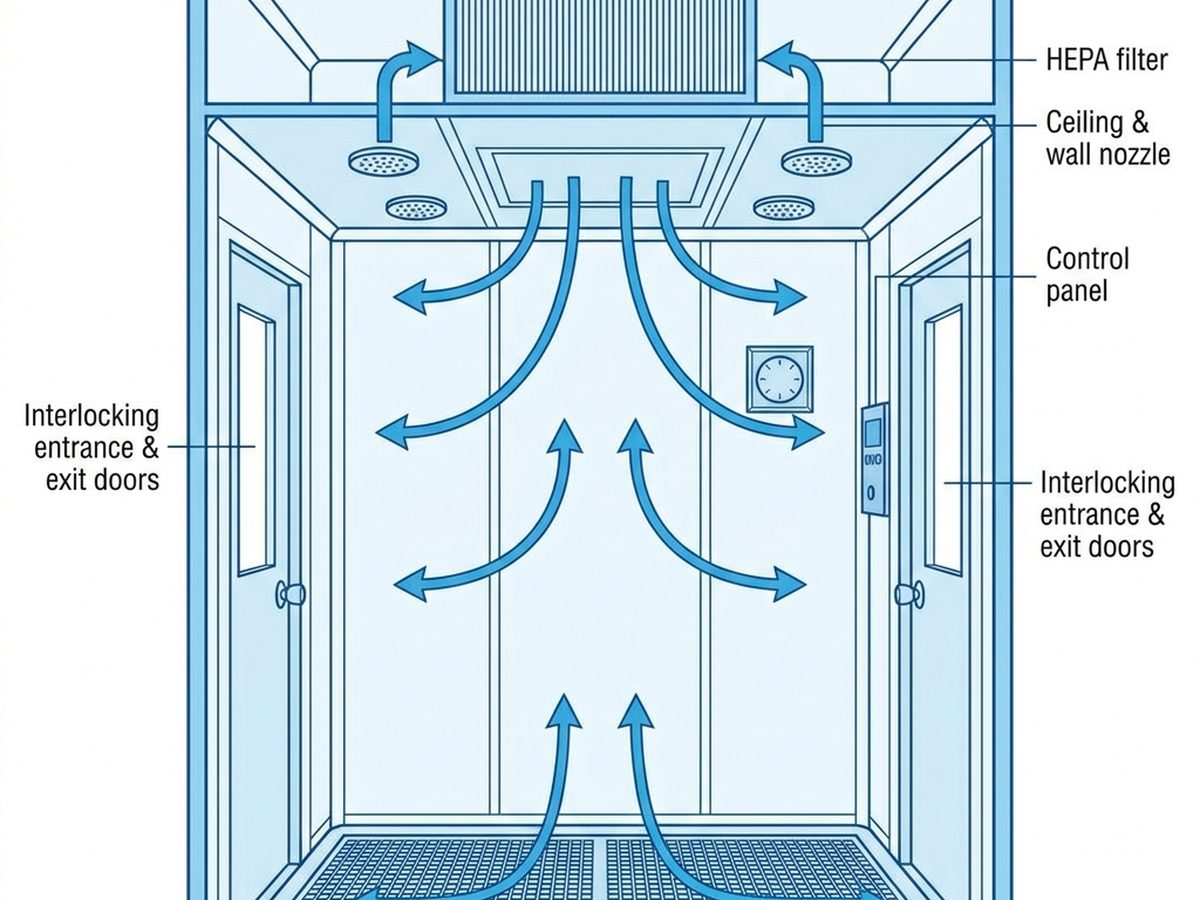
An air shower is an automated decontamination chamber installed at the entrance to clean areas. It blows high-velocity air through nozzles to remove dust particles and contaminants from personnel clothing before they enter sterile zones.
In pharmaceutical and microbiology laboratories, contamination is not just a quality issue — it directly affects patient safety and research validity. A single foreign particle can contaminate bacterial cultures, ruin a drug production batch, or produce false positives in microbiological testing.
WHO GMP (Good Manufacturing Practice) standards and Indonesia's CPOB explicitly require personnel contamination control in Grade A, B, and C pharmaceutical facilities. The air shower serves as the first line of defense before HEPA filters and the cleanroom HVAC system.
Lab vs Industrial Air Shower: Key Differences
Not all air showers are alike. Units for pharmaceutical laboratories have stricter requirements compared to those for electronics factories or general manufacturing:
- Construction materials: Pharma labs require stainless steel 304 or 316L resistant to chemical disinfectants (70% alcohol, hydrogen peroxide, chlorine-based cleaners). Carbon steel with powder coating is not recommended due to corrosion risk and particle shedding.
- Air velocity: Minimum 20–25 m/s at the nozzle exit to ensure particles ≥0.3µm are dislodged from clothing. Microbiology labs often require ≥25 m/s due to higher biological contamination risk.
- Filtration system: HEPA filter H14 (efficiency ≥99.995% at 0.3µm) as the minimum standard. BSL-2/BSL-3 labs may require ULPA filter U15 (≥99.9995%).
- Cycle time: 15–25 seconds for standard pharma labs. Electromagnetic door interlocks are mandatory — entry and exit doors must never open simultaneously.
- Validation and documentation: IQ/OQ/PQ (Installation Qualification, Operational Qualification, Performance Qualification) must be fully documented for BPOM and ISO 14644 audits.
Key Technical Specifications
Here are the specifications to evaluate before purchasing an air shower for your laboratory:
1. Dimensions and Capacity
Standard dimensions: width 800–1,200mm, depth 1,000–1,500mm, height 2,000–2,200mm. Choose based on the number of personnel passing through per shift. For labs with >20 personnel per shift, consider a tunnel-type air shower or dual-unit parallel installation to avoid bottlenecks.
2. Nozzles and Spray Pattern
360° adjustable stainless steel nozzles mounted on three sides (left, right, top). Standard nozzle count: 18–24 units. The spray pattern must cover the entire body from shoulders to feet. Ceiling nozzles target the head and shoulders — the most critical areas due to particles from hair and scalp.
3. Blower and Static Pressure
Centrifugal blower with 0.75–1.5 kW motor, static pressure 400–600 Pa. Higher static pressure ensures consistent air velocity as filters begin to clog. Blowers with variable frequency drives (VFD) allow speed adjustment for different cleanliness levels.
4. Control Panel
PLC with 7-inch touchscreen displaying: door interlock status, HEPA filter operating hours, fault alarms, and emergency stop. Data logging capability is important for audits — recording cycle counts, durations, and alarms per day.
5. Flooring and Drainage
Stainless steel grating floor with a particle collection sump underneath. For pharma labs requiring wet cleaning, ensure a drainage connection to the facility's waste system.
Regulatory Compliance
Air showers in Indonesian laboratories must comply with several regulations:
- CPOB 2018 (BPOM): Requires drug manufacturing facilities to have personnel contamination control systems. Air showers are a recognized method.
- ISO 14644-1: Cleanroom classification standard. Air showers help maintain ISO 7 (Class 10,000) to ISO 5 (Class 100) in sterile production areas.
- WHO GMP Annex 1: International sterile product guideline — emphasizes the importance of controlled gowning rooms and personnel transfer.
- ISO/IEC 17025: For testing and calibration laboratories — environmental control including cross-contamination prevention.
Installation and Cleanroom Integration
An air shower is not plug-and-play equipment. Proper installation requires the following considerations:
- Location: Between the gowning room and the clean production/work area. Ideally in a straight-through configuration (separate entry and exit paths) to prevent cross-contamination.
- Room pressure: The clean area must maintain positive pressure relative to the air shower (+10–15 Pa) to prevent unfiltered air from entering.
- Sealing: All joints between the air shower and cleanroom partitions must be sealed with food-grade or pharma-grade silicone sealant to prevent air leakage.
- Power supply: 220V/1-phase/50Hz Indonesia standard for small units; 380V/3-phase for large or tunnel-type units. Use a dedicated circuit with UPS for emergency stop and door release during power outages.
- BMS integration: For large facilities, connect the air shower PLC to the Building Management System for centralized monitoring and automatic alarms.
Tips for Selecting an Air Shower Vendor
When choosing an air shower vendor for your laboratory, evaluate these criteria:
- Pharma experience: Ask for a project portfolio in the pharmaceutical or laboratory industry — not just electronics factories. Request client references.
- IQ/OQ/PQ documentation: The vendor must provide complete qualification protocols. This is non-negotiable for BPOM audits.
- Spare parts availability: HEPA filters, nozzles, door seals, and PLCs must be available on short notice. Air shower downtime equals production downtime.
- After-sales service: Air velocity calibration, HEPA filter replacement, and biannual preventive maintenance should be included in the contract.
- Material certification: Request material certificates for stainless steel (mill certificates) and HEPA filter test reports (DOP/PAO test).
Routine Maintenance and Filter Replacement Schedule
Air showers require regular maintenance to maintain performance:
- Daily: Check the HEPA filter differential pressure indicator. If ΔP exceeds 2x the initial value, the filter must be replaced.
- Weekly: Clean stainless steel surfaces with compatible disinfectant. Check door interlock and emergency stop functions.
- Monthly: Measure air velocity at each nozzle using an anemometer. A >15% variation between nozzles indicates uneven filter loading or blower issues.
- Biannual: DOP/PAO test for HEPA filter integrity verification. Replace pre-filters (G4/F8) every 3–6 months depending on environmental particle load.
- Annual: Sensor calibration and performance re-validation (including particle count testing inside the air shower during operation).
Read also: HEPA Filter Replacement Schedule for Cleanrooms
FAQ
Common questions about air showers for laboratories:
What is an air shower?
An air shower is a small automated decontamination chamber installed at clean area entrances, using high-velocity HEPA-filtered air jets through nozzles to remove particles from personnel clothing before entering a cleanroom or sterile laboratory.
Is an air shower necessary for pharmaceutical laboratories?
Yes. CPOB and WHO GMP standards require personnel contamination control for Grade A, B, and C pharmaceutical facilities. Air showers are a recognized method for reducing particle and microbial contamination risk from personnel.
What's the difference between an air shower for pharma labs vs electronics factories?
Pharma lab air showers use stainless steel 304/316L (not powder-coated carbon steel), minimum HEPA H14, air velocity ≥20 m/s, and require complete IQ/OQ/PQ documentation for BPOM audits. Units for electronics factories generally have lower specifications.
How long is a standard air shower cycle?
15–25 seconds for standard pharmaceutical laboratories. Duration can be adjusted based on required cleanliness levels.
Do air shower doors need to be interlocked?
Yes, electromagnetic door interlocks are mandatory. This system ensures entry and exit doors cannot open simultaneously, preventing cross-contamination and maintaining room pressure differentials.
How much does a laboratory air shower cost?
Costs vary depending on size, material (304 vs 316L), filter type (HEPA vs ULPA), and control features. Contact our team for a specific quotation tailored to your laboratory needs.
Conclusion
An air shower is an essential investment for pharmaceutical and microbiology laboratories serious about contamination control. Selecting the right unit — with stainless steel 304/316L, HEPA H14, interlock system, and complete IQ/OQ/PQ documentation — will protect the integrity of your research and production for years to come.
For laboratory air showers that meet GMP and ISO standards, contact our team via the contact page or WhatsApp for specifications and pricing consultations.