

Modern Factory Wall Solutions: Sandwich Panel vs Traditional Construction
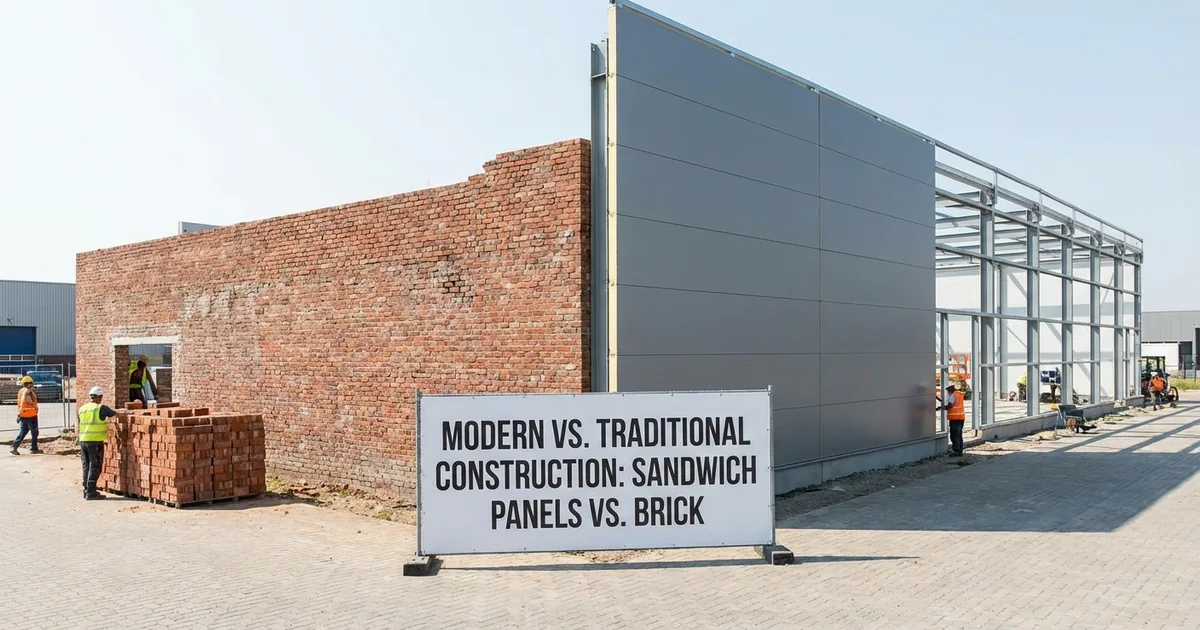
If you're planning to build or renovate a factory, questions about wall materials inevitably arise. Conventional factory walls made of brick and concrete have long been industry standards, but are they still the best choice in the modern era?
Many factory owners face serious issues with traditional walls: high maintenance costs, long construction times, low thermal efficiency, and inflexibility for expansion. In this article, we'll discuss modern solutions using sandwich panels and compare them with traditional construction methods.
5 Major Problems with Conventional Factory Walls
Before discussing solutions, let's first understand the problems faced with conventional factory walls:
1. Poor Thermal Efficiency
Brick and concrete have high thermal conductivity values, meaning they easily transfer heat. In tropical climates like Indonesia, this causes factory temperatures to rise dramatically. Consequently, cooling costs (AC or exhaust fans) can be 30-40% higher compared to buildings with proper insulation.
2. Lengthy Construction Time
The brick wall construction process requires significant time. From foundation installation, brick laying, plastering, to painting takes at least 2-3 months for a medium-sized factory. Longer time means higher overhead costs and production delays.
3. High Maintenance Costs
Brick and concrete walls are susceptible to cracking, water seepage, and structural damage over time. Routine maintenance like repainting, crack repairs, and waterproofing is needed every 3-5 years, adding to long-term operational costs.
4. Inflexibility for Expansion
When a factory needs expansion, brick/concrete walls are difficult to modify. Demolition and reconstruction require substantial time and cost. This low flexibility becomes a barrier for rapidly growing businesses.
5. Heavy Structural Load
Brick and concrete walls have significant weight, requiring stronger and more expensive foundations. This load also limits architectural design and future modification possibilities.
Solution: Sandwich Panels as Modern Alternative
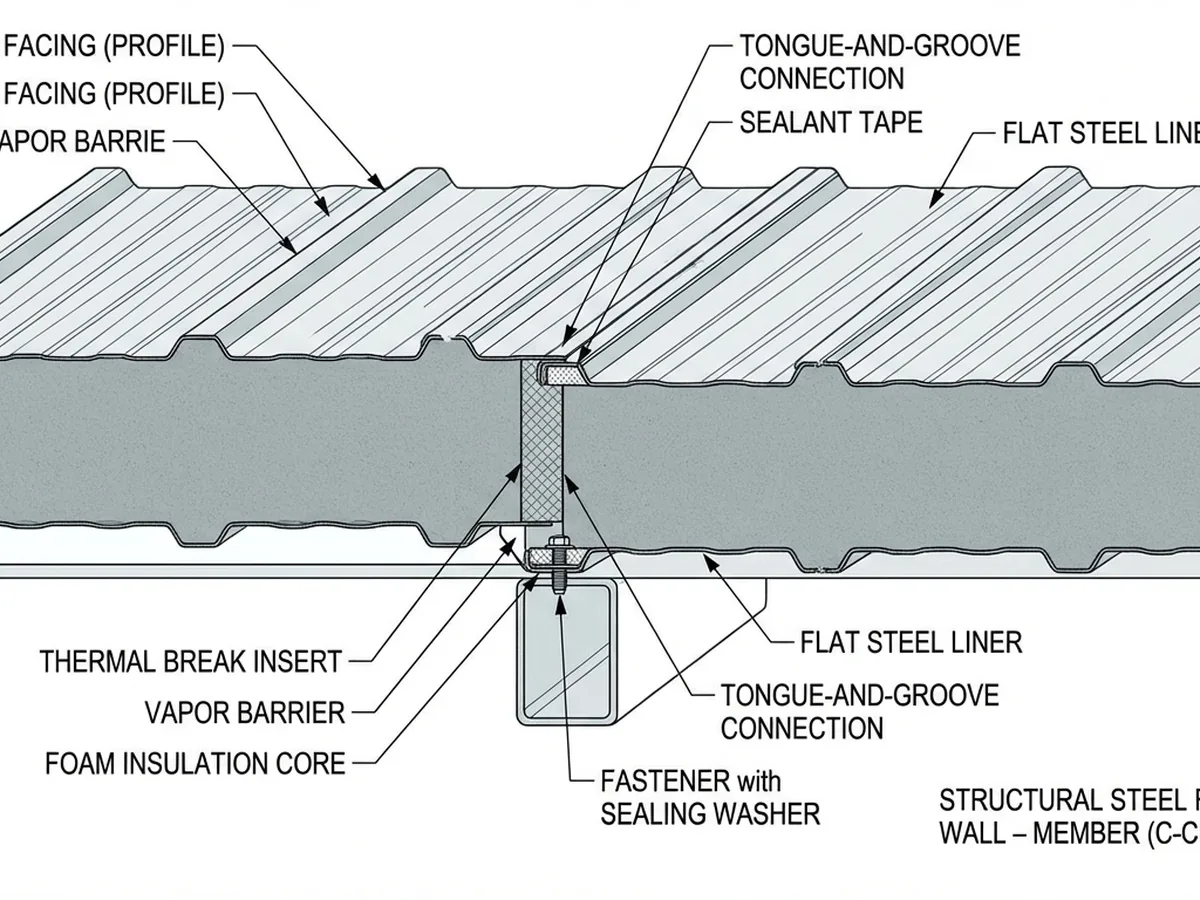
Sandwich panels offer innovative solutions to the above problems. This material consists of three layers: two skin layers (usually galvanized steel or aluminum) and one insulation core layer (could be polyurethane, PIR, or rockwool).
Key Advantages of Sandwich Panels for Factories:
Superior Energy Efficiency: With low U-values (thermal transmittance), sandwich panels reduce heat transfer by up to 70% compared to brick walls. This means significant energy savings for cooling.
Fast Installation Time: Prefabricated panel systems allow installation 3-5 times faster than traditional construction. A 1,000 m² factory can be completed in 2-3 weeks, not months.
Minimal Maintenance: Sandwich panel surfaces are resistant to corrosion, mold, and environmental damage. No repainting or special maintenance is required beyond routine cleaning.
Design Flexibility: Panels can be easily installed, moved, or modified for expansion needs. Modular systems allow layout changes without massive demolition.
Lightweight yet Strong: Although lightweight, sandwich panels have adequate structural strength for most industrial applications, with lighter foundation requirements.
For more information about sandwich panel technical specifications, visit our sandwich panel products page.
Comprehensive Comparison: Sandwich Panel vs Brick/Concrete
| Parameter | Sandwich Panel | Brick/Concrete |
|---|---|---|
| Construction Time | 2-3 weeks (1,000 m²) | 2-3 months (1,000 m²) |
| Initial Cost | IDR 1.2-1.8 million/m² | IDR 800,000-1.2 million/m² |
| Annual Operational Cost | IDR 50,000-100,000/m² | IDR 150,000-250,000/m² |
| Thermal Efficiency | U-value: 0.2-0.4 W/m²K | U-value: 1.5-2.5 W/m²K |
| Service Life | 25-30 years | 20-25 years |
| Maintenance | Minimal (cleaning only) | Intensive (every 3-5 years) |
| Modification Flexibility | Very High | Very Low |
| Weight | 15-25 kg/m² | 200-300 kg/m² |
Although sandwich panels have slightly higher initial costs, operational cost savings and faster construction time provide better ROI in the long term.
Case Studies: Real Industrial Applications
Case 1: Frozen Food Factory in Bekasi
A 2,500 m² frozen food factory switched from brick wall plans to sandwich panels. Results:
- Construction time reduced from 6 months to 6 weeks
- Cooling costs decreased 45% thanks to better insulation
- 500 m² production area expansion took only 2 weeks
- ROI achieved within 2.5 years from energy savings
Case 2: Logistics Warehouse in Surabaya
A logistics company chose sandwich panels for their new warehouse:
- Installation completed in 4 weeks despite rainy season
- No moisture or mold problems common with brick walls
- Flexibility to add loading dock doors without damaging structure
- 5-year maintenance cost: 0 (zero)
See more case studies on our projects page for inspiration on sandwich panel applications across various industries.
Guide to Choosing Sandwich Panels for Factories
If you're considering sandwich panels, here are factors to consider:
1. Insulation Core Type
Polyurethane (PUR/PIR): Highest thermal efficiency, lightweight, suitable for cold storage and temperature-controlled spaces.
Rockwool: Better fire resistance, suitable for areas with high fire risk.
EPS (Expanded Polystyrene): Most economical, suitable for standard warehouses and industrial buildings.
2. Panel Thickness
Common thicknesses: 40mm, 50mm, 75mm, 100mm, 150mm. Thicker panels provide better insulation. For factories in Indonesia, 75-100mm is recommended for cost-performance balance.
3. Surface Finishing
PE (Polyester): Standard, good weather resistance, economical choice.
PVDF: Better UV and corrosion resistance, suitable for coastal environments.
HDP (High Durability Polyester): Performance between PE and PVDF with competitive pricing.
4. Joining System
Ensure the joining system provides good air and water tightness. Tongue-and-groove systems with double seals offer the best performance.
FAQ (Frequently Asked Questions)
1. Are sandwich panels strong enough for factory walls?
Yes, modern sandwich panels are specifically designed for industrial applications. With proper thickness and specifications, they can withstand wind loads, pressure, and factory environmental conditions. Structural strength is supported by well-integrated steel framing.
2. What about fire resistance?
Sandwich panels with rockwool cores have fire resistance classifications up to 2 hours. Panels with PIR cores also have self-extinguishing properties. It's important to choose materials that comply with local fire regulations and your industry type.
3. How long is the service life of sandwich panels?
With proper installation and maintenance, sandwich panels can last 25-30 years. High-quality surface coatings protect against corrosion and UV degradation.
4. Can sandwich panels be installed over existing structures?
Yes, one of the advantages of sandwich panels is easy retrofitting. Panels can be installed as cladding over existing walls, improving thermal performance without complete demolition.
5. How do long-term costs compare?
Although initial costs are 20-30% higher than brick, sandwich panels save 40-60% on energy costs and 80-90% on maintenance costs. ROI is typically achieved within 3-5 years, after which you enjoy net savings.
Conclusion
Conventional factory walls of brick and concrete certainly have their place in industrial history, but in the modern era demanding efficiency, flexibility, and sustainability, sandwich panels offer superior solutions.
From the comprehensive analysis above, it's clear that sandwich panels provide:
- Significant energy savings through superior insulation
- Faster construction time to accelerate ROI
- Minimal maintenance costs throughout building lifespan
- Unmatched flexibility for expansion and modification
- Environmentally friendly solutions with lower carbon footprint
For factory owners wanting to remain competitive in an increasingly tight market, investment in modern building technology is no longer an option—it's a necessity.
🚀 Ready to Transform Your Factory?
Our expert team is ready to help analyze your factory's specific needs and recommend optimal sandwich panel solutions. Get free consultation and personalized ROI calculations for your project.