

A paint room asks for a combination that is rarely requested together: a surface that is easy to clean of overspray, fire performance in the enclosure itself, and tight joints that do not trap paint dust. Plenty of suppliers sell ready-made booths, yet almost nobody explains which document actually governs the walls, partitions, and ceiling around them.
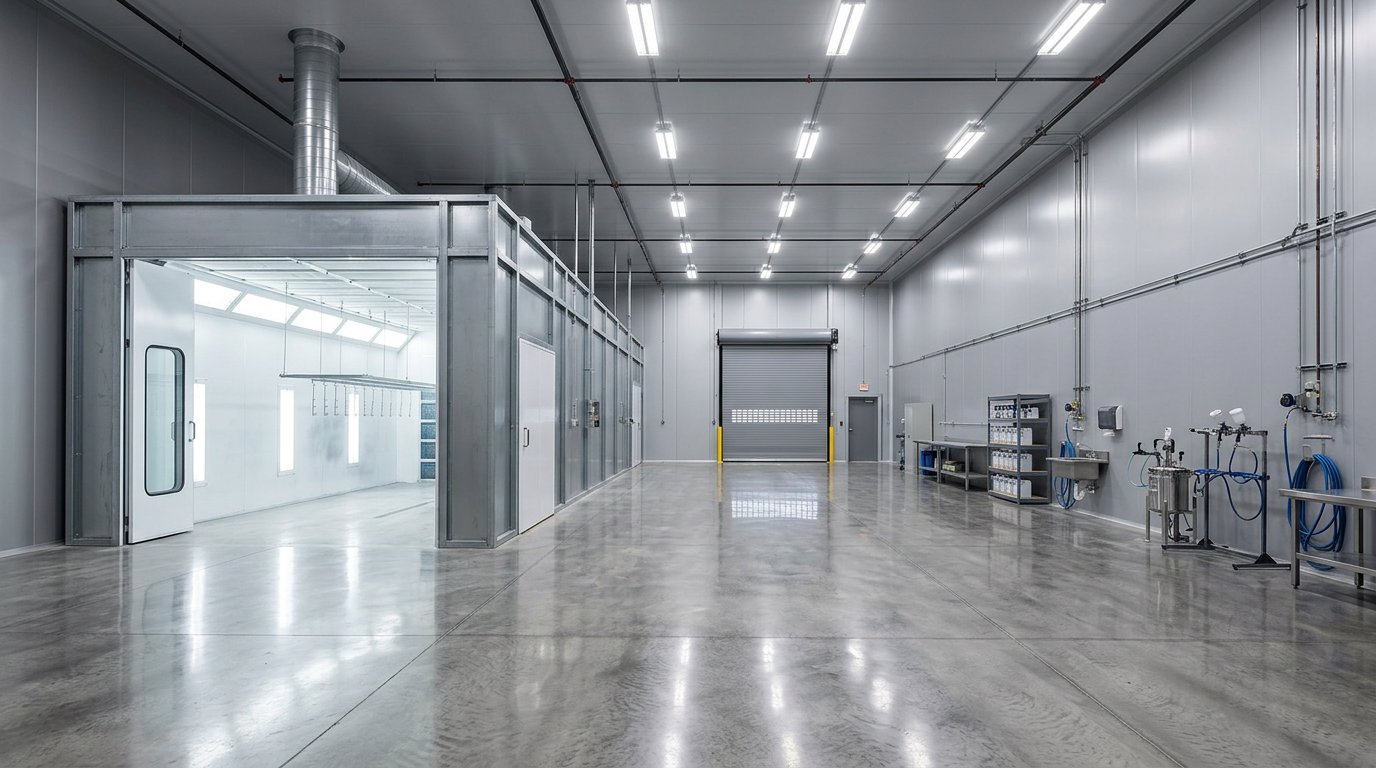
This article separates two things that are routinely mixed up: the rules that govern the booth as a machine, and the rules that govern the room it stands in. That distinction is what decides which panel core you may use.
Which document governs what
EN 12215 (Spray booths for organic coating materials) is a machinery standard, not a building standard. Its scope covers booths and multizone booths together with mechanical, electrical, thermal, noise, hazardous substance, and fire hazards. It has been withdrawn and replaced by EN 16985:2018, which merges three standards at once: EN 12215 for liquid coatings, EN 12981 for powder, and EN 13355 for combination booths.
That merger was not a renumbering exercise. France objected to EN 12981 and EN 12215 over aerolic performance and isocyanate exposure; both were withdrawn from the Official Journal and revised into EN 16985. National withdrawal dates differ from country to country, so ask your national standards body for the edition in force rather than trusting a single date.
Worth noting: none of those documents tells you what the room walls must be made of.
The separation figures people actually cite
NFPA 33 (Standard for Spray Application Using Flammable or Combustible Materials) is the one commonly cited reference that touches walls. Section 5.1 requires walls, doors, and ceilings enclosing a spray area to be of noncombustible or limited-combustible material or assemblies, rigidly supported. That is what constrains the core choice, so it is not a matter of preference.
The separation figures: a spray room is separated from surrounding areas by a one-hour fire-resistance-rated assembly (5.1.6), while a spray booth sits at least 914 mm from other operations or behind a one-hour partition (5.3). The booth body itself is expected to be steel of at least 0.0478 in, or 18 gauge, under local guidance.
The evidence limit belongs in plain sight: the points above were collected from local regulator checklists and test-house summaries of the 2016 to 2023 editions, not from the NFPA 33 text itself, and section numbers shift between editions. NFPA 33 is also not mandatory in Indonesia; it is a practice reference that tender specifications and insurers often ask for.
What that means for the panel core
The noncombustible or limited-combustible requirement filters the core options. A rock wool core with an A2-s1,d0 reaction to fire class under EN 13501-1 satisfies it. EPS, PU, and PIR cores do not satisfy that requirement for a spray area enclosure. This is a traceable technical reason, not an upsell.
Fire resistance of the assembly is a different standard: EN 13501-2 states EI classes in minutes via EN 1364-1 testing. Indicative rock wool figures are EI 60 from 80 mm and EI 120 from 120 mm. Both sit inside a 50 to 150 mm product range.
The surface side matters too. Flat, non-porous coated sheet is easier to clean of overspray, and tight joints reduce the gaps where overspray accumulates. We do not publish a particle-release figure for wet paint film, because we cannot back that claim with testing.
Our own scope, stated plainly: we do not sell roof panels, and the thickness we offer is 50 to 150 mm across every core. A paint room is almost always built inside an existing factory or workshop, so what you buy is the walls, partitions, and ceiling.
The Indonesian chain and what changed in it
Ministry of Manpower Regulation 5/2018 on occupational health and safety in the work environment remains in force, but parts of it were repealed by Regulation 11/2026, effective 3 July 2026: Article 1 point 40, Article 59(5), and Article 70. None of those is Article 3 with the annexes that carry the exposure limits, so the exposure obligation still stands.
Those limits are time-weighted averages, and chemical agents sit in Annex II. A toluene figure of 50 ppm circulates in literature citing that annex. We could not confirm a xylene limit from any Indonesian source, and the 100 ppm figure that surfaces easily comes from a Thai table. Take the table from the official annex.
Waste follows a separate chain. Hazardous waste names, sources, and codes sit in Annex IX of Government Regulation 22/2021. Spent paint and thinner fall under flammable liquids, with a flash point benchmark of up to 60 degrees Celsius. We deliberately print no code here, and we found no VOC emission limit specific to paint shops, so we invent none.
Ventilation: foreign benchmarks, not a panel promise
The airflow figures in circulation are all foreign. Alberta recommends a 0.38 to 0.64 m/s crossdraft, California Title 8 Section 5153 sets different minimum velocities for electrostatic and airless guns than for air-operated guns, and OSHA 1910.107(b)(5) carries a face velocity clarification.
Airflow design, exhaust, filters, and stacks are a mechanical package engineered by others. The panels give you a tight enclosure so the designed airflow can be held, and nothing more. The same split applies to a heavy equipment workshop and to fire-rated panel specification.
Cost: there is no public price list
We will say it plainly: no public 2026 price list for Indonesian rock wool panels exists. The IDR 600,000 to 1,200,000 per m2 range in circulation is for installing single-layer rock wool walling including material and labour, the article carries no date, and it is not a manufactured sandwich panel price.
Foreign benchmarks are worth only a rough comparison: BDT 850 to 2,200 per m2 in Bangladesh in 2026, 18 to 35 USD per m2 from an unsourced vendor blog, and INR 1,599 and 1,958 per m2 from Indian listings. The real price drivers are few:
- panel thickness and rock wool core density;
- sheet thickness and the coating specified;
- volume and joint complexity on site.
FAQ: Frequently asked questions
Which core suits a paint room?
A rock wool core. The noncombustible or limited-combustible requirement on spray area walls and ceilings filters out EPS, PU, and PIR for that use. If your specification calls for an EI class, raise the thickness using EI 60 from 80 mm and EI 120 from 120 mm as the starting point, then ask for the matching assembly test report.
Can the panels be fixed to the booth body?
No, and they do not need to be. The booth has its own steel body that is itself required to be noncombustible, while the panels form the walls and ceiling of the room around it. The clearance or partition between the two is exactly what the separation references above govern.
Next step
If you are preparing a paint room or writing its specification, send us the layout, the room height, and the EI class required. We will help you size the thickness and core, then put a quotation together. Start on our contact page for a consultation and a quotation request.