

Indonesia's dairy industry is heading toward major modernization. The national dairy cattle population currently sits at around 550,000-600,000 head, far below the 2 million head needed for milk self-sufficiency — leaving a gap of roughly 1.4 million head that must be closed through new farms and higher productivity on existing ones. Domestic fresh milk output is only 900,000 to 1 million tons per year, while national demand has reached 4.5-4.7 million tons, meaning around 80% of milk needs still rely on imported raw materials.
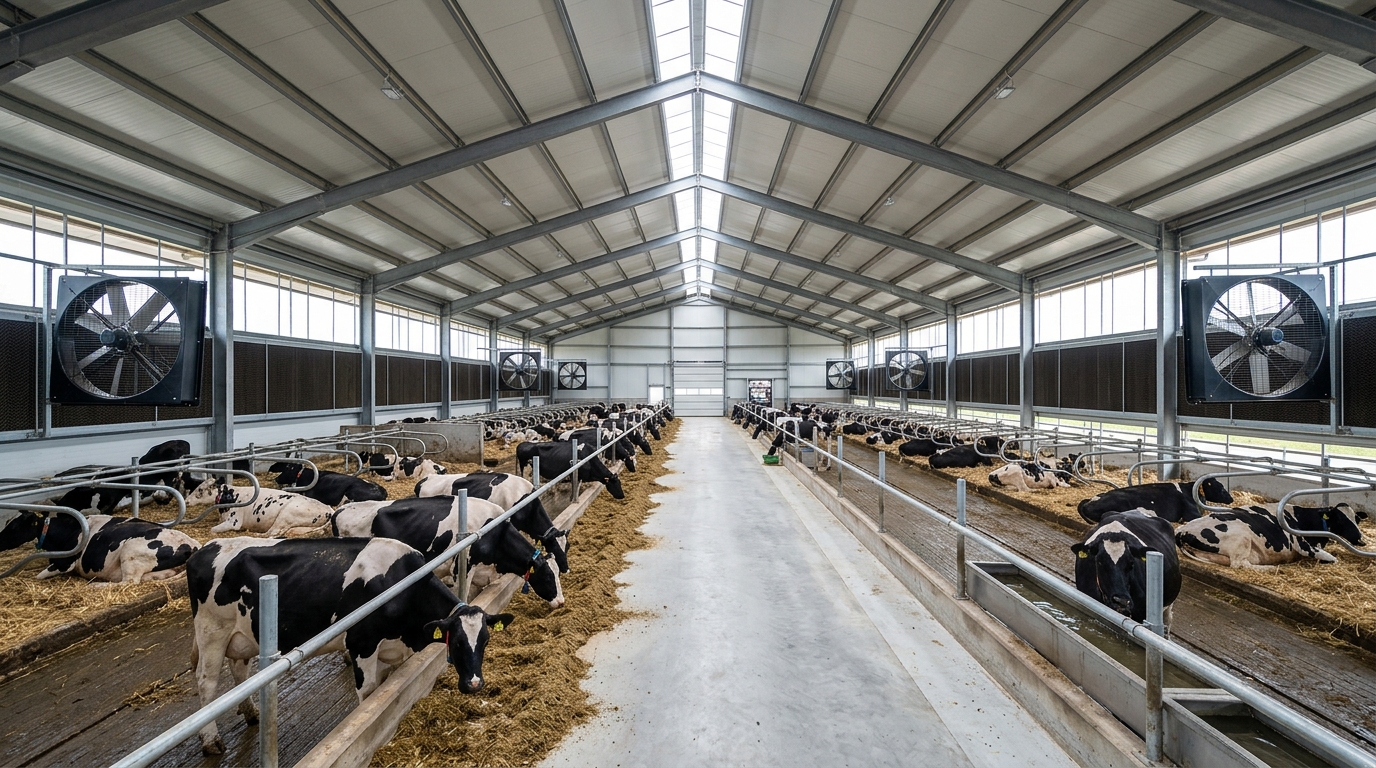
Amid pressure to raise domestic milk production, one technical factor often overlooked is the quality of the barn structure itself. Wall and roof materials that fail to block tropical heat make dairy cows prone to heat stress, which directly suppresses milk yield. This article explains why sandwich panels are a relevant construction solution for modern dairy cattle barns, backed by research data, specifications, and 2026 cost estimates.
Why Temperature Control Is Critical for Dairy Cattle Productivity
Dairy cows are warm-blooded animals highly sensitive to ambient temperature. Livestock studies show the ideal barn temperature for dairy cattle sits at 18.3-21.1°C with 55-70% humidity. Outside this range, especially at the high temperatures typical of Indonesia's tropical climate, cows begin experiencing heat stress that directly affects metabolism and milk production.
A common indicator researchers use to measure this risk is the Temperature-Humidity Index (THI). Dairy cows enter the heat-stress zone at THI 67-76, with productivity declines becoming significant once THI exceeds 72. International research recorded high-yielding cows losing up to 0.335 kg per day during heat-stress periods, compared to just 0.158 kg per day for low-yielding cows.
Once the heat period ends, milk production takes about one month to fully recover. In tropical regions like Indonesia, heat stress can cut milk production by 10-40% depending on severity and duration of exposure. These figures confirm that investing in barn microclimate control is not a minor comfort upgrade — it directly determines the volume of milk that can be harvested each day.
Closed Barns: Indonesia's Dairy Farm Modernization Trend
The closed-barn or semi-enclosed housing trend is increasingly adopted by Indonesian dairy farms, particularly in East Java, home to roughly 50% of the national dairy cattle population. Nestlé Indonesia, for instance, inaugurated its closed-barn system on 21 July 2026 and handed over 90 imported dairy cattle from Australia to three farmer cooperatives in East Java: KUD Dadi Jaya Purwodadi (Pasuruan), Koperasi SAE Pujon (Malang), and KUD Sumber Makmur Ngantang (Malang).
Since its introduction in 2023, Nestlé has supported the construction of more than 50 closed-barn facilities across Malang, Pasuruan, Probolinggo, Ponorogo, Jombang, and Blitar, with field results showing milk productivity gains of more than 20% compared to conventional open barns.
The scale of this modernization is also visible in the PT Global Dairi Bersama (GDB) project, which is building a 710-hectare integrated dairy farm complex with capacity for up to 30,000 cows — one of the largest dairy livestock projects in Indonesia. Enclosed housing at this scale demands building materials that install quickly, last long, and consistently maintain stable temperature and humidity — requirements that ordinary brick walls or corrugated metal roofing struggle to meet.
Why Sandwich Panels Suit Dairy Cattle Barns
Sandwich panels consist of two metal skins (typically coated galvanized or galvalume steel) with an insulating core in between, usually EPS or PU. This structure blocks exterior heat far more effectively than plain corrugated metal or conventional brick walls, easing the workload on a closed barn's cooling pad and exhaust fan systems. A full breakdown of core material differences is available in the guide to sandwich panel types.
Several advantages of sandwich panels are directly relevant to dairy barn operations:
- Stable thermal insulation helps keep barn temperature closer to the ideal 18-21°C range without overloading the cooling system.
- The flat, easy-to-clean metal surface supports barn sanitation, an important factor in preventing mastitis and protecting milk quality.
- Modular installation is far faster than wet brick construction, relevant for large-scale barn projects such as cooperative closed barns or integrated dairy estates.
- Lightweight panels reduce the need for heavy steel framing, lowering total construction cost, especially for long barn structures.
This approach has already proven itself in the poultry sector. The same principle — thermal insulation to curb heat stress and speed up enclosed-barn construction — has long been applied at scale in closed house poultry farms, and is now being replicated for Indonesia's rapidly growing dairy sector.
Specifications and Price Range for Dairy Barn Panels in 2026
Panel thickness commonly used for livestock housing ranges from 50-100 mm, depending on the local climate. In tropical lowlands with high year-round outdoor temperatures, thicknesses at the upper end of that range are recommended so the cooling pad and exhaust fan systems don't carry an excessive load during the dry season.
Based on current market research, sandwich panel prices in Indonesia in 2026 generally range from Rp200,000-700,000 per square meter, depending on core type and thickness:
- EPS panels: the most economical option, suited to small-to-medium barns that don't require maximum thermal insulation.
- PU panels: higher thermal insulation value per millimeter than EPS, better suited to large-capacity closed barns that demand tighter microclimate control.
- PIR panels: a premium option with the best thermal performance, relevant for barns in extreme-temperature lowland areas or farms targeting long-term energy efficiency.
Beyond panel cost itself, a closed-barn budget also needs to account for supporting systems such as exhaust fans, cooling pads, and steel framing — components that collectively determine how effectively the barn's microclimate can be controlled year-round.
Design Tips for Dairy Barns Built with Sandwich Panels
To get the most out of a sandwich panel investment, consider the following when designing a closed-barn dairy facility:
- Orient the building along an east-west axis to minimize direct sun exposure on the barn's long walls.
- Interlocking panel joints must fit tightly so the negative pressure created by the tunnel ventilation system stays consistent and doesn't leak into unwanted areas.
- Coordinate cooling pad and exhaust fan placement with the panel contractor from the design stage so airflow effectively reaches every row of the barn.
- Choose metal coatings resistant to high humidity and ammonia from manure, since the combination can accelerate corrosion if coating quality is low.
Consulting a contractor experienced in livestock projects — rather than one focused only on standard commercial warehouses — helps ensure panel specifications truly match a dairy barn's microclimate needs, instead of simply following generic warehouse building standards.
FAQ
What is the ideal sandwich panel thickness for a dairy cattle barn?
Generally 50-100 mm, depending on local climate. Tropical lowland areas with high year-round temperatures should use thicknesses at the upper end of that range to ease the load on the cooling pad and exhaust fan systems.
Is EPS panel enough for a dairy barn, or is PU/PIR required?
EPS remains adequate for small-to-medium barns on a limited budget. But for large-capacity closed barns requiring tighter temperature-humidity control, PU or PIR panels offer significantly higher thermal insulation value per millimeter, making them more efficient in the long run.
How much does heat stress affect milk production in a poorly insulated barn?
Research shows heat-stress-related milk production losses can reach 10-40% in tropical regions, with high-yielding cows at risk of losing up to 0.335 kg per day during heat periods, and full production recovery taking up to a month after temperatures normalize.