

Modern warehouse occupancy in Greater Jakarta hit 95.8% in the first quarter of 2026, one of the highest levels in years. The driver is clear: an e-commerce boom. Admitad reported Indonesian e-commerce order volume up 18% from January to May 2026 versus the same period last year, with gross merchandise value (GMV) up 21%. IDC projects Indonesia's e-commerce GMV will reach USD 89-95 billion in 2026, a 128% jump from 2023.
For brands and logistics providers, this growth means one urgent thing: new warehouse and fulfillment center capacity, fast. Conventional construction methods that take 3-4 months often can't keep pace with business expansion. This is where sandwich panels have become the preferred solution for logistics and e-commerce players scaling quickly.
Why E-commerce Warehouse Demand Is Exploding in 2026
Indonesia's logistics sector is projected to contribute Rp 1,703.21 trillion to national GDP in 2026, growing 9.31% year over year. Several interconnected factors are driving this surge.
- Same-day and next-day delivery expectations pushing micro-fulfillment centers into second-tier cities, closer to end consumers.
- Order spikes ahead of major shopping seasons (Harbolnas, Ramadan, year-end sales) forcing brands to add seasonal warehouse capacity.
- Marketplace and social commerce expansion requiring new distribution points beyond Jabodetabek.
- Tighter warehouse occupancy pushing rental costs up, prompting some players to build their own facilities instead.
Together, these factors make construction speed a competitive variable, not just a cost line item. Brands that can open a new fulfillment center within weeks gain a real edge heading into peak shopping periods.
Why Sandwich Panels Fit Fulfillment Centers
Warehouse construction with sandwich panels typically takes just 3-4 weeks, compared to 3-4 months for conventional brick-and-steel methods. A case study of a 5,000 m² warehouse using PIR-core panels recorded a 45-day build time, far faster than the roughly 90 days conventional methods need at similar scale.
Beyond speed, sandwich panels also deliver cost efficiency. Compared to conventional lightweight brick construction, savings can reach 40-50% with build times 75% faster. For fulfillment centers storing high-value or temperature-sensitive goods, panel insulation also helps cut cooling energy costs by up to 35% versus warehouses without adequate insulation.
See the full cost breakdown in our 2026 warehouse construction cost guide for estimates matched to your building size.
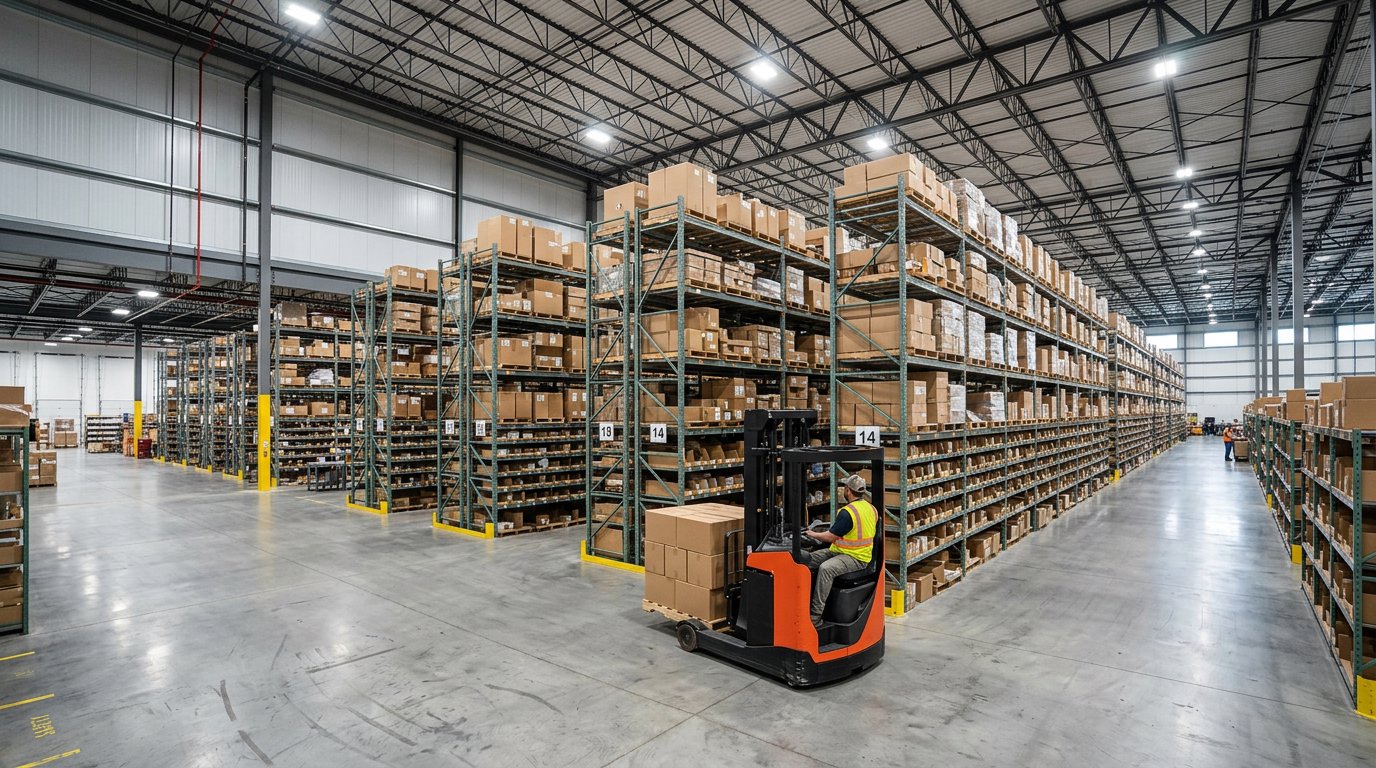
Recommended Panel Specifications
Not every sandwich panel type suits a high-traffic fulfillment center. A few specification points are worth checking before you commit.
- PU or PIR core at 50-75 mm thickness for walls, giving strong thermal insulation without adding excessive structural load.
- Roof panels with proper slope and sealant systems built for a tropical climate with heavy rainfall.
- SNI 1741 certification to confirm the panel meets national building material standards.
- Fire rating matched to the warehouse's building class, especially when storing electronics or flammable packaging.
- Scratch-resistant, easy-to-clean surface coating for loading dock areas with heavy forklift traffic.
Core selection also depends on the space's function. For general storage areas, EPS is more economical. For cold chain or temperature-sensitive product areas, PU/PIR performs far better on insulation. Compare the three core types in our complete sandwich panel types guide.
Micro-Fulfillment Strategy: Building Fast Across Multiple Locations
The micro-fulfillment trend, smaller warehouses spread across urban and second-tier cities, makes construction speed even more critical. Instead of one giant warehouse, many logistics players now favor several smaller distribution points to speed up last-mile delivery and cut transportation costs.
This model only makes economic sense if the cost and build time per site stay low. Sandwich panels, assembled modularly and manufactured with factory precision, make replicating a warehouse design across multiple cities far more practical than rebuilding from scratch with conventional methods at every location.
Construction Cost Estimate
As a starting benchmark, warehouse construction with sandwich panels in 2026 runs Rp 1,500,000 - Rp 2,500,000 per m², depending on panel thickness, core type, and the supporting steel structure specification. Panel installation cost alone ranges Rp 250,000 - Rp 600,000 per meter, depending on thickness and core type chosen.
These figures still need adjusting for specific needs: building height, rack load, HVAC systems for cold chain zones, and project location. Consulting a certified panel supplier helps ensure cost estimates match actual site conditions.
Project location also affects total cost, especially for fulfillment centers outside Jabodetabek, which adds material shipping and installation team mobilization costs. Some logistics players address this by partnering with manufacturers that have distribution networks closer to the project site, cutting custom panel lead time without sacrificing material quality.
Contractor Checklist for Fulfillment Center Projects
A fast promised timeline means nothing if material quality or site execution falls short. Before signing a contract, verify a few things to keep your warehouse project on track for its target operational date.
- Ask for SNI panel certificates and fire rating test results from the manufacturer, not just a verbal claim from sales.
- Check the contractor's portfolio for similar logistics warehouse projects, ideally at a comparable building scale.
- Confirm warranty coverage includes panel corrosion and roof leaks, not just initial installation defects.
- Ask about custom panel production lead time, since this is often the hidden bottleneck rather than on-site installation.
- Compare at least two to three quotes with matching thickness and core specifications for an apples-to-apples price comparison.
For fulfillment centers racing against a peak-season deadline, communicate that deadline to the contractor from day one. Most panel project delays come not from installation itself, but from custom panel production lead time and material shipping to sites far from the manufacturing facility.
As an extra safeguard, add a delay-penalty clause to the contract whenever the warehouse's opening date is tied directly to a specific business moment, such as Harbolnas or the year-end shopping season. This clause pushes the contractor to keep production and installation schedules disciplined.
FAQ
How long does it take to build a fulfillment center warehouse with sandwich panels?
For a mid-size warehouse, sandwich panel construction typically takes 3-4 weeks. Larger projects, such as a 5,000 m² warehouse, have been completed in 45 days, versus roughly 90 days with conventional methods. Actual timelines still depend on design complexity and site readiness.
Are sandwich panels strong enough for warehouses with heavy forklift traffic?
Sandwich panel walls are designed as building cladding, not load-bearing floor structure. Forklift traffic capacity depends on the concrete floor slab and supporting steel structure, not the wall panels. Quality galvalume-surfaced panels still resist light impact around loading dock areas and are easy to repair if scratched.