

Indonesia's poultry industry keeps expanding, and mid-to-large scale farmers are increasingly shifting from open houses to closed house systems. One of the most decisive components in this shift is the wall and roof material of the house, where sandwich panels have become the leading choice, replacing plain corrugated steel sheets or conventional brick walls.
According to Indonesia's Ministry of Agriculture data portal (Satu Data Pertanian), the national broiler population in 2024 was estimated at around 3.12 billion birds with chicken meat production of 3.39 million tons, growing at an average rate of 1.45% per year. Production is projected to reach 3.65 million tons by 2027, while 2026 alone is expected to record a national chicken meat surplus of roughly 233,510 tons.
Statistics Indonesia (BPS) and the East Java Provincial Livestock Office also note that around 70% of the national broiler and layer population remains concentrated on Java island, with West Java as the largest broiler meat producer (899,588 tons), followed by Central Java (791,997 tons). At this scale, house efficiency — including building material choice — has a direct impact on production cost and livestock mortality rates.
What Is a Closed House System and Why Sandwich Panels Matter
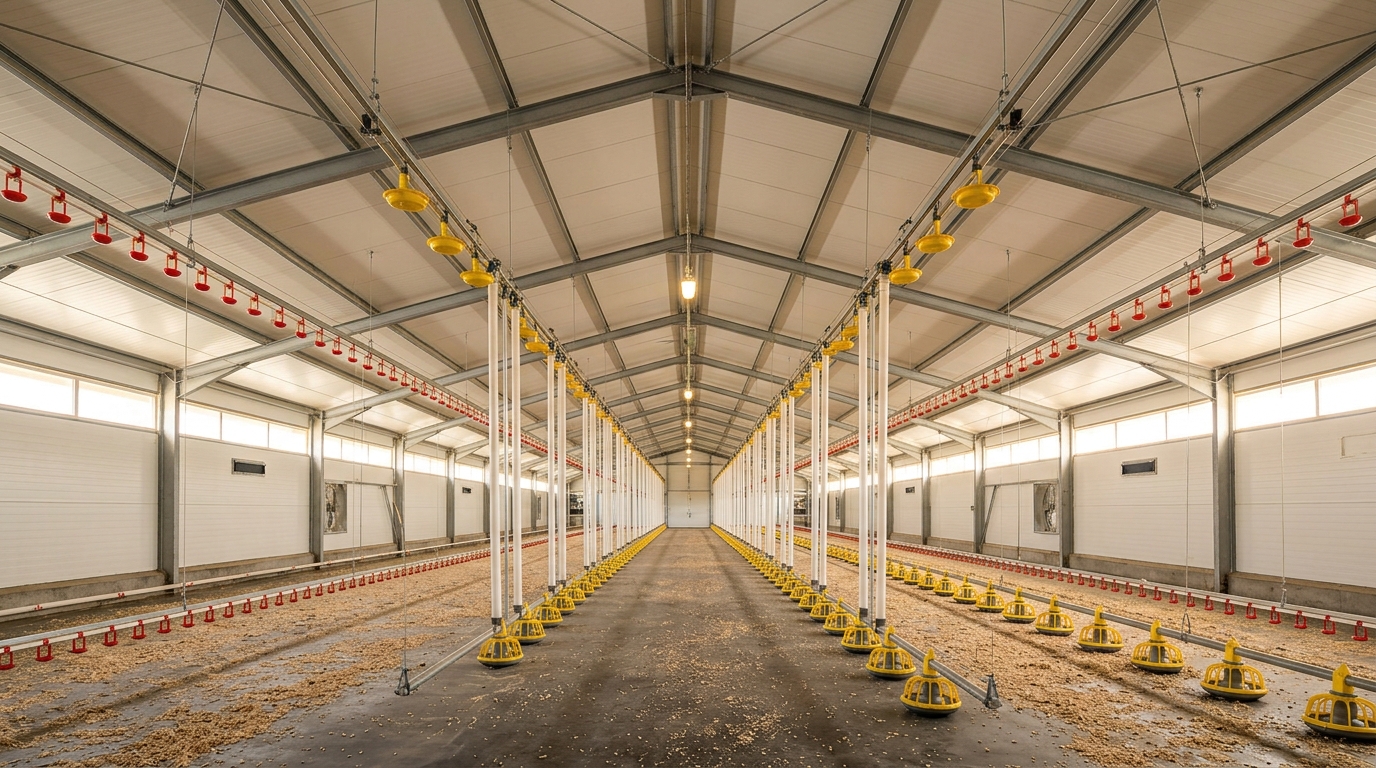
A closed house is a fully enclosed poultry housing system that mechanically controls temperature, humidity, air circulation, and lighting, unlike open houses that rely entirely on natural conditions. A typical closed house structure consists of the building frame, exhaust fans/blowers, evaporative cooling pads, curtains or enclosure walls, an air inlet system, lighting, plus a control panel and electrical system.
Because this entire system works to maintain a stable microclimate, the wall and roof material must resist external heat while minimizing air leakage from inside. This is where sandwich panels — two metal skins (typically coated galvanized steel) with a PU (polyurethane), EPS, or rockwool insulation core in between — clearly outperform single-layer corrugated steel or brick walls that lack comparable thermal insulation value.
Ideal Panel Specifications for Poultry Houses
Panel thickness commonly used for closed houses ranges from 50-100 mm, depending on the local climate. In low-altitude tropical locations with consistently high outdoor temperatures, thickness on the higher end (75-100 mm) is generally recommended so the cooling pad and exhaust fan system doesn't have to work as hard. For a deeper look at how thickness relates to insulation performance, farmers can refer to this standard sandwich panel thickness guide, which covers the relationship between thickness, core density, and thermal conductivity (U-value/K-value).
Beyond thickness, three specification aspects deserve close attention when selecting panels for a poultry house:
- Insulation core type: PU/PIR delivers the highest thermal insulation value per millimeter, making it suitable for large-volume houses; EPS is more economical for small-to-medium houses; rockwool offers superior fire resistance but adds more weight.
- Metal skin protection: use galvalume/galvanized steel with a coating resistant to high humidity and ammonia gas exposure from manure, since early corrosion on panels is one of the most common complaints in closed houses that have been operating for more than 2-3 years.
- Panel jointing system: a tight interlocking joint reduces air leakage at seams, so the negative pressure created by the tunnel ventilation system stays intact instead of "leaking" through unintended points.
Benefits of Sandwich Panels Over Conventional Materials
Compared to plain corrugated steel or plastered brick walls, sandwich panels offer several practical advantages for closed house operations:
- Significantly better thermal insulation, reducing the workload on fans and cooling pads and potentially lowering electricity consumption compared to houses with uninsulated walls.
- Light weight speeds up construction and reduces the need for heavy frame structures, relevant for long houses (typically 100-150 meters for capacities of tens of thousands of birds).
- A flat, easy-to-clean and disinfect surface, supporting the biosecurity practices now mandatory in modern poultry health management.
- Modular installation shortens construction time compared to wet brick construction, getting the house production-ready sooner.
For houses that also prioritize hygiene and microbial resistance on wall surfaces — such as breeding farms with stricter biosecurity standards — panel specifications can be paired with a food-grade coating, as discussed in this antibacterial and food-grade sandwich panel guide.
Ventilation and Cooling Pads: How Panels Support Performance
Ventilation is the heart of any closed house system. Based on broiler house ventilation management research published by Politeknik Negeri Malang (Polinema), fan requirements are calculated in CFM (Cubic Feet per Minute), typically ranging from 4.0-6.21 CFM per kilogram of bird weight, using exhaust fans around 52 inches in diameter working together with sensors and an automated control panel. This system removes excess heat, lowers ammonia and other harmful gas levels, and keeps oxygen supply adequate inside the house.
For tunnel ventilation to work effectively, negative pressure inside the house must stay consistent — fresh air should only enter through the designated inlets and cooling pads, not through leaky wall gaps. The more precisely sandwich panels are jointed to the building frame, the better the evaporative cooling system performs at maintaining effective house temperature.
Field references indicate that day-old-chick (DOC) brooding temperature is ideally kept at 32-35°C using heaters, while effective temperature for adult birds is generally maintained around 31-35°C with 50-70% humidity for optimal growth performance and feed conversion ratio (FCR).
Corrosion and Ammonia Challenges in Poultry Houses
One of the biggest material challenges in poultry housing is exposure to ammonia gas (NH3) from accumulated manure, combined with high humidity from cooling pad systems. This combination is highly corrosive to low-quality coated metal, and over a few years can cause deterioration at panel joints and steel frames.
The corrosion-resistant material principles typically applied in chemical plants — double-layer protective coatings, coating types matched to environmental acidity, and joint details that minimize moisture traps — are equally relevant for closed house construction. A more detailed discussion on selecting corrosion-resistant panel walls for chemically aggressive environments can serve as a useful technical reference for both farmers and house contractors.
Cost Estimates and ROI Considerations
Building a closed house with sandwich panels generally costs more upfront than a conventional open house, since it includes investment in insulated panels, exhaust fan systems, cooling pads, and automated control panels. However, field practice among mid-to-large scale Indonesian farms shows this initial cost gap is gradually offset through:
- Lower mortality from heat stress, which is a leading cause of losses in open houses during dry season.
- Improved FCR (feed conversion ratio), as birds grow within a more stable temperature-humidity range closer to ideal conditions.
- Higher stocking density per square meter (around 12-15 birds/m² at harvest for broilers), enabled by better microclimate control than open houses allow.
- Longer panel service life compared to plain corrugated steel, lowering long-term maintenance and material replacement costs.
An accurate ROI calculation still needs to account for house scale, current feed and DOC prices, and local electricity tariffs — which is why consulting an experienced poultry-sector contractor or panel supplier before finalizing specifications is strongly recommended.
How to Choose a Contractor or Panel Supplier for Poultry Houses
A few things worth checking before appointing a contractor or sandwich panel supplier for a closed house project:
- A portfolio of similar poultry projects (broiler, layer, or breeding farms) — not just warehouse or cold storage projects.
- Availability of verifiable fire-rating test certificates and complete technical specifications (core density, metal skin thickness, coating type), not just marketing claims.
- Ability to adapt panel jointing design to the chosen tunnel ventilation system (exhaust fan type, inlet and cooling pad layout).
- After-sales service and warranty against corrosion or joint leakage, given that poultry house environments are considerably more aggressive than typical commercial buildings.
Frequently Asked Questions (FAQ)
What is the ideal sandwich panel thickness for closed house poultry farms?
Generally 50-100 mm depending on local climate. Low-altitude areas with consistently high temperatures should lean toward the thicker end so the cooling system carries a lighter load.
Is EPS panel enough for a poultry house, or is PU required?
EPS remains usable for small-to-medium houses on a limited budget, but PU/PIR offers higher thermal insulation value per millimeter, making it more efficient for large-capacity houses that need tighter microclimate control.
How do I address ammonia-related corrosion risk on house panels?
Choose panels with quality metal coating (galvalume/galvanized with appropriate coating), ensure joint details don't trap moisture, and clean regularly to reduce ammonia buildup, which is corrosive to metal.
Is sandwich panel investment for poultry houses worth the cost?
For mid-to-large scale farms, this investment is generally worthwhile, contributing to lower heat-stress mortality, improved FCR, and higher stocking density — though the actual ROI still depends on farm scale and local market conditions.