

Comprehensive Comparison of 2026 Sandwich Panel Prices: EPS vs PU vs PIR
As a business owner or contractor planning a construction project, understanding the comparison of sandwich panel prices for 2026 is key to preparing an accurate budget. Sandwich panels have become an increasingly popular modern construction solution in Indonesia, especially for warehouse, factory, cold storage, and other industrial building applications. With three main types available in the market—EPS (Expanded Polystyrene), PU (Polyurethane), and PIR (Polyisocyanurate)—choosing the right material is not just about quality, but also about long-term cost efficiency.
In 2026, trends in raw material prices, production technology, and market demand continue to change. This article will provide an in-depth analysis of the price comparison of these three types of sandwich panels, including factors affecting costs, the advantages of each material, and recommendations based on specific applications. With this information, you can make smarter investment decisions for your construction project.
Factors Affecting 2026 Sandwich Panel Prices
Before diving into specific price comparisons, it's important to understand the key factors that determine the cost of sandwich panels:
1. Core Material Type
The core material is the largest component affecting price. EPS is generally the most affordable, followed by PU, and PIR as a premium option with the best insulation performance.
2. Panel Thickness
Panel thickness ranges from 50mm to 200mm. The thicker the panel, the higher the cost. The right thickness depends on your project's thermal and acoustic insulation needs.
3. Coating Quality
Coatings such as PVDF, HDP, or polyester affect weather resistance, corrosion resistance, and aesthetics. Premium coatings increase the price but extend the life of the panel.
4. Purchase Volume
Bulk purchases usually receive significant discounts. Industrial-scale projects can save up to 15-25% compared to retail purchases.
5. Design and Installation Complexity
Panels with special shapes, additional accessories, or complex installation requirements will increase the overall cost.
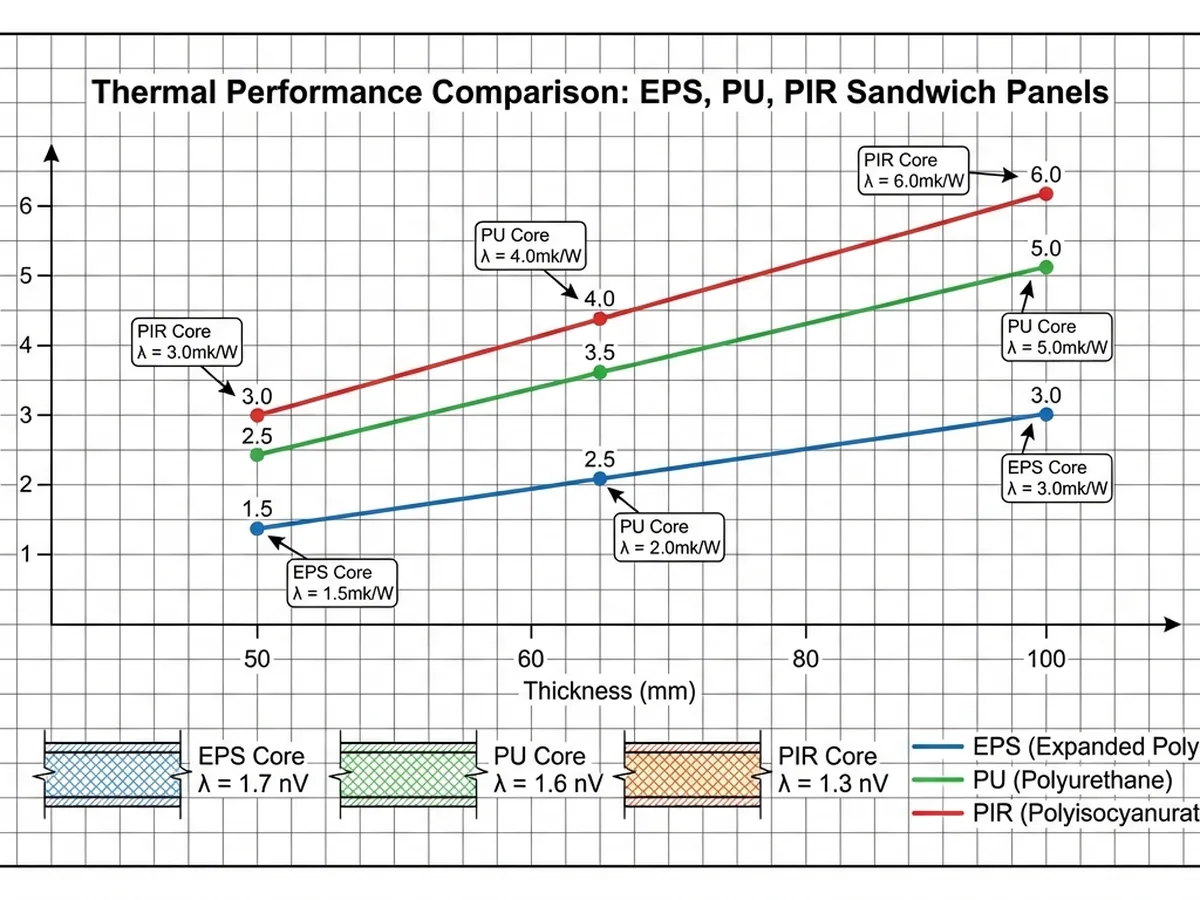
2026 EPS Sandwich Panel Prices: Economical Option with Sufficient Performance
EPS (Expanded Polystyrene) remains the most popular choice for projects with limited budgets. Here are the estimated prices for 2026:
Price Range per m²:
- 50mm Thickness: IDR 350,000 - IDR 450,000
- 75mm Thickness: IDR 450,000 - IDR 550,000
- 100mm Thickness: IDR 550,000 - IDR 650,000
- 125mm Thickness: IDR 650,000 - IDR 750,000
- 150mm Thickness: IDR 750,000 - IDR 850,000
Advantages of EPS:
- Most competitive price in the market
- Lightweight, making transportation and installation easy
- Good moisture resistance
- Mature and stable production process
Limitations:
- Lower R-value (thermal resistance) compared to PU and PIR
- Less ideal for extreme temperature applications (very low-temperature cold storage)
- Lower fire resistance (requires special treatment)
EPS is suitable for: conventional warehouses, factory offices, internal partitions, and buildings with standard insulation needs. For projects with tight budgets that still require adequate quality, EPS is the right choice. Learn more about how to calculate panel needs for an accurate estimate.
2026 PU Sandwich Panel Prices: Balance between Performance and Cost
Polyurethane (PU) offers better insulation performance than EPS at an still affordable price. Estimated 2026 prices:
Price Range per m²:
- 50mm Thickness: IDR 550,000 - IDR 650,000
- 75mm Thickness: IDR 650,000 - IDR 750,000
- 100mm Thickness: IDR 750,000 - IDR 850,000
- 125mm Thickness: IDR 850,000 - IDR 950,000
- 150mm Thickness: IDR 950,000 - IDR 1,100,000
Advantages of PU:
- 30-40% better thermal insulation value than EPS with the same thickness
- Closed-cell structure provides optimal moisture resistance
- Remains lightweight with good mechanical strength
- Strong adhesion between core and skin
Limitations:
- Price is 20-30% higher than EPS
- Insulation performance is still below PIR
- Thickness options may be more limited at some suppliers
PU is ideal for: medium-temperature cold storage (-10°C to +5°C), food production rooms, pharmaceuticals, and buildings with higher insulation needs. For those looking for a balance between cost and performance, PU is the optimal solution. Make sure you work with trusted suppliers to get guaranteed quality.
2026 PIR Sandwich Panel Prices: Premium Solution for Maximum Performance
Polyisocyanurate (PIR) is a premium core material with the best-in-class insulation performance. Estimated 2026 prices:
Price Range per m²:
- 50mm Thickness: IDR 750,000 - IDR 850,000
- 75mm Thickness: IDR 850,000 - IDR 950,000
- 100mm Thickness: IDR 950,000 - IDR 1,100,000
- 125mm Thickness: IDR 1,100,000 - IDR 1,250,000
- 150mm Thickness: IDR 1,250,000 - IDR 1,400,000
Advantages of PIR:
- Highest R-value (thermal resistance) among the three
- Excellent fire resistance (Class B1/B2)
- Superior dimensional stability in extreme temperature conditions
- Longer service life with minimal maintenance
- Eco-friendly with recycled material content
Limitations:
- Price is 40-60% higher than EPS
- Availability may be limited in some areas
- Requires special expertise in installation
PIR is recommended for: very low-temperature cold storage (-25°C to -40°C), medical facilities, laboratories, clean rooms, and applications with strict insulation and safety requirements. Although the initial investment is higher, long-term energy savings can compensate for the additional cost.
Life Cycle Cost Analysis
Choosing a sandwich panel is not just about the initial purchase price, but also the operational costs over the life of the building. Here is a comparison of the 20-year life cycle costs for a 1,000 m² building:
1. Capital Cost:
- EPS: IDR 500-700 million (depending on thickness)
- PU: IDR 700-900 million
- PIR: IDR 900 million - 1.2 billion
2. Operational Costs (Energy for Cooling/Heating):
- EPS: IDR 300-400 million (assuming intensive use)
- PU: IDR 200-300 million (30% more efficient than EPS)
- PIR: IDR 150-250 million (40-50% more efficient than EPS)
3. Maintenance Costs:
- EPS: IDR 50-80 million (more frequent routine maintenance)
- PU: IDR 40-60 million
- PIR: IDR 30-50 million (longer service life)
Total 20-Year Cost:
- EPS: IDR 850 million - 1.18 billion
- PU: IDR 940 million - 1.26 billion
- PIR: IDR 1.08 - 1.5 billion
This analysis shows that while PIR has the highest initial cost, its energy efficiency can provide significant long-term savings, especially for applications requiring strict temperature control.
Macroeconomic Factors Affecting 2026 Prices
Several global and national economic trends will affect sandwich panel prices in 2026:
1. Chemical Raw Material Prices
Fluctuations in the prices of polyol, isocyanate, and styrene will directly impact PU and PIR production costs. Predicted annual increases of 5-8%.
2. Energy and Environmental Policies
Increasingly strict energy efficiency regulations will increase demand for panels with high insulation performance (PU and PIR).
3. Rupiah Exchange Rate
Some raw materials are still imported, so exchange rate fluctuations will affect the final price.
4. Production Technology
Innovations in manufacturing processes can lower production costs, especially for high-performance panels.
5. Construction Sector Demand
Growth in the logistics, food & beverage, and pharmaceutical sectors will continue to drive demand for sandwich panels.
Recommendations Based on Application and Budget
For Limited Budgets (≤ IDR 500,000/m²):
Choose EPS with 75-100mm thickness. Suitable for dry goods storage warehouses, workshops, and additional buildings.
For Medium Budgets (IDR 500,000 - 800,000/m²):
PU with 100mm thickness is the optimal choice. Provides a balance between cost and performance for medium-temperature cold storage.
For Premium Budgets (≥ IDR 800,000/m²):
PIR with 100-125mm thickness provides the best performance for critical applications such as pharmaceuticals, laboratories, and very low-temperature cold storage.
Large Scale Projects (≥ 5,000 m²):
Price negotiations with suppliers can provide 15-25% discounts. Consider material combinations based on building zones (PIR for critical areas, PU/EPS for support areas).
Tips for Negotiating Prices with Suppliers
- Prepare Detailed Specifications: The clearer the technical specifications, the more accurate the quote received.
- Request Multiple Quotes: Compare at least 3-4 suppliers to get competitive prices.
- Negotiate Full Packages: Including transportation, installation, and accessories for the best value.
- Consider Purchase Timing: Prices tend to be more competitive outside of peak construction seasons.
- Long-term vs Short-term: For recurring projects, negotiating long-term contracts can provide better pricing.
FAQ: Common Questions about Sandwich Panel Prices
1. Do the prices above include VAT?
Prices listed are usually excluding 11% VAT. Make sure to confirm with the supplier whether the price includes tax or not.
2. How much is the installation cost per m²?
Installation costs range from IDR 100,000 - 250,000 per m², depending on complexity, height, and project location.
3. Is there a warranty for sandwich panels?
Trusted suppliers usually provide a 5-10 year warranty for materials and 1-2 years for installation.
4. How to get the best price for my project?
Send project details (area, specifications, location) to several suppliers and compare quotes. Don't hesitate to negotiate based on volume.
5. Will prices rise significantly in 2026?
Predicted annual increases of 5-8% due to inflation and rising raw material prices. It is recommended to order early if the project is certain.
Conclusion: Smart Investment for 2026 Construction
Choosing the right sandwich panel for your 2026 construction project requires careful consideration of budget, technical needs, and long-term goals. EPS remains an economical choice for standard applications, PU offers optimal balance for most industrial projects, while PIR is a premium investment with returns through energy efficiency.
The price estimates presented above are a preliminary guide to help you plan your project budget better. However, each project has unique characteristics that can affect the final cost. Therefore, it is very important to consult with construction experts and trusted suppliers to get the most efficient and effective solution for your specific needs.
By considering factors such as core material, thickness, and coating quality, as well as conducting life cycle cost analysis, you can ensure that your investment in sandwich panels will provide maximum value, both in terms of building performance and long-term operational cost efficiency. Good luck building your future projects with the best construction materials!