

Choosing a sandwich panel factory or supplier is not just about comparing price per square meter. Panels that look identical in a brochure can arrive with wildly different core thickness, density, and frame welding quality once they reach the job site. A bad supplier choice usually only shows up 1-2 years later: panels sag, joints leak in heavy rain, or a warranty claim gets refused because the factory has closed down or changed its name.
This guide breaks down the technical criteria and practical checklist for vetting a sandwich panel factory in Indonesia before signing a contract - from mandatory certifications to spotting a suspiciously cheap quote.
Why the Factory You Pick Determines Your Building's Lifespan
A sandwich panel carries two jobs at once: building envelope structure and thermal insulation. If the core (PU, PIR, EPS, or rockwool) isn't produced with the correct density and curing process, insulation performance can fail within months even though the panel still looks fine on the outside. To understand how each core type differs before evaluating a factory, see the complete guide to sandwich panel types on SandwichPanels.id.
A factory that consistently controls production quality tends to also be consistent with technical documentation - and that documentation is exactly what you can verify before goods ship.
Certifications and Standards You Must Verify
The primary reference standard for metal-faced sandwich panels is EN 14509, the harmonized European CE standard covering factory-made specifications for self-supporting double skin panels - including structural performance, thermal insulation, and fire resistance. Certification requires testing by a Notified Body and issuance of a Declaration of Performance (DoP) as the basis for CE marking, according to Applus+ Laboratories.
Locally, also check for SNI 8399, which governs the light-gauge steel frame profiles that support the panels, and SNI 1741, commonly referenced in fire-resistance test certificates for panel systems. Indonesia's National Standardization Agency (BSN) is the official reference for confirming the status and scope of any SNI a factory claims to hold.
- Test certificates from an accredited laboratory, not an internal statement from the factory
- A test report number, the standard applied (EN 14509, SNI 1741), and the thickness and density of the specimen tested
- A Declaration of Performance (DoP) if the panel is claimed to comply with EN 14509 for CE marking
- The certificate's issue date - core formulations change over time, so an old certificate may not represent current production
Factory Visit Checklist: What to Inspect in Person
2026 market research shows that shady suppliers rarely lie about which core material they use - instead they quietly ship thinner or lower-density panels than what was promised on paper, a tactic that's hard to catch without an in-person visit. Panels thinner than specified are prone to sagging or water seepage at the joints. If your project needs a specific thickness, cross-check it first against the standard wall panel size and thickness guide so you know a reasonable range before negotiating.
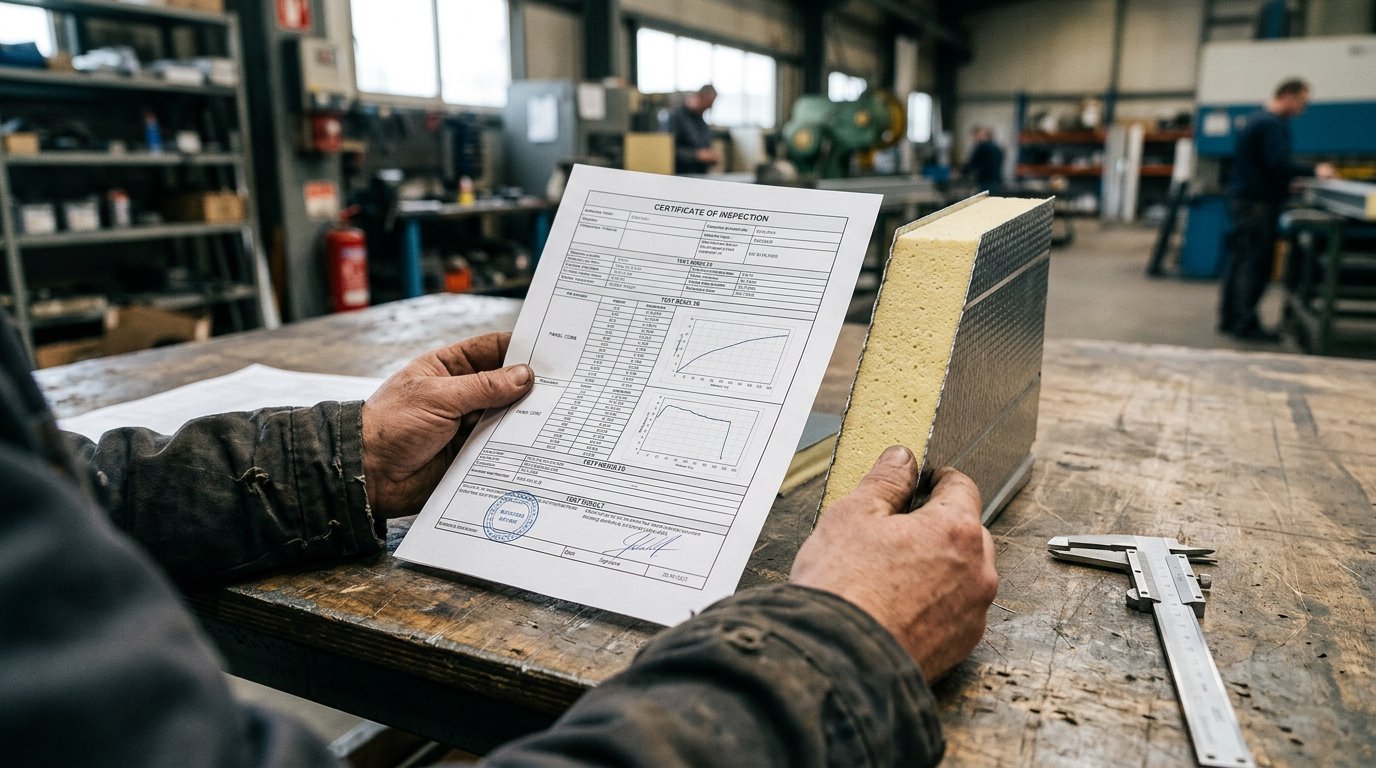
During a factory visit, ask to watch the actual foam injection or core lamination process, not just the finished-goods warehouse. Check sample panels physically: no dents, scratches, or delamination between the metal facing and the core. Measure panel thickness yourself with calipers and compare it against the quoted spec - a significant gap is a reason to walk away from the deal, not an opening to ask for a bigger discount.
Comparing Prices: Don't Just Chase the Lowest Number
Based on 2026 market research, sandwich panel prices in Indonesia vary widely depending on the core type and the certification behind it. Use the ranges below as a starting benchmark when comparing quotes, not a final number:
- PU (polyurethane) panels: roughly IDR 280,000 - 400,000 per m²
- PIR (polyisocyanurate) panels: roughly IDR 350,000 - 1,200,000 per m², a wide range driven heavily by fire-rating certification and thickness
- Rockwool panels: roughly IDR 400,000 - 700,000 per m²
The price gap between a 50 mm and a 100 mm panel can reach 30-50 percent, since thickness directly affects both insulation performance and structural strength. If a quote comes in far below this range for the same thickness and core type, there's a good chance the factory is cutting corners on core density, steel facing gauge, or anti-corrosion coating - details that rarely get mentioned upfront.
Red Flags: Warning Signs of a Supplier to Avoid
A few patterns keep showing up in real-world sandwich panel complaints. Be wary of suppliers who refuse factory-visit requests with shifting excuses, can't produce an original test certificate with a traceable report number, or hand over a written warranty without a clear legal entity name and factory address. Another pattern: quoted prices drop sharply the moment you push back on thickness guarantees, or a "factory-direct" supplier turns out to be a trader with no actual production facility of its own.
Warranty Terms and After-Sales Support
A credible sandwich panel warranty usually separates coverage between the structure/paint finish on the facing (typically 5-10 years depending on coating type) and the core's insulation performance. Ask for a written warranty clause spelling out what voids a claim, the claim procedure, and who covers reshipment costs if a production defect is confirmed. A supplier unwilling to put these details in the contract - and only promises them verbally - is an additional red flag beyond certification and price.
Production Capacity and Lead Time
A factory running a continuous panel line can usually give a clear production estimate based on daily machine capacity, not just a vague "as soon as possible" promise. Ask about daily production capacity in square meters, the current order backlog, and whether the factory keeps buffer stock of core material and steel coil so schedules aren't derailed by raw-material import delays. For time-sensitive projects like a warehouse or factory that must open by a fixed date, production schedule certainty matters just as much as price and certification.
Also ask for details on shipping method and how panels are handled in transit, since rough handling on the road can dent corners or damage the metal facing before arrival - damage that's often mistaken for a factory production defect.
FAQ
What is the typical minimum order quantity (MOQ) for sandwich panels from a factory?
MOQ varies by factory, generally ranging from tens to a few hundred square meters depending on the core type and thickness ordered. Smaller projects can usually still be served through an authorized distributor that carries stock from several factories, rather than ordering directly off the production line.
Are all sandwich panels sold in Indonesia required to carry SNI certification?
Not every panel category has a specific mandatory SNI covering the insulation core itself, so many factories rely on a combination of the European CE standard (EN 14509) and SNI standards for supporting structural components like light-gauge steel frames. Always ask the factory to show exactly which standards genuinely apply to the specific product you're buying, not a generic list printed in the brochure.
How do you verify that a factory's test certificate is genuine?
Match the test report number on the certificate directly with the issuing laboratory, check whether the tested specimen's thickness and density match the product being quoted, and confirm the issue date is still relevant to the current production batch.