

Introduction: The Operating Room Investment Dilemma
Building or renovating an operating room is one of the most significant investment decisions for hospital management. Between rising accreditation targets and growing patient volumes, hospital administrators face a critical question: stick with familiar conventional construction, or switch to a Modular Operating Theatre (MOT) that promises speed and precision?
The short answer: MOT delivers total cost savings of 20-30% over a 5-year lifecycle, primarily from shorter construction timeframes and lower operational costs. However, this depends on project scale, hospital type, and utilization targets. This article provides a transparent cost comparison — from initial investment to total cost of ownership — so you can make a data-driven decision rather than relying on assumptions.
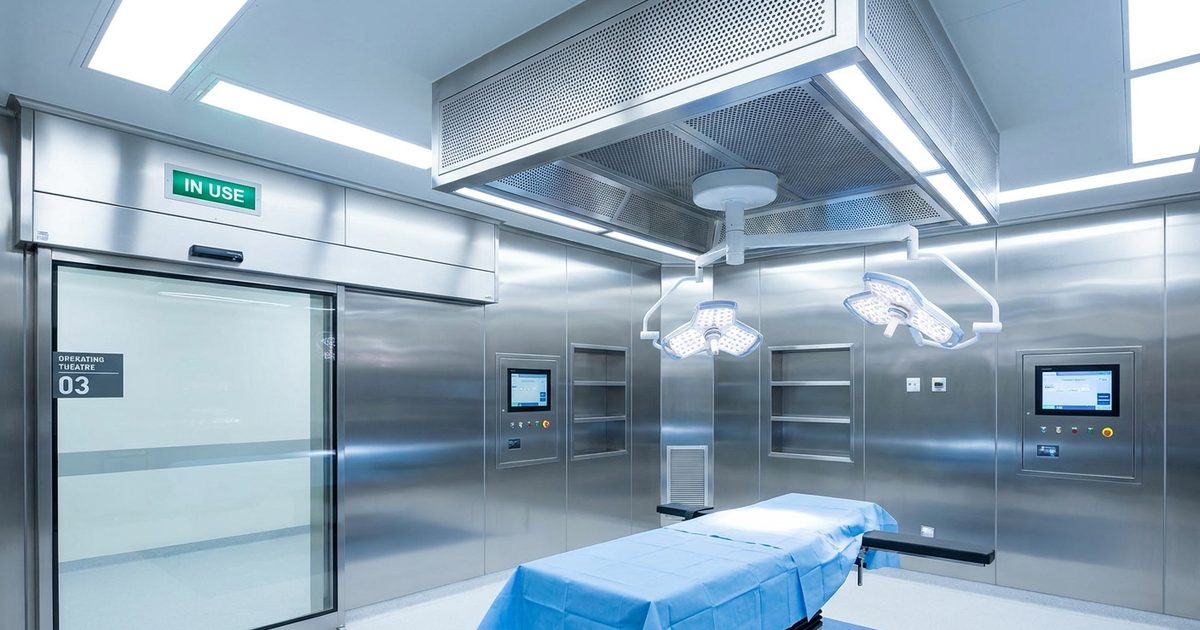
What Is a Modular Operating Theatre (MOT)?
A Modular Operating Theatre is a surgical suite built using prefabricated sandwich panel wall and ceiling systems, integrated with HEPA HVAC systems, hermetic doors, and digital environmental controls. See also: Complete Guide to Cleanroom Equipment for Hospitals and Pharma. All components are factory-manufactured with high-precision tolerances, then assembled on-site within weeks.
Key MOT components include:
- PIR/PU sandwich wall panels — superior thermal insulation, antibacterial surfaces, anti-static properties
- Laminar airflow ceilings — HEPA H14 sterile air distribution with 100% surgical zone coverage
- Hermetic sliding doors — air-tight seals, motion sensors, electromechanical interlock
- BMS control system — real-time monitoring of temperature, humidity, differential pressure, and particles
- Touch control panels — surgical LED lighting, timer, and alarm management
Unlike conventional construction, MOT involves zero wet work (no concrete casting, plastering, or skim coating) on-site. All joints use tongue-and-groove systems with medical-grade sealants that are ISO 14644 certified.
What Is a Conventional Operating Room?
Conventional operating rooms are built using standard civil construction methods: lightweight brick or concrete walls that are plastered and epoxy-painted, gypsum ceilings with separate AHU systems, and standard swing doors. The construction process follows the general building project workflow:
- Structural and architectural works (3-4 months)
- MEP installation — ducting, medical gas piping, electrical (2-3 months)
- Finishing — epoxy flooring, antibacterial wall paint, sealing (1-2 months)
- Commissioning and validation — DOP test, pressure decay, particle count (1-2 months)
- Certification and handover (1 month)
This method has been proven over decades and is well understood by most local contractors. However, dependency on skilled on-site labor, weather risks, and potential rework mean that cost and timeline estimates frequently deviate from initial plans.
Initial Cost Comparison: MOT vs Conventional
Here is the estimated cost comparison for constructing a single Class 1 operating room (ISO 7 / Grade B) with an area of 42 m² in Indonesia in 2026:
| Cost Component | MOT (IDR) | Conventional (IDR) | Difference |
|---|---|---|---|
| Wall & ceiling structure | 180,000,000 | 120,000,000 | +60M (MOT higher) |
| HEPA HVAC + LAF system | 250,000,000 | 280,000,000 | -30M (MOT lower) |
| Hermetic doors (2 units) | 160,000,000 | 140,000,000 | +20M (MOT higher) |
| MEP & medical gas installation | 120,000,000 | 180,000,000 | -60M (MOT lower) |
| Finishing (epoxy, sealing) | Integrated | 80,000,000 | -80M (MOT lower) |
| Commissioning & validation | 40,000,000 | 80,000,000 | -40M (MOT lower) |
| Project management & supervision | 50,000,000 | 100,000,000 | -50M (MOT lower) |
| Total | IDR 800,000,000 | IDR 980,000,000 | -180M (MOT cheaper) |
Note: Estimates as of March 2026, subject to variation based on location and technical specifications.
Although MOT panel components carry a higher upfront material cost, integrated finishing and MEP installation efficiency result in total initial costs that are 18% lower compared to conventional construction.
Construction Timeline: The Biggest Cost-Saving Factor
Time is money in hospital operations. Every day of delay in opening a new OR means potential lost revenue. Here is the timeline comparison:
- MOT: 4-6 weeks total (panel fabrication 2-3 weeks, installation 1-2 weeks, commissioning 1 week)
- Conventional: 6-12 months (depending on complexity and labor availability)
Assuming average OR revenue of IDR 15 million per day (3-4 surgeries per day), the 5-month faster delivery from MOT equates to IDR 2.25 billion in additional potential revenue that is not lost during the construction period. This factor is frequently overlooked in traditional budget calculations.
Beyond revenue, hospitals also save on project overhead: no separate MEP contractors needed, no concrete curing waiting time, and no risk of rework due to on-site execution errors.
Long-Term Operational Costs
Once the OR is operational, ongoing costs become the dominant factor in total cost of ownership. Here is the annual cost comparison for a single OR:
| Annual Cost Item | MOT (IDR/year) | Conventional (IDR/year) |
|---|---|---|
| HVAC electricity (30% more efficient) | 36,000,000 | 52,000,000 |
| Wall maintenance (no repainting needed) | 2,000,000 | 15,000,000 |
| HEPA filter replacement | 18,000,000 | 18,000,000 |
| Sterilization & cleaning | 8,000,000 | 14,000,000 |
| Sealant & grouting repair | 1,000,000 | 10,000,000 |
| Total | IDR 65,000,000 | IDR 109,000,000 |
MOT saves approximately IDR 44 million per year per OR — or IDR 220 million over a 5-year cycle. Antibacterial sandwich panel surfaces require no periodic repainting, there is no wall cracking like brick construction, and integrated sealing systems reduce pressure leaks that burden HVAC systems.
Flexibility & Scalability
One of the most underrated MOT advantages is relocation and expansion capability. Modular sandwich panels can be dismantled, moved, and reassembled with minimal damage. For hospitals planning phased expansion, this means:
- No total demolition required for layout changes
- Horizontal expansion by simply adding panels without disturbing active ORs
- Higher salvage value — MOT components retain value when relocated
In contrast, conventional operating rooms are permanent. Renovation or relocation means complete demolition at a cost nearly equal to new construction.
Case Study: 5-Year Total Cost of Ownership
Let us calculate the TCO for a single OR over 5 years of operation:
| 5-Year TCO Component | MOT (IDR) | Conventional (IDR) |
|---|---|---|
| Initial construction cost | 800,000,000 | 980,000,000 |
| 5-year operational costs | 325,000,000 | 545,000,000 |
| Lost revenue during construction | 450,000,000 (1 month) | 2,250,000,000 (5 months) |
| Renovation/repainting (year 3) | 0 | 80,000,000 |
| Total | IDR 1,575,000,000 | IDR 3,855,000,000 |
Total cost of ownership for MOT is 59% lower compared to conventional over 5 years. Even if we exclude lost revenue (for greenfield projects), MOT still leads by a margin of IDR 400 million.
Common Mistakes in OR Budget Planning
Hospital procurement teams frequently make these errors when comparing MOT vs conventional:
- Comparing material costs only — ignoring installation, finishing, and commissioning costs
- Ignoring time cost — not calculating lost revenue during the construction period
- Excluding 5-year maintenance costs — focusing on CAPEX while ignoring OPEX
- Assuming equivalent quality — MOT has built-in ISO 14644 compliance; conventional requires additional validation
- Forgetting rework costs — conventional construction averages 10-15% unplanned rework
FAQ: Common Questions About MOT vs Conventional Costs
Is MOT always cheaper than a conventional OR?
Not always. For small-scale projects (single OR) in regions with very low labor costs, conventional upfront costs may be lower. However, 5-year TCO still favors MOT in nearly all scenarios due to energy efficiency and minimal maintenance requirements.
How long does MOT last compared to a conventional OR?
With proper maintenance, MOT has a design life of 15-25 years, matching or exceeding conventional operating rooms. Sandwich panels use PIR material that does not experience thermal degradation, unlike conventional fiberglass insulation.
What about financing? Do MOT vendors offer installment plans?
Several MOT vendors — including supplier networks in Indonesia — offer milestone-based payment schedules. Contact the sandwichpanels.id sales team via WhatsApp for current financing options.
Can MOT be used for Type C and D hospitals?
Yes. Modular MOT is available in various configurations tailored to hospital class. For Type C/D facilities, MOT configurations can start from 30 m² with specifications that still meet KARS and Ministry of Health standards.
What is the annual maintenance cost difference between MOT and conventional?
As shown in the table above, annual MOT maintenance costs approximately IDR 65 million vs IDR 109 million for conventional. The largest savings come from eliminating repainting (saving IDR 13 million/year) and HVAC electricity efficiency (saving IDR 16 million/year).
Conclusion: When to Choose MOT, When to Choose Conventional
Choose MOT when:
- Your hospital is targeting international accreditation (JCI) within 2-3 years
- You need a new operating room operational within 2 months
- You plan phased expansion or future relocation
- Electricity and maintenance costs are a primary concern
- Construction area is limited and does not allow large-scale wet work
Consider conventional when:
- Your project is a new building that already includes ORs in the main contract
- Local labor is very inexpensive and abundantly available
- OR specifications are highly custom and cannot be accommodated by standard modular systems
Overall, the data shows MOT as the more cost-effective choice for most hospitals in Indonesia. With TCO savings reaching 59% and construction time 5x faster, this decision is increasingly easy to justify financially.
For more details about MOT components, visit our MOT components and standards guide. Need further consultation? The sandwichpanels.id expert team is ready to help you calculate specific RAB for your hospital project. Contact us via WhatsApp now for a free consultation and site survey visit.