
Introduction
Hermetic doors are critical components in operating rooms, ICUs, sterile laboratories, and medical cleanroom facilities. Their function goes beyond that of a regular door — they serve as barriers that prevent cross-contamination between rooms by maintaining air pressure differentials. Improper installation can lead to air leakage, contamination, and regulatory audit failures. This article covers the technical requirements and step-by-step installation guide for hermetic doors according to industry standards.
Why Hermetic Door Installation Requires Precision
Hermetic doors differ from standard doors because they must be airtight. In operating rooms, positive pressure must be maintained to keep sterile air inside and prevent external contaminants from entering. In contrast, infectious isolation rooms use negative pressure. Even the smallest installation error — a loose seal, an unlevel frame, or a gap exceeding tolerance — can disrupt the differential pressure of the entire room.
Indonesia's Ministry of Health (Kemenkes) requires operating rooms to maintain a minimum positive pressure of 15 Pa relative to corridors. Without proper hermetic installation, this standard is impossible to achieve.
Pre-Installation Technical Requirements
Before beginning installation, ensure all of the following technical requirements are met to avoid costly rework:
- Wall opening: Must be precise according to manufacturer specifications, with a maximum tolerance of ±3mm on width and height. The wall must be finished and level.
- Floor flatness: The floor near the bottom track must be completely level (tolerance ±2mm per 2 meters). Uneven surfaces cause the door to jam or fail to close completely.
- Ceiling structure: The ceiling above the track must support a minimum operational load of 150 kg for single-leaf doors and 300 kg for double-leaf doors.
- Power supply: Prepare a dedicated 220V/50Hz circuit with a minimum capacity of 5A for the motor and control panel. Include a UPS backup for emergency operation.
- Clearance space: Both sides of the door must have a minimum clearance of 1.5× the door leaf width for technical access and maintenance.
Key Components to Verify Before Installation
Before installation begins, verify the completeness of all components. Any missing or damaged parts must be replaced before proceeding:
- Door leaf with insulation core — check flatness and perimeter seal integrity
- Anodized aluminum or stainless steel frame — verify dimensions match the opening specification
- Track and hanger system (top-mounted or top-bottom depending on type)
- Motor operator with pressure control — test functionality before mounting
- Gasket seal (EPDM/silicone) — check for tears or deformation
- Safety sensors (IR beam or pressure sensor) — calibrate before installation
- Interlock system if the door serves as an airlock — verify control logic
Hermetic Door Installation Steps
The installation process is divided into five main stages. Each stage must pass a quality check before moving on to the next:
Stage 1: Preparation and Marking
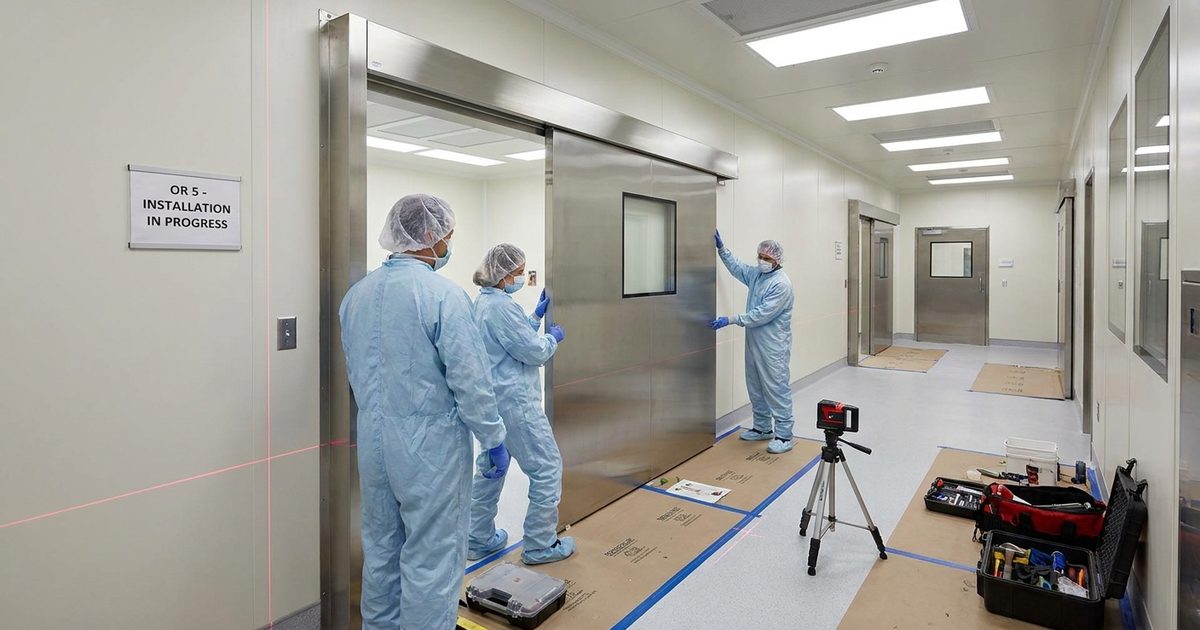
Mark the centerline position of the opening on the floor, wall, and ceiling using a laser level. Verify actual opening dimensions against manufacturer specifications. Clean the work area of dust and debris — small particles can damage seals or tracks when the door operates.
Stage 2: Frame Installation
Mount the frame into the wall opening using anchor bolts every 400-600mm. Use steel shims (not wood or plastic) to achieve flatness — the frame must be level within ±1mm tolerance both vertically and horizontally. Once the frame is installed, fill the gap between the frame and wall with non-shrink sealant to ensure no air leakage paths. Allow sealant to cure according to manufacturer instructions (minimum 12 hours) before proceeding.
Stage 3: Track and Hanger Installation
Mount the upper track to the ceiling structure — ensure it is perfectly straight and aligned with the frame. For doors with bottom tracks, install the guide channel on the floor after the upper track. Hang the door panel onto the hanger system, then adjust the height and tilt of the door leaf using adjustment bolts. Target gap between door leaf and floor: 5-8mm for standard doors, or 3-5mm if equipped with an automatic drop seal.
Stage 4: Seal Adjustment and Airtightness
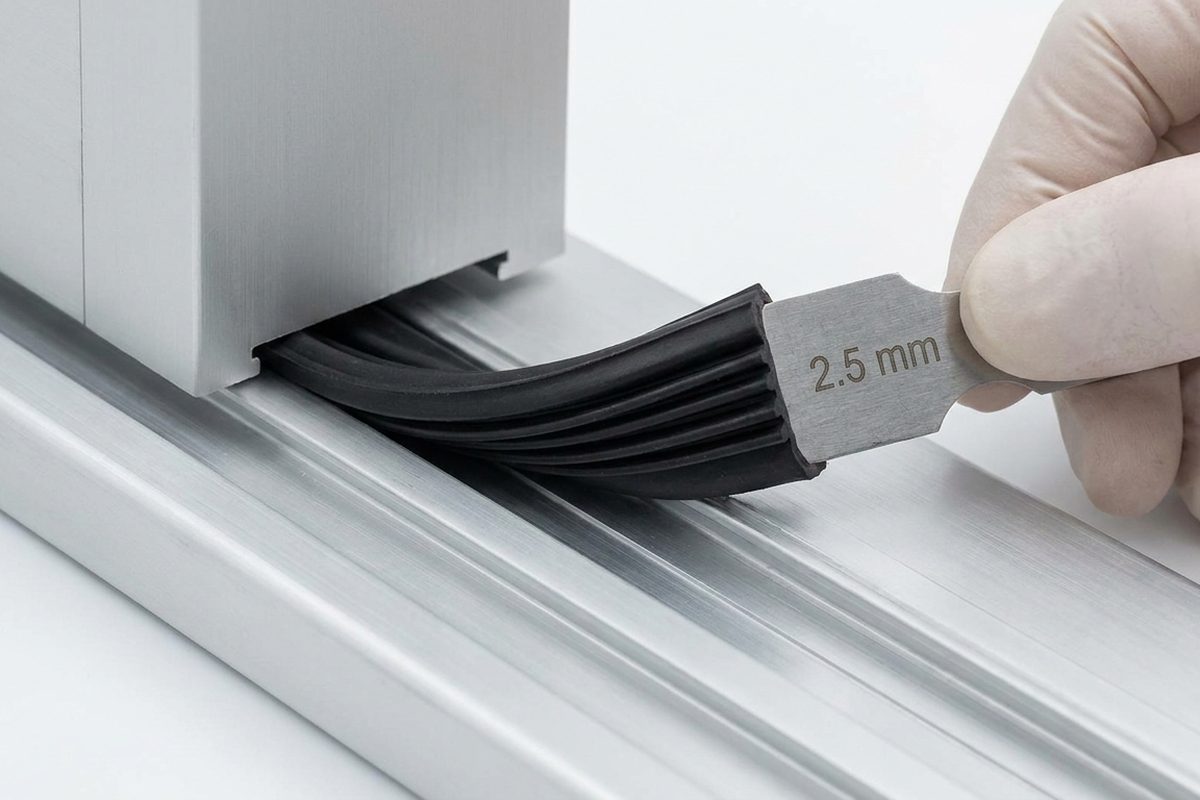
This is the most critical stage. Install the gasket seal around the door leaf perimeter — ensure the seal compresses evenly when the door closes. Conduct an initial airtightness test using the visual method: close the door and shine a flashlight from the opposite side — no light should penetrate. Adjust the door leaf position and seal compression until airtightness is achieved across the entire perimeter.
Stage 5: Motor and Control Installation
Mount the motor operator according to the manufacturer's specified position. Connect it to the control panel and power supply. Configure parameters: open/close speed (recommended 300-500mm/second), holding force, and delay time. Activate safety sensors and test obstacle detection function. For interlock systems, program the logic: door B cannot open if door A is not fully closed.
Common Installation Mistakes to Avoid
Based on hospital project experience in Indonesia, here are the most frequent mistakes and how to prevent them:
- Unlevel frame: Using a manual spirit level instead of a laser level. Solution: always use a digital laser level with ±0.5mm/m accuracy.
- Excessive seal gap: Skipping trial fitting before final tightening. Solution: perform a dry-fit of the door leaf before permanently installing the seal.
- Damaged seal during installation: Seal gets scratched when inserting the door leaf into the frame. Solution: use temporary guide plates during door leaf mounting.
- Motor overload: Speed parameters set too high for the door weight. Solution: follow the manufacturer's torque curve and use soft-start configuration.
- Missing documentation: Not recording airtightness and commissioning test results. Solution: create a written checklist with photos at each QC stage.
Commissioning and Final Testing
After installation is complete, perform commissioning to ensure the entire system functions according to specifications:
- Airtightness test: Use a smoke test or differential pressure gauge. With the door closed, the pressure difference between the two sides must not drop more than 5 Pa within 30 seconds.
- Operational test: Open and close the door for a minimum of 50 cycles. Listen for grinding noise — this indicates alignment or track issues.
- Safety test: Activate obstacle detection — the door must reverse upon detecting an obstacle with a force of less than 150N.
- Interlock test: Verify interlock logic according to the desired sequence.
- Emergency test: Simulate a power failure — the door must be manually operable without special tools.
How to Choose a Competent Installation Team
Not every general contractor can install hermetic doors correctly. Ensure the installation team meets these qualifications: a minimum of 10 hermetic door units installed in healthcare facilities, understanding of differential pressure standards and hospital HVAC systems, calibrated equipment (laser level, differential pressure gauge, smoke pen), and the ability to provide a written commissioning report with quantitative data.
FAQ: Hermetic Door Installation
it take to install one hermetic door unit?
Standard installation requires 2-3 working days per unit: day one for frame and track, day two for door leaf and seal, day three for electrical and commissioning. The timeline may extend if wall opening conditions are not precise.
installed on standard brick walls?
Yes, but the brick wall must be plastered smooth and have a reinforced header above the opening. The most ideal installation is on cleanroom sandwich panel walls, which are already precise and have uniform support structures.
hermetic door seals?
Clean the seal with a damp cloth (no harsh detergents) every 3 months. Check for cracks or deformation — seals should be replaced every 2-3 years or if a smoke test shows leakage.
between sliding and swing hermetic door installation?
Sliding doors require a track and side clearance space, while swing doors need heavy-duty hinges and a door closer with adjustable closing force. Sliding is more common for operating rooms due to space efficiency and more consistent sealing.
have to be done by the manufacturer?
Recommended, but not mandatory. Independent installation teams can do it provided they have manufacturer training and strictly follow the installation manual. What is mandatory is documented final commissioning.
Conclusion
Proper hermetic door installation is an investment in patient safety and regulatory compliance. Small installation errors can have serious consequences: operating room contamination, audit failures, and risks of nosocomial infections. Use an experienced team, follow technical requirements with discipline, and never skip the commissioning stage.
PT. Ruida Grup Indonesia provides sliding and swing hermetic doors for hospitals, clinics, and cleanroom facilities with professional installation support. Contact our team for specification consultation and a free site survey.